11

The Chicago Cubs organization is currently grappling with an increasingly complex roster management situation, a predicament exacerbated by a series of injuries that necessitate both immediate, short-term solutions and strategic long-term flexibility for the eventual return of key players. This intricate balancing act has become particularly pronounced in recent weeks, placing significant demands on manager Craig Counsell and the front office to maintain competitive depth while adhering to roster constraints.
The most significant challenge facing the Cubs’ infield stemmed from the absence of their cornerstone shortstop, Dansby Swanson. A pivotal figure within the franchise, Swanson’s unexpected stint on the injured list has triggered a cascade of adjustments, including a substantial infield shuffle and a series of dynamic changes to the big-league roster. The timing of this injury could not have been more critical, arriving at a juncture in the baseball calendar where every game carries heightened importance for teams vying for playoff contention.
As Jordan Bastian meticulously detailed for MLB.com, "With Dansby Swanson currently on the injured list and sidelined for at least the next month, the Cubs’ depth at shortstop has been thinned at a crucial point in the baseball calendar." Swanson’s injury, a left oblique strain sustained during a recent game against the St. Louis Cardinals on Sunday, led to his placement on the 10-day injured list on Monday. An oblique strain, notoriously tricky for baseball players, typically demands a recovery period that can span several weeks, if not longer, especially for a position player whose movements involve rotational power for both hitting and throwing. His absence, projected for at least a month, leaves a significant void not only in the Cubs’ defensive alignment but also in the heart of their batting order and clubhouse leadership.
The ripple effect of Swanson’s injury necessitated immediate action from the Cubs’ management. With their franchise shortstop out, the team was compelled to explore external and internal options to bolster their infield depth. This search led to a series of roster transactions designed to temporarily fill the void and provide stability, even as the team kept an eye on Swanson’s eventual return. Among the players brought in to address the immediate need was veteran infielder Owen Miller, whose experience across multiple major league seasons was seen as a potential asset.
However, Miller’s tenure on the Cubs’ active roster proved to be remarkably brief, highlighting the fluid and often unforgiving nature of major league roster management. His stay was an illustration of how quickly circumstances can change, forcing teams to make difficult decisions to optimize their lineup and pitching staff. Miller, who had been called up just days prior to help mitigate the impact of Swanson’s absence, found himself designated for assignment on Friday, effectively ending his latest major league opportunity after a mere single game appearance.
Anthony Franco, reporting for MLB Trade Rumors, underscored the swiftness of Miller’s departure, noting, "Miller was just called up on Monday as an extra infielder after Dansby Swanson went on the injured list." His contribution was limited to a single inning at second base during Tuesday’s memorable walk-off victory against the Chicago White Sox. Notably, Miller did not even register a single plate appearance during his brief time with the team. Franco further elaborated on the primary catalyst for Miller’s removal, stating he "was pushed off the roster when Chicago had a chance to grab a superior defender in Arias." This strategic move signaled the Cubs’ immediate prioritization of defensive prowess in their infield, especially crucial in the absence of a top-tier defender like Swanson.
The circumstances surrounding Miller’s departure make it particularly noteworthy and serve as a stark reminder of the cutthroat competition for roster spots in professional baseball. His designation was not a consequence of an extended period of poor on-field performance or a slump at the plate. Instead, Miller became the unfortunate casualty of a numbers game, the "odd man out" when the Cubs needed to create space on their 40-man roster to accommodate other strategic acquisitions and returning players.

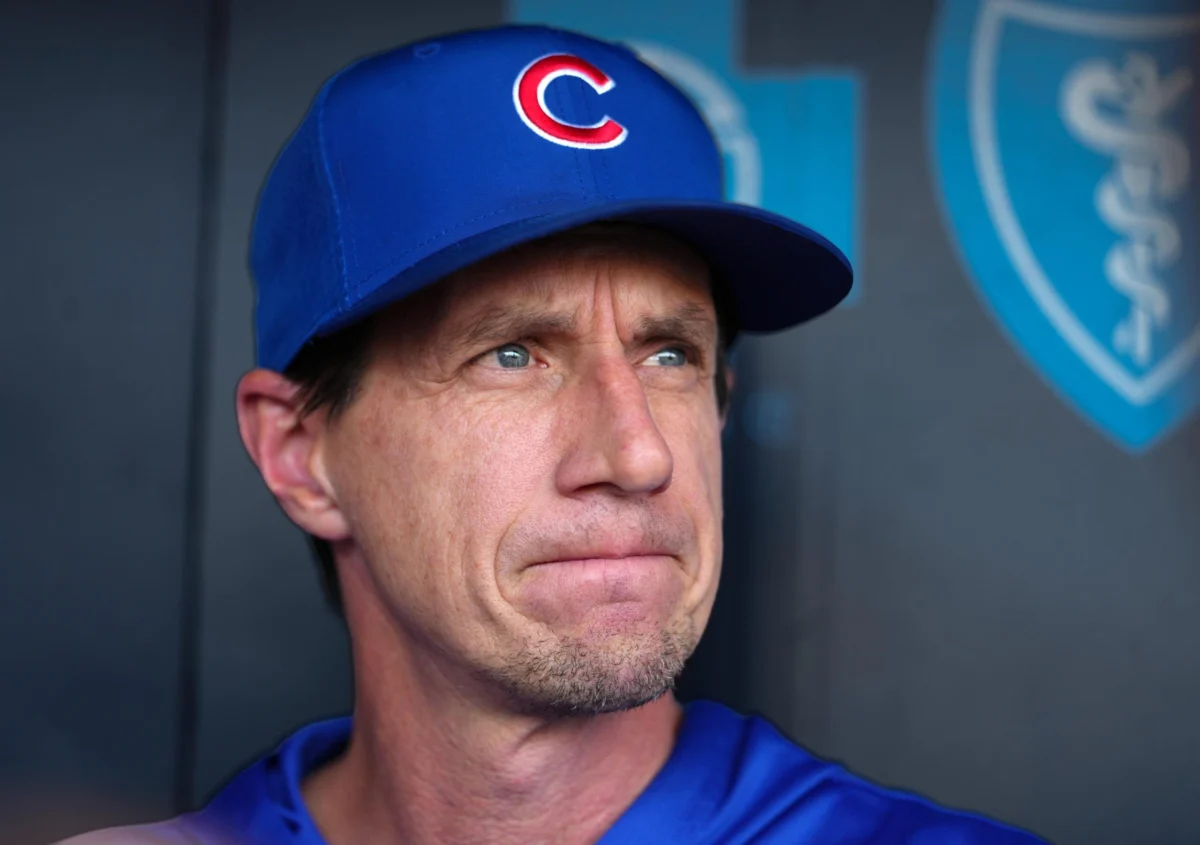
David Shovein of NBC Sports provided further clarity on the precise factors leading to Miller’s designation, explaining, "The Cubs needed to clear a spot on their 40-man roster for the return of Daniel Palencia on Friday and unfortunately for Miller he was the odd man out." This dual need – to add a "superior defender" in Gabriel Arias and to activate pitcher Daniel Palencia – underscored the multifaceted challenges facing manager Craig Counsell and his staff. Counsell, as seen in the photograph taken on August 7, 2026, conversing with media prior to a game against the Kansas City Royals, is at the forefront of these daily decisions, balancing immediate needs with long-term strategic planning. The 40-man roster limit often forces teams to make difficult choices, sacrificing depth in one area to reinforce another. Palencia’s return, presumably from an injury stint or a minor league assignment, was deemed essential, thus directly necessitating a corresponding roster move.
The designation for assignment process, or DFA, is a standard but often impactful procedure in Major League Baseball. When a player is designated for assignment, they are immediately removed from the team’s 40-man roster. The club then has a period of ten days to either trade the player, release them, or place them on outright waivers. If the player clears waivers, meaning no other MLB team claims them, the designating club can then elect to outright them to the minor leagues. However, for a player like Owen Miller, who is out of minor league options, clearing waivers would grant him the right to elect free agency, allowing him to sign with any other organization. This makes his situation particularly precarious but also potentially ripe for another opportunity. Shovein noted this possibility, suggesting, "It’s possible that the 29-year-old infielder could attract interest on waivers."
Despite the abrupt and somewhat anticlimactic conclusion to his time with the Cubs’ big-league roster, Owen Miller’s broader professional trajectory and recent performance statistics offer compelling reasons to believe that another Major League organization might indeed take a chance on him. Miller is not a newcomer to the rigors of big-league baseball, having now accumulated major-league experience across six consecutive seasons. Throughout his career, he has donned the uniforms of four different organizations, a testament to his resilience and ability to consistently earn opportunities, even if they are often fleeting.
Over just over 1,000 major league plate appearances, Miller has posted a career slash line of .238/.287/.342. While these numbers might not jump off the page as elite offensive production, they represent a professional hitter capable of contributing at the highest level, particularly in a utility role. His value often lies in his defensive versatility and ability to play multiple infield positions.
Crucially, Miller’s performance at the Triple-A level for the Iowa Cubs this season had been considerably more encouraging and productive, making his call-up entirely merited. Prior to his promotion to the big leagues, Miller was hitting an impressive .296/.350/.457 with seven home runs. This strong offensive showing demonstrated a player who was consistently finding success in the minor leagues and merited another look in the majors. This level of production at Triple-A typically signals a player who can provide valuable depth and potentially contribute offensively to a major league club, thereby increasing his chances of attracting interest from other teams on the waiver wire.
As mentioned, Miller being out of minor league options adds a unique layer to his situation. Any team that chooses to claim him off waivers would be obligated to immediately add him to their 26-man major league roster. This requirement means a claiming team must have an immediate need and be prepared to commit a major league roster spot to him, making the decision to claim a player like Miller a more significant one. Should Miller clear waivers without being claimed, he would then have the option to elect free agency, allowing him to seek out a new contract with any team of his choosing. Alternatively, the Cubs, recognizing his strong Triple-A performance and potential value, could attempt to re-sign him to a minor league contract if he clears waivers, thereby retaining his services within their organization, albeit outside of the 40-man roster.
The Chicago Cubs’ current predicament underscores the constant fluidity and strategic maneuvering inherent in Major League Baseball. The loss of a key player like Dansby Swanson creates a domino effect, forcing the team to make rapid adjustments. While Owen Miller’s brief return to the majors ended abruptly due to these roster machinations, his track record and recent minor league success suggest that this may not be the final chapter in his major league journey. For the Cubs, the focus remains on navigating these immediate challenges while meticulously planning for the long-term health and competitive strength of their roster as the season progresses.