 11
 1
 2
 3

CHINA
Beijing Labels Cryptocurrencies as "Accomplices" in Espionage Amidst Tightened Rhetoric
China’s Ministry of State Security (MSS) has significantly escalated its cautionary stance on cryptocurrencies, now branding them as "accomplices" in espionage activities and emphasizing that their perceived anonymity is a misconception. The MSS published an article on social media detailing how these digital assets are allegedly being exploited to facilitate money laundering, cyberattacks, and, crucially, to serve as tools for espionage. This hardline approach underscores Beijing’s deep-seated concerns about the potential for cryptocurrencies to undermine national security and financial order.
According to the South China Morning Post, the MSS article specifically points to "overseas anti-China hostile forces" as utilizing crypto to disrupt China’s financial stability. A particularly pointed observation within the statement highlights that the purported anonymity of cryptocurrency transactions is often used to deceive individuals being recruited for espionage. The MSS claims that foreign intelligence agencies deliberately mislead potential spies by asserting that virtual currency circulation is difficult to trace, thereby encouraging their use in illicit activities. This warning, "We’re watching the blockchain," serves as a direct message to any foreign actors who might mistakenly believe they can conduct clandestine financial operations undetected. While this warning holds true for many mainstream cryptocurrencies like Bitcoin and Ethereum, the MSS implicitly acknowledges that certain privacy-focused coins, such as Monero or Zcash, could potentially offer greater anonymity when utilized correctly. China has a history of stringent cryptocurrency regulations, having implemented multiple bans, including a comprehensive prohibition on exchanges in 2017 and a mining ban in 2021, effectively declaring all cryptocurrency-related businesses as illegal within its borders.
SINGAPORE
Singapore’s Crypto Economy Soars 55% Amidst Regional Contraction, Reclaiming Dominance
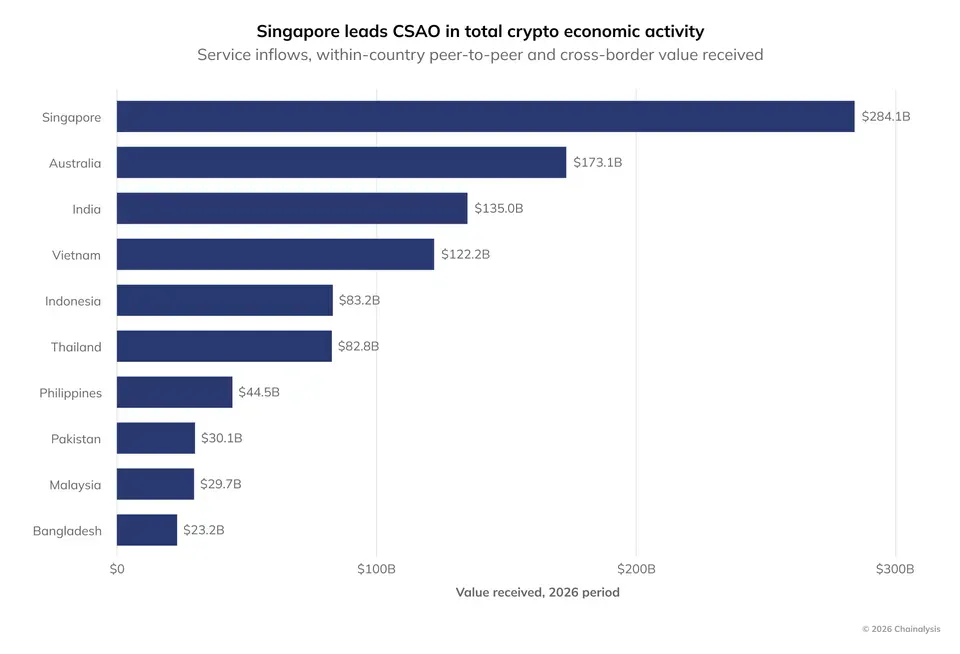
In stark contrast to the broader regional trend, Singapore’s cryptocurrency activity has experienced a remarkable surge, growing by 55.4% to reach an estimated $284 billion in the year ending June 2026. This impressive expansion has re-established Singapore as the preeminent crypto economy within the Central and Southeast Asia and Oceania (CSAO) region, according to a report by Chainalysis. The growth is largely attributed to a substantial increase in institutional platform activity, which saw a 94% jump to $60 billion. This institutional surge was concentrated among a select group of market makers, over-the-counter trading firms, and institutional brokerages. The broader CSAO crypto economy, meanwhile, experienced a contraction of 6.8% during the same period.

Chainalysis observed that Singapore’s institutional crypto ecosystem expansion was highly concentrated, characterized by high-volume transactions executed by established platforms rather than the emergence of numerous new services. This suggests a consolidation of significant trading activity within existing institutional players, contributing to the overall growth figures. The report indicates that while the overall regional market contracted, Singapore’s robust institutional engagement allowed it to not only weather the downturn but also to significantly expand its market share and influence.
SOUTH KOREA
South Korea Considers Market-Making Framework to Enhance Crypto Market Stability
South Korea’s Financial Services Commission (FSC) is actively considering the introduction of a market-making system for digital assets. This deliberation comes in the wake of a significant price anomaly involving a stablecoin pegged to the Japanese yen, which traded at four times its intended value on a major South Korean cryptocurrency exchange earlier this month. The stablecoin in question, JPYC, experienced a dramatic price surge on the Upbit exchange on September 17th. Opening at 12 Korean won per JPYC, it rapidly climbed to a high of 37.6 Korean won within an hour, a more than fourfold increase from its intended peg. This extreme volatility was attributed to limited liquidity on the platform.
Yoo Young-joon, director of digital finance policy at the FSC, stated that the commission will "also review the need to introduce systems such as market-making activities to increase the efficiency and stability of the digital asset landscape." Currently, South Korea’s Virtual Asset User Protection Act does not include exemptions for market-making activities from its market manipulation provisions, effectively preventing market makers from actively providing liquidity in the nation’s crypto markets. The potential introduction of such a system could address liquidity gaps and enhance price stability for digital assets traded in the country.
In related news, U.S.-based payments and infrastructure firm MoonPay has launched a South Korean subsidiary as part of its broader Asian expansion strategy. The company aims to collaborate with local financial institutions on services including remittances, payments, settlements, and digital asset distribution. However, MoonPay is still awaiting the necessary regulatory approvals to fully commence its operations in the country.
JAPAN
Binance Pay Enables Overseas Visitors to Spend Crypto at Millions of Japanese Merchants
Binance Pay has introduced a new service allowing eligible overseas users visiting Japan to spend over 100 cryptocurrencies at a vast majority of merchants accepting PayPay, a leading Japanese cashless payment service. This integration, which commenced on Wednesday, operates through HIVEX, a payment interoperability framework that connects international QR payment services with PayPay-supported merchants. Binance Pay utilizes Tether USDt (USDT) as its backend settlement layer, with HIVEX facilitating settlements with PayPay, which in turn settles with merchants in Japanese yen.
Binance has stated that this marks the first cryptocurrency payment service to gain access to PayPay-supported merchants via the HIVEX framework, meaning merchants do not need to take separate opt-in actions. PayPay is widely accepted across Japan, encompassing millions of locations including major retail chains, smaller shops, vending machines, taxis, and public transportation. The platform currently supports nine other overseas payment services through HIVEX, primarily from China, Hong Kong, and Taiwan, underscoring Japan’s growing embrace of digital payment solutions for both domestic and international consumers.
HONG KONG
Hong Kong Regulators Enhance Financial Reporting Oversight for Licensed Crypto Firms
Hong Kong’s financial regulators have formalized an agreement to expand cooperation on financial reporting and audits for licensed cryptocurrency firms. The Securities and Futures Commission (SFC) and the Accounting and Financial Reporting Council (AFRC) have signed a Memorandum of Understanding (MOU) to bolster their collaborative efforts in audit and assurance work. This agreement establishes a clear framework for information sharing, case referrals, mutual assistance, and coordinated inspections and investigations pertaining to licensed crypto entities operating within the jurisdiction. This initiative signifies Hong Kong’s commitment to enhancing regulatory oversight and ensuring greater transparency and accountability within its burgeoning digital asset sector.
In a separate development, HSBC is preparing for a phased rollout of its new Hong Kong dollar-backed stablecoin, named RedCoin. The initial launch will focus on person-to-person and merchant payments, with plans to extend its use cases to corporate and institutional clients in subsequent phases. Concurrently, HSBC is initiating an educational campaign to inform the public about the stablecoin and to mitigate the risk of scams and fraudulent activities. This move by a major global financial institution highlights the increasing institutional interest and development within the stablecoin ecosystem in Hong Kong.