 11

HBO’s highly anticipated series, Lanterns, has become a significant point of contention for some critics, who express profound confusion and disappointment regarding its creative direction, particularly concerning the origin story of John Stewart and the fundamental mechanics of the Green Lantern Corps. Despite a reported wave of positive reviews from other critics and fans, the show’s initial episodes, with Episode 3 singled out as the weakest thus far, are being described as "supremely mid" and perplexing.
A primary source of bewilderment stems from the show’s radical departure from established Green Lantern lore, specifically how new recruits are chosen and how the iconic power rings function. In the traditional comic book canon, the Green Lantern power rings are sentient artifacts that autonomously seek out individuals possessing immense willpower and the ability to overcome great fear. Historically, a candidate like Hal Jordan was often characterized as "a man entirely without fear," a quality the ring instinctively recognized and gravitated towards.
This foundational concept was further nuanced and deepened by Geoff Johns during his acclaimed Green Lantern: Rebirth comic book run in the early 2000s. Johns intelligently reframed the prerequisite, acknowledging the human impossibility of being entirely fearless. Instead, he posited that the true qualification for a Green Lantern was not the absence of fear, but rather the sheer willpower to act decisively and courageously even when confronted by overwhelming terror. This refined understanding provided a more relatable and psychologically complex basis for the Corps’ recruitment, where the ring would choose an individual who demonstrated such profound inner strength.
However, Lanterns has chosen a dramatically different and, according to the review, "bizarre" and "goofy" approach. The show depicts the Guardians of the Universe – the blue-skinned, ancient beings who oversee the Green Lantern Corps – as actively intervening in the selection process. Instead of the ring seeking out its wielder, the Guardians are shown dispatching glowing green bubbles to prospective candidates, waking them from sleep to directly interrogate them with the question, "Are you afraid?" This method is criticized for its overt silliness and for undermining the intrinsic, almost mystical, connection between a Lantern and their ring, transforming a profound moment of destiny into a somewhat clunky, literal job interview conducted by extraterrestrials. The critic posits that this recruitment method is antithetical to the show’s ambition to be a "Very Serious TV Show," as much of its foundational writing and setup appears "incredibly silly."
This altered selection process directly impacts John Stewart’s origin. In the narrative presented, John’s father is the initial target of a green bubble. Startled awake, he fails to provide the "correct" answer to the Guardian’s direct inquiry about fear. Consequently, the ring bypasses him and instead finds its way to Hal Jordan. The incident leaves John’s father traumatized, casting a long shadow over his life and hinting at marital strife with his wife. This sequence introduces a Guardian, the same woman John interacts with in 2016 before his own eventual encounter with Hal, who appears to the family. Her alien nature is visually confirmed through a clever, budget-conscious metamorphosis shot observed from behind, avoiding costly CGI for her facial features.
The portrayal of John Stewart’s mother has also drawn significant criticism. Far from being a supportive or even conventionally concerned parent, she is depicted as "an insane person" who exhibits alarming detachment and ambition regarding her infant son’s potential future as a Green Lantern. When the Guardian suggests that her baby might one day be a contender for the Corps, the mother shows no hesitation or concern. The review highlights a troubling absence of natural parental questions, such as "Would this be good for my child?" or "Will this create division and resentment between him and his older brothers?" Instead, she appears to enthusiastically embrace the idea of dedicating her infant son’s life to what the critic describes as "truly monstrous nonsense." Examples cited include her proposal for William Tell-style apple shooting practice (revealed to be her idea, not his father’s) and deliberately making a young John walk home alone through a dangerous part of town, seemingly as character-building exercises for his potential future as a cosmic peacekeeper.

Furthermore, a conversation between John’s mother and the Guardian is singled out for being "extremely on-the-nose." The mother expresses shock that an alien from a completely different planet might not grasp the specific socio-economic and racial inequities faced by Black people in America. While acknowledging the potential for nuanced discussions on race within superhero narratives, the critic contrasts this clunky exposition unfavorably with Damon Lindelof’s previous work on Watchmen, which explored similar themes with greater depth and integration into the plot and character development. In Lanterns, these discussions feel "shoehorned in," adding little to the narrative or character arcs.
The portrayal of Hal Jordan is another point of contention. The review expresses dislike for Hal being depicted as "unworthy" of the Green Lantern ring. While acknowledging that the story could still evolve in various directions, the current writing’s "clunky and uneven" nature instills a sense of uncertainty regarding Hal’s ultimate trajectory and whether his character will be handled with the necessary nuance.
Episode 3 also introduces a "truly bizarre subplot" concerning John Stewart’s military background. John reveals he was dishonorably discharged from the Marines for failing to complete a mission. The mission itself is described as inherently flawed from the outset: a solo assassin sniper operation to eliminate a target at a remote compound. John parachutes in during a massive storm, isolating himself for months without communication, awaiting his quarry. The mission is deemed "FUBAR" (Fouled Up Beyond All Recognition) from its inception due to its impossible parameters. The only reason John doesn’t complete his mission is because Hal Jordan unexpectedly intervenes, arresting the target before John can carry out the assassination. The critic finds it "beggars belief" that a Marine, even one from special operations, would be sent on such a solitary, likely illegal, and top-secret mission, only to be dishonorably discharged for an outcome entirely beyond his control.
Beyond the narrative specifics, structural choices for Episode 3 also came under fire. The decision to dedicate nearly the entire third episode to a single, lengthy flashback so early in the season’s run is described as a "very strange choice," suggesting that the crucial backstory could have been condensed into a much shorter segment without disrupting the overall pacing.
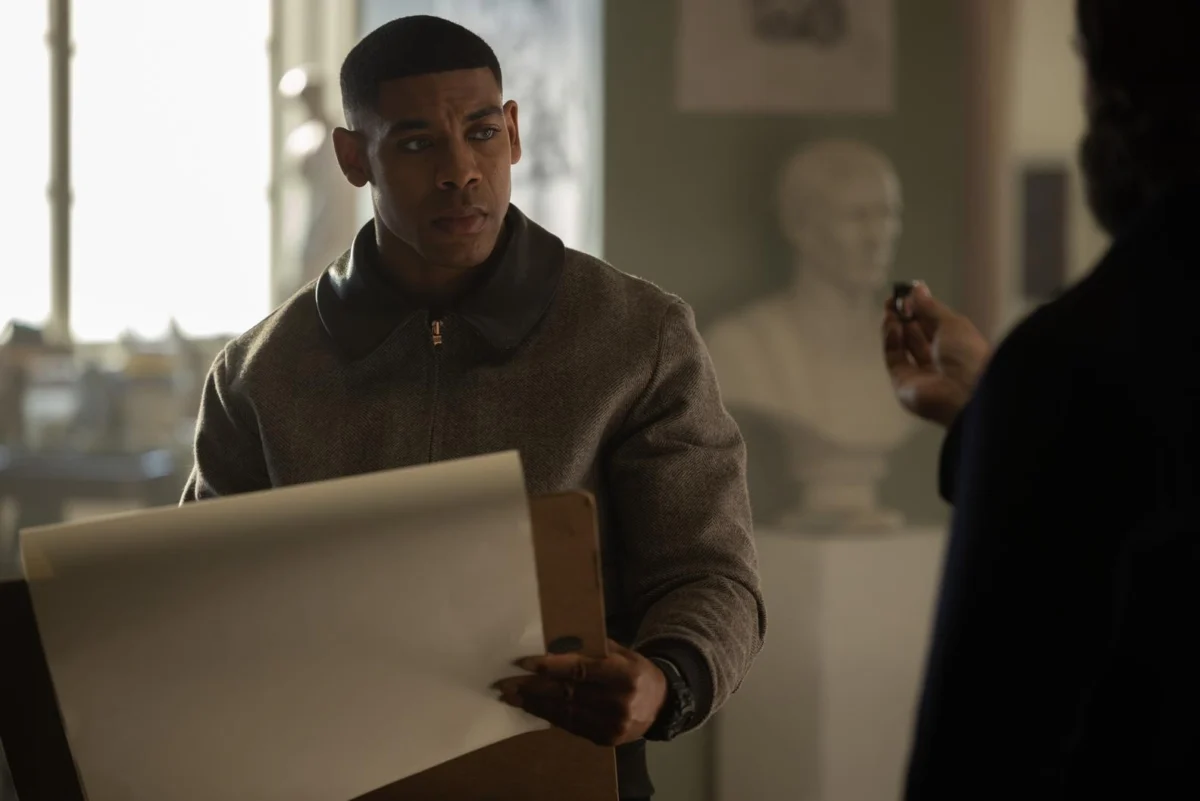
The episode’s most compelling moment, according to the review, occurs when John rushes home, eager to inform his "horrible, psychopathic parents" that the Guardians have finally recruited him to replace Hal. He arrives only to find Hal already seated at the family table. Their subsequent interaction outside sees Hal feigning friendliness before revealing his true intentions: he has no plans to relinquish the ring and intends to resist the Guardians’ efforts to replace him. This development, which suggests Hal is well aware of the Guardians’ machinations, is praised by the critic. Despite significant issues with the script, both Aaron Pierre as John Stewart and Kyle Chandler as Hal Jordan are commended for their strong performances.
A lingering, unexplained element also puzzles the reviewer: "what the heck was up with that diamond?" This seemingly random detail, devoid of context or explanation within the episode, further contributes to the sense of narrative incoherence.
In conclusion, Lanterns continues to be viewed with "a great deal of skepticism." The show is critically perceived as a "CW show cosplaying as a prestige HBO drama," suggesting a disconnect between its production values and its often-muddled narrative and character choices. The hope remains that the series will improve, but current impressions highlight significant concerns regarding its faithfulness to established lore, its character portrayals, and its overall storytelling efficacy.