 11
11
The rapid integration of artificial intelligence into the software development lifecycle has fundamentally altered the pace of feature delivery, creating a secondary challenge in the realm of global product localization. Atlassian, a leading provider of team collaboration software, recently disclosed a transformative shift in its approach to translation and internationalization. As developers began utilizing AI assistants to write and ship code at unprecedented speeds, the sheer volume of linguistic data requiring translation grew beyond the capacity of traditional human-centric workflows. To address this bottleneck, Atlassian implemented a dual-pronged strategy: leveraging large language models (LLMs) to generate initial translation drafts and deploying automated tooling to rectify source code deficiencies before they reach the localization pipeline. This systemic overhaul has allowed the company to maintain high linguistic quality while managing a massive increase in demand, ultimately ensuring that products remain accessible and natural to users in more than 20 languages.
The necessity for this evolution became apparent in the second half of the 2025 fiscal year. During this period, Atlassian recorded a 272 percent year-over-year increase in the volume of words sent for translation. This surge was a direct byproduct of AI-assisted development; as developers became more efficient at creating new features and running experiments, they simultaneously generated a tidal wave of new strings—the text elements within a user interface. In a traditional localization model, such an explosion in content would lead to slipping deadlines, escalating costs, and a strained relationship between development teams and the professional translators responsible for regional nuances. For a global company serving markets from Tokyo to São Paulo, maintaining the "native feel" of a product is a non-negotiable requirement for customer trust and retention.
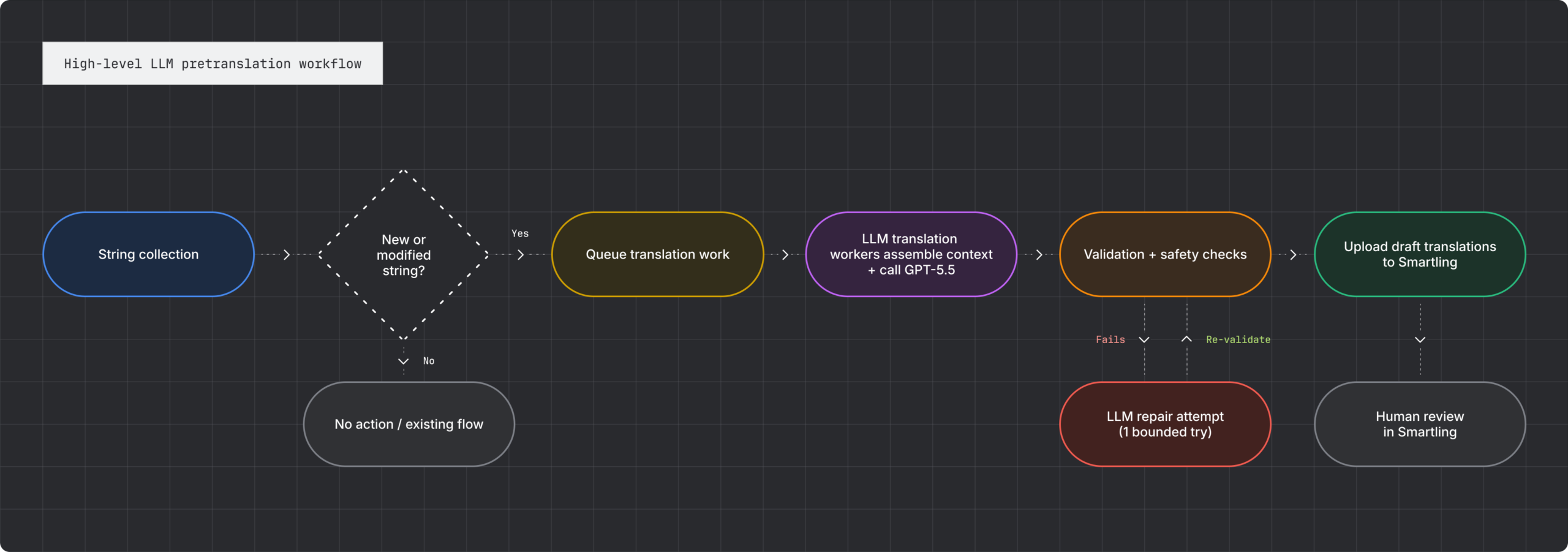
To reconcile the need for speed with the requirement for quality, Atlassian made two strategic "bets" on the future of localization. The first bet focused on the translation process itself, moving toward a "machine-draft, human-approve" model. In this workflow, an AI system produces the first pass of every string using Atlassian’s existing translation assets, including historical data and glossaries. This draft is then funneled into a Translation Management System (TMS), specifically Smartling, where professional human translators review, edit, and sign off on the content. This shift ensures that while the machine handles the repetitive labor of initial drafting, the final judgment—the cultural and contextual nuance that machines often miss—remains firmly in the hands of human experts.
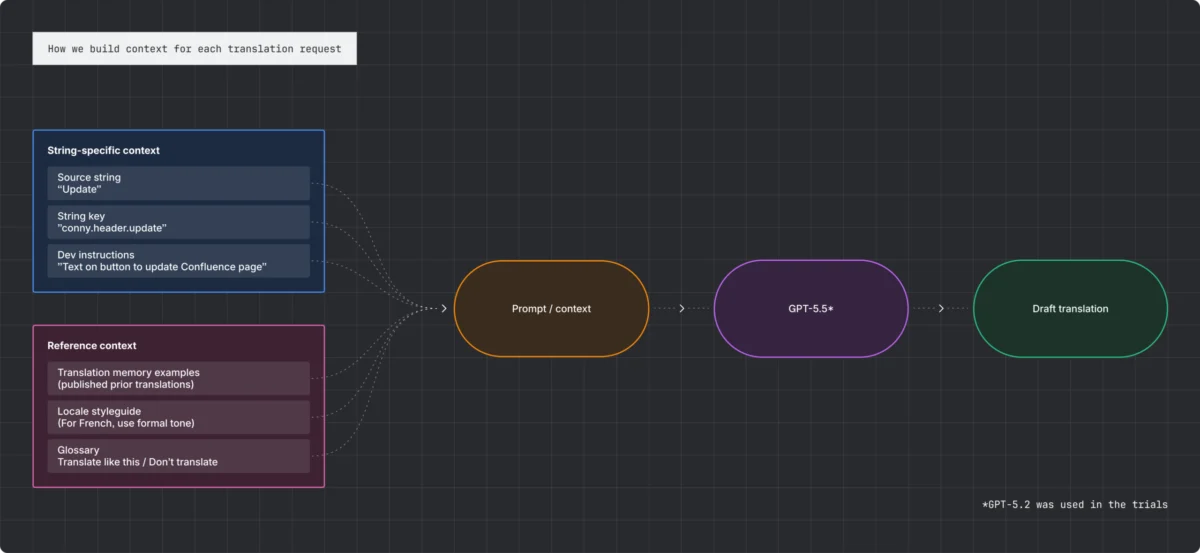
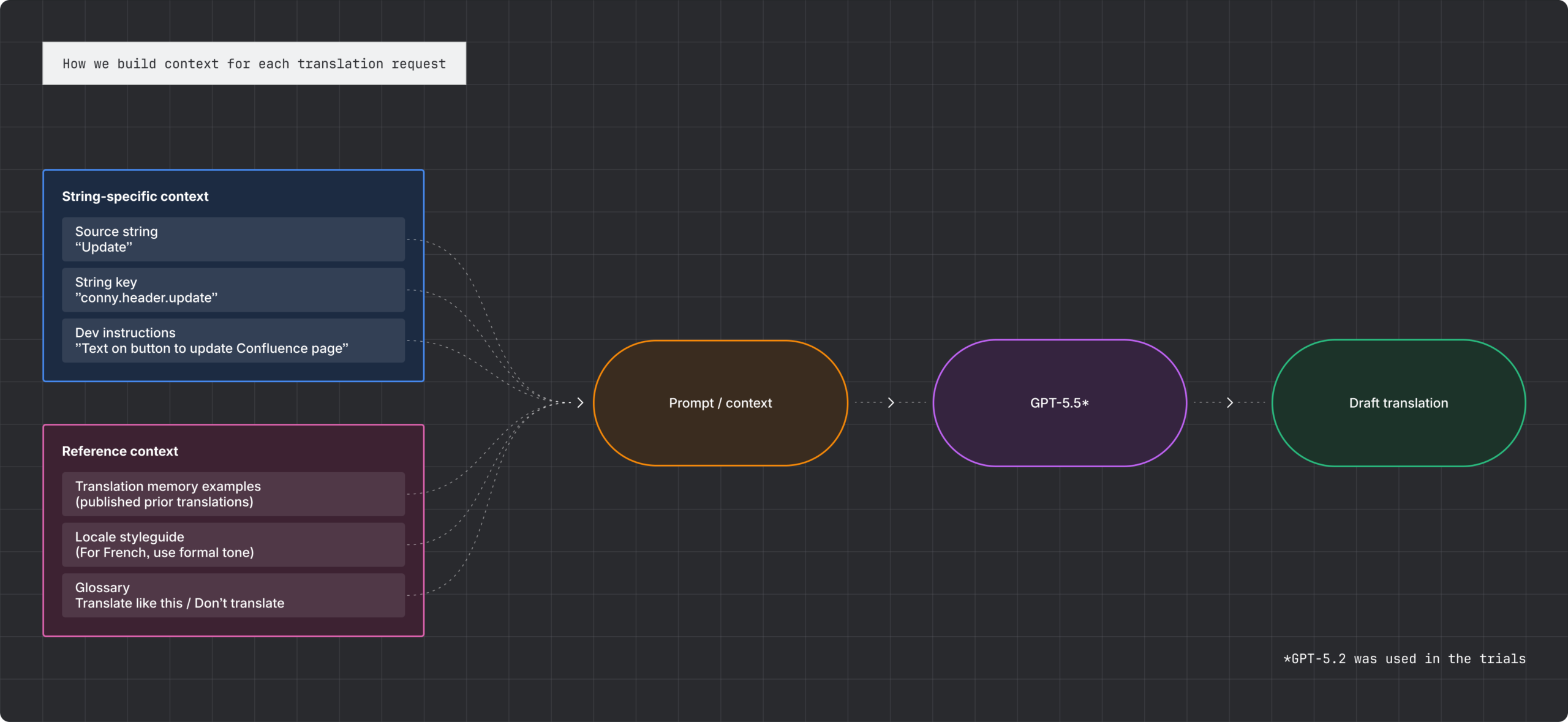
Atlassian’s implementation of this AI drafting system involves two distinct streams. The first is an internal AI translation system built by Atlassian’s own engineers. This system is designed to be highly context-aware; before it generates a translation, it aggregates essential metadata, including developer notes, similar previously translated strings, specific glossary terms, and the established style rules for each locale. The second stream routes translations through an external AI vendor hub. By running these parallel streams, Atlassian can compare performance and ensure redundancy. Crucially, neither stream bypasses the human element. A blind quality trial conducted across multiple languages prior to the full rollout confirmed that AI-drafted, human-reviewed strings were equal in quality to those produced by high-end external translation vendors.
The efficiency of this new model is tracked through a metric known as the Translation Edit Rate (TER). TER measures the extent to which a human reviewer must modify an AI-generated draft before it is deemed ready for production. A low TER suggests that the AI is providing a high-quality foundation, leaving the human reviewer to perform "polishing" rather than "re-writing." In early production runs, Atlassian observed TER ranges from 10 percent to just under 50 percent, depending on the complexity of the target language. These edit rates have already translated into significant financial benefits, as they allow the company to qualify for deeper discount tiers with translation service providers. Furthermore, the system creates a continuous feedback loop: every edit made by a human reviewer is fed back into the model as a training signal, theoretically lowering the TER over time and potentially driving cost savings of up to 50 percent.
The second bet in Atlassian’s strategy addresses the "upstream" problem: the quality of the source code itself. Localization experts have long understood that a translation is only as good as its source. If an English string is ambiguous, grammatically fragmented, or lacks context, the resulting translations in German, Japanese, or French will inevitably suffer. AI models are particularly sensitive to these source-level flaws. To mitigate this, Atlassian built an internationalization (i18n) validation system designed to catch errors at the point of authorship—within the developer’s code editor or during the code review process.
Common issues in source code include "hardcoded" strings that are not flagged for translation, "sentence stitching" (where fragments of sentences are combined in a way that only makes sense in English grammar), and a lack of pluralization rules. For instance, a developer might write a line of code that says count count === 1 ? 'item' : 'items' selected. While this logic works for English, it fails in languages with more complex plural forms, such as Russian or Arabic. Atlassian’s new tooling guides developers to use plural-aware messages, such as formatMessage(messages.workItemsSelected, count ), which allows the translation system to provide the correct grammatical structure for any language.
Contextual metadata is another critical component of "global-ready" source code. A string like "Selected count" is often too vague for an AI or a human to translate accurately. Without knowing if "count" refers to people, tasks, or files, a translator may choose the wrong gender or noun class. Atlassian’s system encourages "strong" descriptions, such as: "Toolbar label above a list, showing how many work items the user has selected. count is the number selected." When provided with this level of detail and a glossary mapping "work item" to specific regional terms (such as the German Vorgang), the AI produces a draft that is grammatically and terminologically correct on the first pass.
The impact of these "source-fixing" tools extended beyond new code. Atlassian utilized AI to address a massive backlog of existing internationalization issues across its frontend codebase. By pointing AI at these legacy problems, the company was able to fix issues in bulk and generate Pull Requests (PRs) for developer review. This automated cleanup successfully resolved over 20,000 existing issues, drastically reducing the technical debt that had previously hindered the localization pipeline.
The overarching lesson from Atlassian’s experience is that scalability in the AI era cannot be achieved through raw processing power alone. While AI can generate text in seconds, true scalability requires a holistic integration of technology and human expertise. By fixing the source code, providing the AI with rich context, and maintaining a rigorous human review process, Atlassian has created a workflow that keeps pace with the speed of modern software development without sacrificing the quality of the user experience. This strategy ensures that as Atlassian continues to ship features faster than ever before, its global community of users will continue to receive products that feel locally crafted and intuitively designed, regardless of the language they speak. The transition highlights a future where AI does not replace the human element in localization but rather empowers it to focus on high-level judgment and cultural nuance, while the machine handles the burden of volume and repetition.