11
11
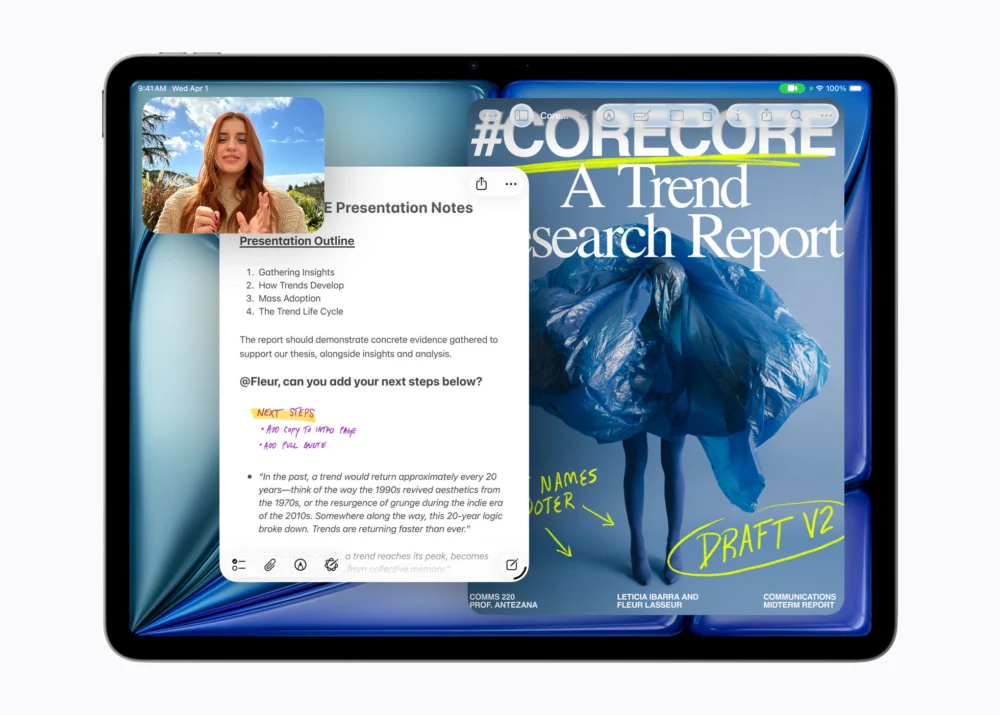
Apple on Monday officially unveiled a significantly refreshed iPad Air, now powered by the company’s latest M4 chip. This strategic upgrade positions the popular tablet line squarely in the era of artificial intelligence, promising enhanced performance and advanced capabilities for a broad range of users. The announcement comes as part of a series of product introductions from Apple, timed to capture attention amidst a bustling week for the global technology industry.
The Cupertino-based tech giant highlights that the new device is engineered for unprecedented speed and efficiency, thanks to the integration of an updated neural engine and increased memory. These core enhancements are specifically designed to bolster the iPad Air’s prowess in handling sophisticated AI workloads, a growing priority across the computing landscape. According to Apple’s internal testing, the new M4-powered iPad Air delivers a substantial performance boost, boasting speeds up to 30% faster than its M3-equipped predecessor and an impressive 2.3 times faster than the M1 version. This leap in performance is expected to be immediately noticeable to users engaging in demanding tasks, from complex creative projects to advanced machine learning applications. The M4 chip, previously exclusive to the higher-end iPad Pro line, brings a level of processing power to the Air that significantly narrows the gap between Apple’s mid-range and professional tablets, making advanced computational tasks more accessible.
Despite these significant internal upgrades and the integration of Apple’s cutting-edge M4 silicon, the company has opted to maintain the previous generation’s pricing structure, a move likely to be welcomed by consumers. The 11-inch model of the new iPad Air will retail for a starting price of $599, while the larger, more expansive 13-inch variant begins at $799. This decision to hold the line on pricing, even with a generational leap in processing power, could be a strategic play to broaden the iPad Air’s appeal and ensure it remains a highly competitive option for a wide demographic, from everyday users to creative professionals and students. Apple continues to offer preferential pricing for its educational customers, a long-standing commitment to making its technology accessible for learning environments. For eligible students and educators, the 11-inch iPad Air is available for $549, and the 13-inch model starts at a reduced price of $749. These educational discounts are typically available through Apple’s education store online or at retail locations for verified students, faculty, and staff, further enhancing the device’s value proposition in academic settings.
Delving into the technical heart of the new iPad Air, the M4 chip introduces a formidable computing architecture. The device now features an 8-core CPU, delivering robust general-purpose processing capabilities crucial for everything from everyday multitasking to running professional applications. This CPU is complemented by a powerful 9-core GPU, which significantly enhances graphical performance. This combination makes the iPad Air a highly capable machine for visually intensive applications, including high-fidelity gaming with demanding graphics, intricate image manipulation in apps like Adobe Photoshop or Affinity Photo, and professional-grade photo and video editing tasks in Final Cut Pro or DaVinci Resolve. Users can expect smoother gameplay, faster rendering times in creative suites, and more responsive interactions across the board. The enhanced GPU is particularly beneficial for artists and designers who rely on their tablets for graphic-intensive work, offering a desktop-class experience in a portable form factor, allowing them to render complex 3D models or work with multiple layers of high-resolution images seamlessly.
A critical upgrade contributing to the iPad Air’s AI capabilities is the significant boost in unified memory. The new model now comes with up to 12GB of unified memory, representing a substantial 50% increase over previous generations. Unified memory is a hallmark of Apple Silicon, allowing the CPU and GPU to share the same pool of high-bandwidth, low-latency memory, which drastically improves overall system performance and efficiency by eliminating data duplication and reducing latency. Furthermore, the memory bandwidth has been expanded to an impressive 120GB/s. This increased bandwidth is pivotal for applications that demand rapid data access, such as the execution of complex artificial intelligence models, real-time analytics, and processing large media files. For users working with large datasets, advanced computational photography, or real-time AI processing, this means faster operations and a smoother, more fluid experience, enabling more complex tasks to be handled directly on the device.

Central to the iPad Air’s AI focus is its advanced 16-core Neural Engine. This dedicated hardware component is specifically engineered to accelerate machine learning tasks and is reported to be three times faster than the Neural Engine found in the M1 chip. A more powerful Neural Engine translates directly into superior performance for on-device AI models. This capability is crucial for features such as advanced natural language processing for dictation and translation, intelligent image recognition for photo organization and editing suggestions, enhanced voice commands for Siri, and sophisticated video analysis for smart editing and effects, all performed directly on the device without requiring constant cloud connectivity. This not only boosts speed but also enhances privacy and reduces latency for AI-driven applications, paving the way for a new generation of smart features and intelligent workflows directly on the tablet. The ability to run complex AI models locally means users can leverage powerful AI tools even in offline environments, making the iPad Air an even more versatile tool for professionals and enthusiasts alike.
Beyond raw processing power, the refreshed iPad Air also boasts significant advancements in connectivity. It now supports the latest Wi-Fi 7 standard, offering dramatically faster wireless speeds, lower latency, and improved network efficiency compared to previous Wi-Fi generations. Wi-Fi 7 (802.11be) is designed for multi-gigabit speeds and enhanced capacity, which is particularly beneficial for streaming high-resolution content like 4K or 8K video, engaging in online gaming with minimal lag, and downloading massive files with greater speed and reliability, especially in crowded network environments. Complementing this is the inclusion of Bluetooth 6, which promises enhanced wireless accessory performance, more stable connections, and improved power efficiency for peripherals like headphones, keyboards, and other smart devices, ensuring a seamless wireless ecosystem. Powering these wireless capabilities are Apple’s newly developed N1 and C1X connectivity chips, designed to optimize wireless and cellular performance respectively, ensuring robust and seamless connectivity across various environments, whether users are connected via Wi-Fi or cellular networks. Despite these internal overhauls, the physical dimensions of the iPad Air remain consistent with its predecessors. The 11-inch model measures 9.74 x 7.02 inches, while the 13-inch model maintains its expansive footprint at 11.04 x 8.46 inches. This continuity in design ensures compatibility with existing cases and accessories while offering a familiar ergonomic experience.
The camera system on the new iPad Air has also received attention, featuring a capable 12-megapixel Center Stage camera on the front. This front-facing camera is strategically positioned along the landscape edge for optimal video conferencing and selfie taking, ensuring a natural eye line during calls. Its Center Stage feature intelligently keeps users in the frame as they move around during video calls, automatically panning and zooming to follow the subject. This makes virtual meetings, online classes, and family chats more engaging and dynamic. On the rear, a 12-megapixel Wide camera allows for crisp photo and video capture, suitable for documenting moments, scanning documents with high clarity, or even augmented reality applications, offering versatility for both creative and practical uses. As is customary with Apple’s tablet ecosystem, the new iPad Air seamlessly integrates with a range of Apple accessories. Users can enhance their productivity and creativity with the Magic Keyboard, transforming the tablet into a highly capable laptop-like device with a comfortable typing experience and integrated trackpad. Furthermore, the new iPad Air supports both the venerable Apple Pencil and the recently introduced Apple Pencil Pro, offering precision input for drawing, note-taking, and intricate graphic design. The Apple Pencil Pro, with its advanced haptic feedback, barrel roll, and squeeze gestures, unlocks new levels of control and interaction for creative professionals, providing a more intuitive and expressive tool for digital artistry.
Prospective buyers will be able to pre-order the updated iPad Air starting Wednesday, March 4. Orders can be placed directly through Apple.com and via the official Apple Store app in a total of 35 countries and regions, including the crucial U.S. market. The new iPad Air will be available in a refreshed palette of four distinct finishes: a vibrant blue, a sophisticated purple, a classic starlight (a warm silver-gold), and the timeless space gray, offering users a choice to match their personal style. In terms of storage, Apple provides a flexible range of options to cater to varying user needs, starting with a base of 128GB, moving up to 256GB, 512GB, and a generous 1TB for those requiring extensive storage for apps, media, and professional projects. This comprehensive array of choices ensures that there is an iPad Air configuration suitable for almost every user profile and budget within its pricing tier, from casual browsing to intensive creative work.
The launch of the new iPad Air is not an isolated event but forms part of a broader series of announcements Apple has planned for this week. Industry observers are also anticipating the unveiling of the new iPhone 17e and expected upgrades to the company’s MacBook lineup, signaling a significant refresh across multiple product categories. This coordinated launch strategy is notably timed to coincide with Mobile World Congress (MWC) in Barcelona, one of the world’s largest gatherings for the mobile industry. While Apple itself traditionally refrains from participating in MWC or other major trade shows, preferring to host its own highly curated events, the timing of its announcements is a clear strategic move. By releasing new hardware concurrently, Apple aims to divert attention and generate buzz alongside the numerous innovations being showcased by its primary smartphone rivals, such as Samsung, Xiaomi, and Honor, who are actively unveiling their latest devices and technological advancements at MWC. This approach allows Apple to control its narrative and messaging, ensuring its product launches receive undivided media and consumer attention, rather than being one among many at a crowded industry event. This week, Apple is reinforcing this strategy by holding a series of targeted hands-on events in select cities, providing media and key influencers with direct access to its new products, further amplifying the impact of its carefully orchestrated announcements and maintaining its unique position in the global tech spotlight.