 11

The United Nations announced a significant stride towards modernizing global data access on Thursday, revealing a collaborative effort with Google to make its extensive collection of global statistics more readily accessible and usable by artificial intelligence (AI) systems. This initiative addresses a critical challenge in the age of AI: ensuring that sophisticated algorithms can reliably access and interpret authoritative, verifiable data for crucial insights.
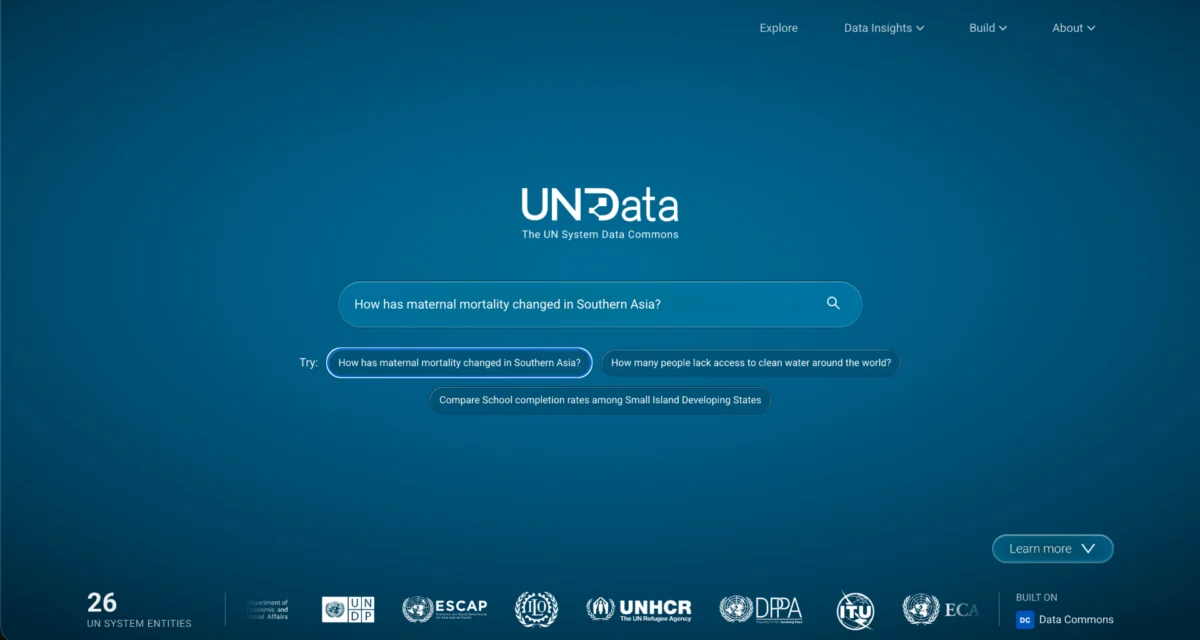
Central to this effort is the new platform, the UN System Data Commons, which is built upon Google’s open-source Data Commons platform. Designed for intuitive interaction, the system allows users to search for statistics from across various UN agencies using natural-language queries, moving beyond the traditional database interface. This marks a substantial upgrade from its predecessor, the UNData portal, which required users to navigate and search for statistics through a more conventional, often cumbersome, browsing experience. A key technological advancement of the new platform is its support for the Model Context Protocol (MCP), a standard specifically engineered to enable AI systems to connect directly to external data sources, thereby streamlining the process of data retrieval and integration for AI agents.
The urgency for such a system is underscored by the current limitations of AI in handling authoritative data. Despite the increasing reliance on AI tools for information and answers, many systems continue to struggle with consistently surfacing reliable and accurate data. Joâo Pedro Azevedo, UNICEF’s chief statistician, highlighted this issue in a virtual briefing with reporters, revealing findings from a recent UNICEF benchmark study. The study evaluated six prominent large language models (LLMs) across more than 133,000 responses to questions pertaining to global development indicators. The results were stark: the models achieved an average accuracy score of just 21.2%.
The LLMs tested in the UNICEF study included OpenAI’s GPT-4o and GPT-4o-mini, Anthropic’s Claude Sonnet 4.5 and Haiku 4.5, and Google’s Gemini 2.5 Flash and Gemini 2.0 Flash. Azevedo informed TechCrunch that approximately three out of every five responses provided by these models did not offer a usable numerical answer, often due to the models hedging their responses or failing to provide specific figures. Furthermore, the study exposed a worrying inconsistency: when the same questions were re-run on the identical model versions just two days later, models that had provided a numerical answer both times returned the identical number in only about half of those instances. This variability in outputs from identical queries highlights a significant challenge for researchers and policymakers who rely on consistent and accurate data.
The UNICEF study is currently a working paper, in preparation for journal submission, and has not yet undergone peer review. However, the organization has committed to releasing its full methodology, underlying code, and data alongside the paper, fostering transparency and allowing for independent verification of its findings.
The need for a more robust and AI-friendly data infrastructure is also evident in the changing patterns of user engagement with UN data sources. UNICEF, for instance, has observed a sharp increase this year in traffic originating from generative AI assistants directed to its data website. The UNICEF data site is a highly popular resource, receiving over six million visits each month. Between January 1 and September 14 of the current year, referrals from users clicking links within ChatGPT answers to the UNICEF site surged by 67% year-over-year, Azevedo told TechCrunch. Such AI-driven referrals now account for 6.4% of all sessions, and UNICEF estimates that, overall, AI assistants are responsible for approximately one in every ten visits to its data portal. This growing reliance on AI as an intermediary for data access underscores the imperative to ensure that AI tools are connected to reliable and verifiable sources.
The UN System Data Commons represents a significant step towards consolidating and standardizing the vast datasets generated by various UN bodies. At launch, data from nearly 20 UN entities is already available on the platform, with a total of 26 entities having formally committed to contributing their data. The United Nations has set an ambitious target: to integrate 80% of the UN system’s statistical datasets onto the platform by 2027. This comprehensive approach aims to create a unified and accessible hub for global statistics.

Shantanu Mukherjee, acting director of the UN Statistics Division, emphasized the transformative nature of this new initiative. "We are orders of magnitude more advanced in scale, scope, and flexibility, connecting for the first time across so many agencies across the UN system," Mukherjee stated. He added, "And [we are] taking this moment to also make our data AI-ready," highlighting the dual objective of improving accessibility for human users and ensuring compatibility with emerging AI technologies.
Google’s involvement extends beyond just providing the underlying technology. Google.org, the philanthropic arm of the tech giant, has provided $2 million in capacity-building funding and crucial technical support to establish the core infrastructure of the UN System Data Commons. Prem Ramaswamy, who leads Google’s Data Commons team, explained to TechCrunch that the system operates on a UN-governed instance, with the long-term vision for the UN to independently maintain, operate, and scale the platform. This approach ensures UN ownership and sustainability. Ramaswamy noted, "We have taken a ‘train-the-trainer’ approach throughout the rollout, and we have already seen the UN system team ramp up quickly," indicating a successful transfer of knowledge and operational capabilities.
Google originally launched its Data Commons in 2018 with the aim of organizing diverse public datasets into a common, structured framework, making it easier to discover and integrate information from various sources. The platform further evolved last year when it added support for the Model Context Protocol (MCP), a development that directly enables AI agents to query Data Commons for statistics and their corresponding sources. This prior investment in data organization and AI integration made Google’s platform a natural fit for the UN’s objectives.
A critical feature of the UN System Data Commons is its robust mechanism for tracking the provenance of each statistic. This ensures that users, and crucially, AI systems, can trace any data retrieved directly back to its original UN source. Azevedo underscored the importance of this traceability, particularly as more individuals and institutions come to rely on AI tools to find, interpret, and disseminate information. This feature is vital for fostering trust and accountability in AI-generated insights, mitigating the risks of misinformation or misattribution.
Beyond simply enabling AI agents to retrieve individual statistics, Google demonstrated the platform’s advanced capabilities. An AI system connected to the UN data via MCP could pull together multiple relevant indicators and then autonomously generate comprehensive dashboards, illustrative charts, and even written analyses. This capability eliminates the need for a user to manually locate, extract, and combine disparate datasets, significantly accelerating the research and reporting process.
In one compelling demonstration, Google tasked an AI system with assessing the impact of the U.S. President’s Emergency Plan for AIDS Relief (PEPFAR) in Africa. The AI system, leveraging the UN System Data Commons, successfully identified and aggregated relevant UN statistics, including measures related to HIV infections, AIDS mortality rates, and life expectancy in the affected regions. From this data, the AI then produced a detailed infographic, showcasing its ability to synthesize complex information into actionable visual formats. This example illustrates the potential for AI to rapidly generate insights and communicate critical information, powered by authoritative data.
However, despite the revolutionary potential of providing AI systems with authoritative data, both the UN and Google leaders cautioned against overreliance on AI-generated conclusions without human validation. Prem Ramaswamy explicitly stated, "Because models can misinterpret nuance, a human should always review the outputs before citing or publishing them." This crucial caveat highlights that while the UN System Data Commons can supply the most accurate and reliable data to AI, the interpretative and analytical capabilities of current AI models still necessitate human oversight to ensure accuracy, context, and the correct understanding of complex global issues. The initiative represents a powerful step forward in data accessibility and AI integration, but it firmly upholds the indispensable role of human expertise in navigating and interpreting the world’s most critical statistics.






