 11
11
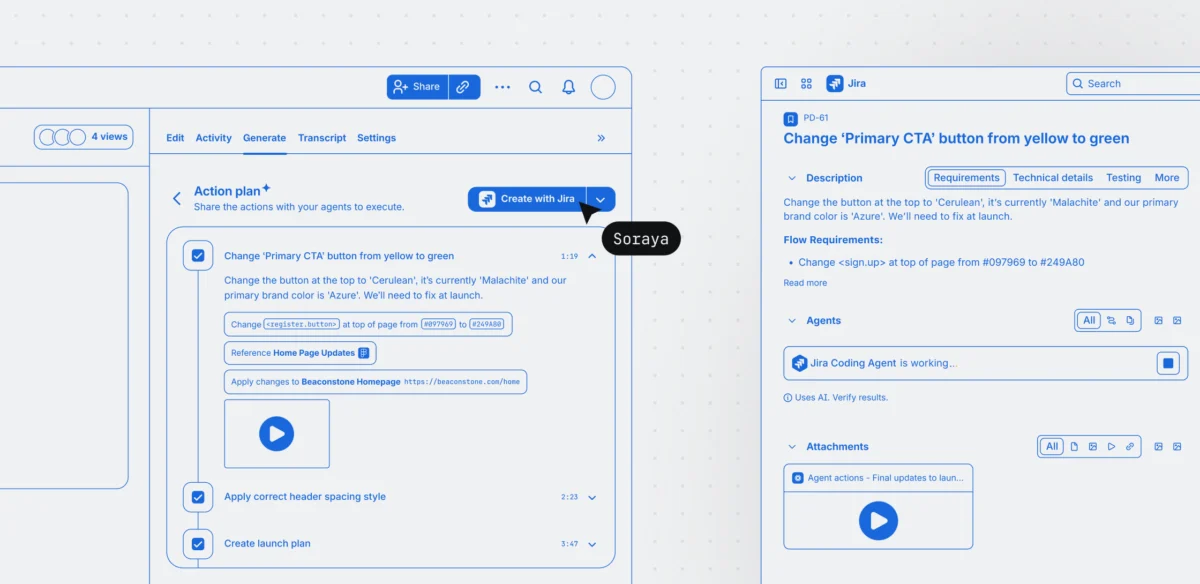
Atlassian-owned Loom has announced the launch of "video prompts," a new feature designed to bridge the communication gap between human users and artificial intelligence agents. This development marks a significant shift for the asynchronous video platform, transitioning its utility from a purely human-to-human communication tool to a foundational interface for AI-driven automation. By allowing users to record their screens and narrate instructions, Loom now generates structured, machine-readable action plans that AI agents can interpret and execute, effectively aiming to eliminate the complexities associated with manual prompt engineering.
The introduction of video prompts addresses a primary bottleneck in the current AI landscape: the difficulty of providing high-fidelity context to autonomous agents. While AI agents have demonstrated the potential to automate tedious workflows—such as updating user interfaces, building prototypes, or managing complex software documentation—they remain dependent on precise human input. Traditionally, this input has been delivered through text-based prompts, which often require extensive "prompt engineering" to achieve the desired result. Text-based instructions frequently lack the visual nuance required for design or development tasks, leading to cycles of back-and-forth clarification and reducing the overall efficiency gained by using AI.
According to Loom, the limitations of existing methods—including text descriptions, static screenshots, and voice transcripts—are significant. Text prompts often fail to capture visual context, while static screenshots miss the dynamic "click paths" and transitions between different screen states. Voice transcripts, though rich in intent, often lack the technical structure required for an agent to perform a specific sequence of actions within a software environment. Loom’s new video prompts feature seeks to synthesize these elements, converting a standard screen recording into an "agent-ready" action plan by automatically parsing narration, keyframes, target UI elements, and visited URLs.
The technical mechanism behind video prompts involves Loom’s AI engine analyzing the video recording to extract relevant metadata. As a user navigates through a website or software application, the tool identifies the specific UI elements being interacted with and maps out the workflow. This results in a structured document that includes rich instructions, which can then be shared with various AI agents or integrated directly into project management tools. This process effectively converts real-time human communication into the structured data formats—such as step-by-step checklists and technical requirements—that modern AI models require for high-accuracy execution.
This launch is particularly relevant within the context of Atlassian’s broader strategy following its $975 million acquisition of Loom in late 2023. By integrating Loom’s video capabilities with Atlassian’s suite of productivity tools, the company is positioning video as a primary data source for work management. A key feature of the new video prompts rollout is its direct integration with Jira. Users with a Jira account and the necessary permissions can convert their video-generated action plans into Jira work items with a few clicks. This allows a design fix or a bug report captured on video to move instantly from a visual demonstration to a tracked task in a developer’s backlog, complete with the structured context needed for an AI agent or a human developer to begin work.
The workflow for utilizing video prompts is designed to be integrated into the user’s existing browser experience via the Loom Chrome extension. To initiate the process, users navigate to the "Generate" tab within the extension, where the video prompt mode appears automatically. After recording the screen and describing the desired task—such as a UI adjustment or a workflow modification—the AI processes the video to produce the structured plan. This plan serves as a handoff document that bridges the gap between an initial idea and technical execution.
The move toward "agentic" AI—AI that can take action rather than just generate text—has become a focal point for the technology industry. However, the efficacy of these agents is often hampered by the "input problem." Loom’s solution suggests that video is a more efficient medium for conveying complex intent than text. For example, when a developer wants to show an agent how to fix a broken layout in a web application, demonstrating the issue on-screen while speaking is faster than writing a multi-paragraph technical specification. Loom’s AI acts as the translator, turning that visual demonstration into the technical "language" the agent understands.
Loom has confirmed that video prompts are currently rolling out in a beta phase. The feature is available specifically to Loom customers on "Business + AI" or "Enterprise" plans. This tier-based availability underscores the professional and technical focus of the tool, targeting organizations that are already investing in AI-enhanced workflows. The requirement of the Loom Chrome extension also highlights the tool’s focus on web-based environments, where a significant portion of modern software development and design takes place.
The broader implications of this technology suggest a shift in how professional documentation is created. In many organizations, documenting a process for an automated agent or a new team member is a time-consuming manual task involving spreadsheets, screenshots, and long-form writing. By automating the creation of "machine-readable instructions," Loom is attempting to turn documentation into a byproduct of natural communication. If a user can record a 60-second video and receive a 10-step technical plan, the overhead of adopting AI automation is significantly lowered.
Furthermore, the integration with the Atlassian ecosystem, specifically Jira, points to a future where "work items" are no longer just text descriptions but are backed by rich, multimodal data. This helps reduce the ambiguity that often plagues software development cycles. When an AI agent receives a Jira ticket created via a Loom video prompt, it has access to the visual state of the application at the time of the recording, the specific links visited, and the narrated intent of the user. This level of detail is intended to minimize errors and the need for human intervention during the automation process.
As AI agents continue to evolve into more sophisticated "autonomous coworkers," the tools used to manage them must also evolve. Loom’s video prompts represent a move toward a more intuitive human-computer interface. Rather than forcing humans to learn the specific syntax of prompt engineering, the technology is adapting to accept natural human communication—voice and visual demonstration—and translating it into the rigid structure required by software.
Atlassian’s investment in this area also reflects the competitive landscape of AI-powered productivity tools. With other major players like Microsoft and Google integrating AI into their respective ecosystems, Atlassian is leveraging Loom’s unique position in the asynchronous video market to offer a specialized solution for the developer and designer workflow. The focus is clearly on reducing "toil"—the repetitive, manual work of describing tasks that could otherwise be automated.
For users interested in adopting this new capability, Atlassian has provided support resources and documentation to guide the transition from traditional screen recording to video-prompting for AI. The company emphasizes that this is a beta release, suggesting that the parsing capabilities and the depth of the structured instructions will likely improve as more data is processed and the AI models are refined.
In summary, the launch of Loom video prompts represents a strategic effort to solve the "human-to-agent" communication barrier. By leveraging the speed of video and the analytical power of AI, Loom and Atlassian are providing a pathway for more seamless workflow automation. The ability to record a screen, talk through a problem, and immediately receive a structured, actionable plan for an AI agent or a Jira backlog marks a notable advancement in how technical work is captured and executed in an AI-centric professional environment. This feature simplifies the transition from an abstract idea to a concrete technical task, potentially setting a new standard for how instructions are delivered to the next generation of digital workers.