11

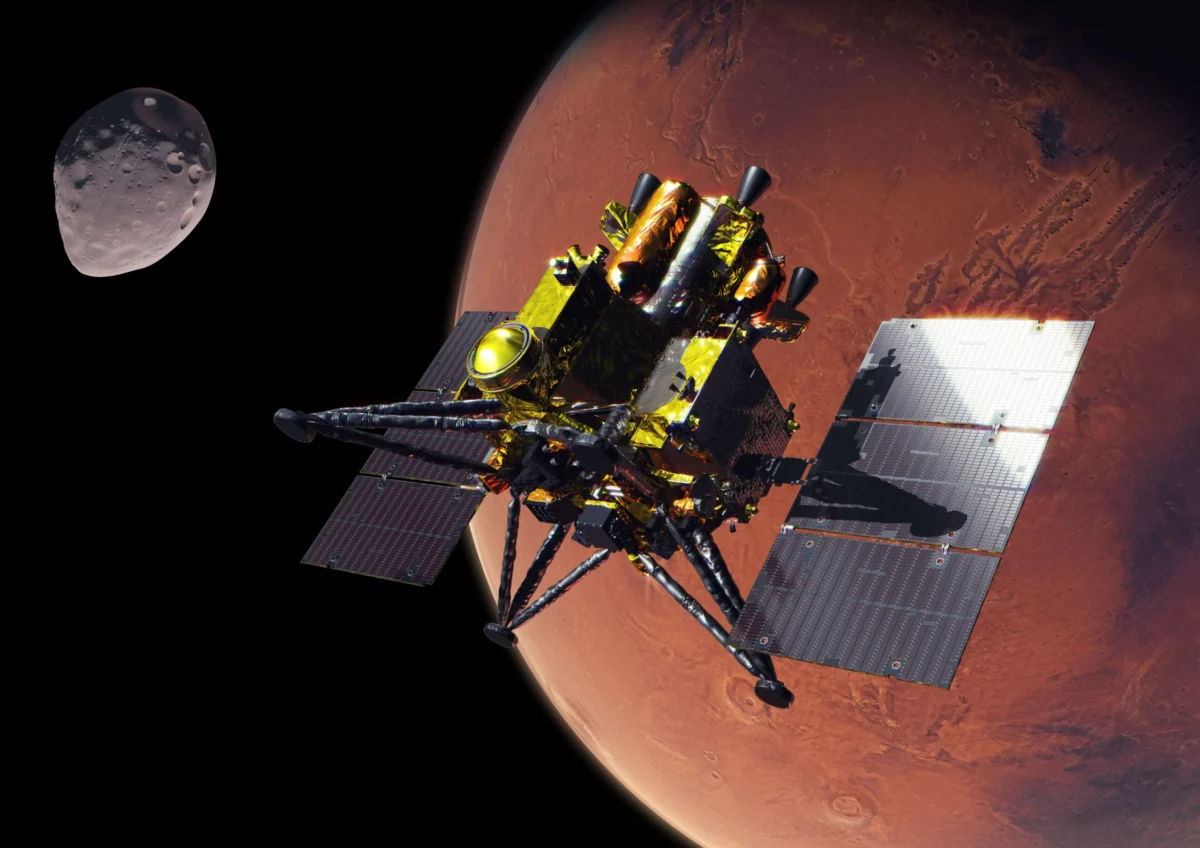
The Japan Aerospace Exploration Agency (JAXA) is embarking on an ambitious deep-space mission, the Martian Moons eXploration (MMX), designed to address long-standing questions about Mars and its two enigmatic moons, Phobos and Deimos. This groundbreaking endeavor aims to collect at least 10 grams of samples from Phobos, the larger of the two Martian satellites, and return them to Earth. If successful, these will be the first rocks from a Martian moon ever brought back for scientific analysis, offering unprecedented insights into the formation and evolution of the Red Planet’s celestial companions.
The MMX mission is a testament to the complexities and extended timelines inherent in interplanetary travel and sample return operations. The probe is scheduled to launch from Japan’s Tanegashima Space Center on October 20, 2026. Following its departure from Earth, the spacecraft will embark on an approximately one-year journey to reach the vicinity of Mars. Once in orbit around the Red Planet, MMX will spend three years conducting its primary operations, including detailed observations of both Phobos and Deimos, and critically, the collection of samples from Phobos. After completing its scientific objectives and securing its precious cargo, the probe will then begin its year-long return voyage to Earth. Current projections anticipate that scientists will finally receive these invaluable lunar rocks in 2031, marking the culmination of a demanding and multi-year mission.
A central scientific driver for the MMX mission is to definitively answer one of the most intriguing questions in planetary science: how did Mars’ moons, Phobos and Deimos, form? Two primary hypotheses currently dominate the scientific debate, each with compelling but incomplete evidence.
One leading possibility, known as the giant impact hypothesis, posits that the moons condensed from material ejected into space following a massive collision with Mars. This scenario is analogous to the prevailing theory for the formation of Earth’s Moon. Evidence supporting this hypothesis comes from the orbital characteristics of Phobos and Deimos. Their orbits are nearly circular, lie closely along Mars’ equatorial plane, and move in the same direction as the planet’s rotation. These specific orbital parameters are difficult to explain by other mechanisms and are often considered strong indicators of an in-situ formation event from a debris disk around Mars.
The alternative hypothesis suggests that Phobos and Deimos are captured asteroids. According to this theory, these celestial bodies originated in the outer solar system, likely in the asteroid belt, and were subsequently pulled into orbit by Mars’ gravitational field as they ventured too close. This idea is supported by the moons’ physical characteristics. Both Phobos and Deimos are notably dark in color, and their light-reflecting properties bear a striking resemblance to those of C-type asteroids, which are known to be rich in water and carbon compounds. However, the captured asteroid theory struggles to explain their remarkably regular, near-equatorial orbits, which are not typical for captured objects that usually retain more eccentric and inclined paths.
The MMX mission aims to resolve this scientific deadlock through direct analysis of samples from Phobos. By comparing the mineralogical and chemical composition of samples collected from Mars’ moons to those previously obtained from the Martian surface (for instance, by NASA’s Perseverance or Curiosity rovers) and to known asteroid types, scientists hope to find a definitive fingerprint that supports one hypothesis over the other. Such an answer would not only illuminate the origin of Mars’ moons but also provide broader insights into planetary formation processes within the solar system.
Bringing Martian moon rocks back to Earth presents a formidable array of technical and engineering challenges in the realms of spacecraft design, propulsion, navigation, and communication. At launch, the MMX spacecraft will have a substantial mass of 4,480 kilograms (approximately 9,900 pounds). A significant portion of this weight, more than half, will consist of fuel, strategically divided into three distinct reserves: one for the outbound journey to Mars, another for orbital operations and exploration around the Red Planet, and a final reserve dedicated to the return leg to Earth. This meticulous fuel management strategy also involves the jettisoning of modules; for instance, the outbound module will be separated once its propellant is exhausted after reaching Mars, and the exploration module will similarly be discarded following a close flyby of Deimos, optimizing the spacecraft’s mass for subsequent phases of the mission.
The most critical and challenging phase of the mission is the landing on Phobos. The moon’s diminutive size, with an approximate radius of just 11 kilometers, makes it a particularly difficult target. For comparison, Earth’s Moon boasts a radius exceeding 1,700 kilometers, offering a much more substantial gravitational well for landing operations. Phobos’ gravitational pull is about 300 times weaker than that of Earth’s Moon, rendering conventional descent methods that rely on stronger gravity unfeasible. However, Phobos’ gravity is still approximately 50 times greater than that of asteroid Ryugu, where JAXA successfully landed its Hayabusa2 probe to collect samples. The landing method used on Ryugu, which involved prolonged hovering, is not practical for MMX on Phobos because the stronger gravitational pull of Phobos would consume an unacceptably large amount of fuel during such a maneuver.
To overcome these unique challenges, the MMX probe is equipped with a highly sophisticated, high-precision autonomous navigation system. This autonomy is crucial because of the substantial communication delay between Earth and Mars, which can be up to 20 minutes for a radio signal to travel one way. Such a delay makes real-time human intervention impossible during critical descent, landing, and takeoff sequences. The probe must therefore be capable of autonomously deciding on and executing these complex maneuvers with minimal external command.
During its descent, the MMX probe will continuously compare real-time imagery of the terrain with pre-loaded topographic data of Phobos’ craters and surface features. This information will be used to precisely adjust its position and trajectory toward the predetermined target landing site. As it approaches the surface, reaching an altitude under 300 meters, the probe will employ advanced sensors to detect any significant discrepancies in elevation, labeling potential hazards such as large boulders or sudden cliffs. This critical mechanism allows the probe the flexibility to either modify its landing site in real-time or, if necessary, abort the landing and temporarily ascend to a safer altitude to reassess the situation.
Further enhancing the mission’s safety and scientific yield, a small rover named IDEFIX will be deployed onto the surface of Phobos just ahead of the main MMX spacecraft’s landing. This rover, a collaborative effort jointly developed by the French (CNES) and German (DLR) space agencies, is designed to conduct approximately 100 days of independent exploration. Its primary role will be to perform a preliminary survey of the landing zone, acting as a scout to gather vital information about the immediate environment, ensuring a safer and more informed landing for the main sample-return probe.
Once the MMX probe has successfully landed on Phobos, it will employ a multi-faceted approach to collect samples. A robotic arm will drill cylindrical tubes into the moon’s surface, extracting core samples that provide insights into the subsurface composition. Additionally, the probe is equipped with an innovative device, originally developed by NASA, that utilizes a stream of nitrogen gas to collect fine particles from the very top layer of dust. This dual approach ensures a comprehensive collection of materials from various depths and granularities.
An particularly exciting aspect of the sample return is the potential for discovering Martian material on Phobos. Experts believe that over eons, meteorite impacts on Mars have blasted significant amounts of material off the planet’s surface, some of which has subsequently coated its moons. Scientists anticipate that approximately 0.1 percent of the samples collected by MMX will consist of debris originating directly from Mars itself. The presence of these "bonus" Martian samples would provide a unique opportunity to study Martian geology indirectly, offering insights that complement samples gathered directly from the Martian surface by other missions.
The MMX mission carries a price tag of approximately $345 million US, reflecting the complexity and advanced technology involved. For Japan, this mission marks a significant milestone, being JAXA’s first Mars probe launch in 28 years and signaling a renewed focus on Martian exploration. Beyond its profound scientific contributions to understanding the origins of Mars’ moons and the early solar system, MMX also serves as a crucial engineering testbed. The mission aims to validate and refine new technologies in autonomous navigation, precision landing, fuel-efficient propulsion, and robust sample return mechanisms. These technological advancements are not only vital for the success of MMX but are also foundational to aiding future human and robotic exploration, paving the way for more ambitious sampling missions and ultimately, laying the groundwork for round-trip travel to Mars and beyond.