11
11
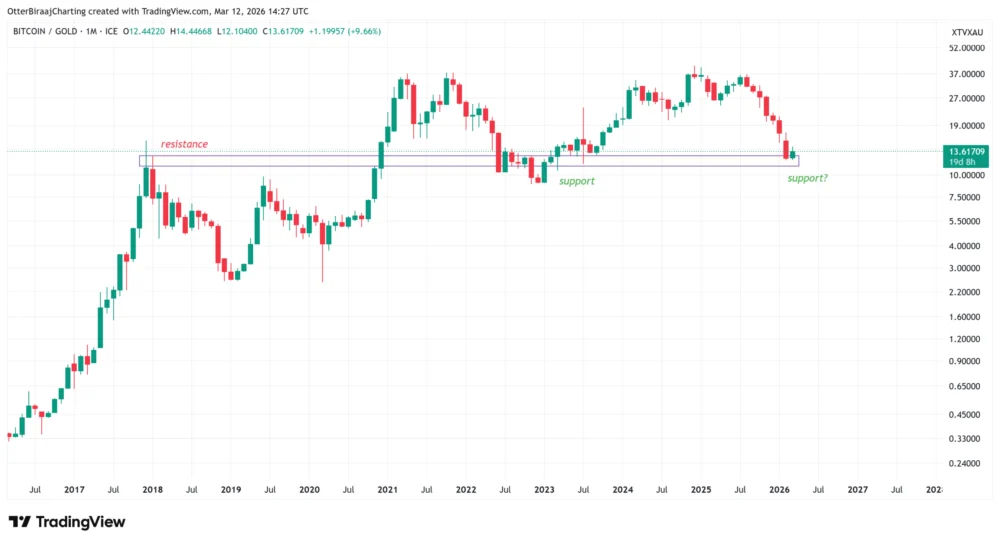
Bitcoin’s (BTC) long-term price trend against gold is exhibiting a significant bullish shift, marked by a recent retracement to levels not seen since 2017, 2022, and 2023. This potential trend reversal is occurring alongside what analysts are characterizing as an "opportunity within risk" in the broader financial landscape.

BTC-Gold Ratio Exhibits Bullish Divergence
Michaël van de Poppe, founder of MN Capital, has highlighted that the Bitcoin-to-gold ratio is demonstrating notable strength. This positive development is underpinned by the formation of a bullish divergence with the Relative Strength Index (RSI) on the daily chart. A bullish divergence is a technical indicator where an asset’s price makes lower lows, but its momentum indicator, like the RSI, forms higher lows. This pattern suggests a weakening of selling pressure and a potential reversal of the downtrend.

In February, the BTC-gold ratio experienced a retracement to a critical support level situated between 12 and 13. This level had previously acted as resistance in 2017 before transitioning into support in both 2022 and 2023. The retest of this significant historical support zone suggests that it could now serve as a potential bottom for Bitcoin’s long-term valuation relative to gold.
Further bolstering the case for a bullish outlook are recent shifts in exchange-traded fund (ETF) flows for both Bitcoin and gold. In a striking development, the SPDR Gold Shares (GLD), a prominent U.S. gold-backed ETF, recorded an outflow of $3 billion on March 6. This outflow was described by The Kobeissi Letter as exceeding any previous large daily outflow observed over the past two years by over 200%.

In contrast, Bitcoin ETFs have experienced a turnaround in their flow dynamics. The 30-day change in Bitcoin ETF flows improved to $906 million in net inflows as of March 11, a significant rebound from a $1.9 billion outflow observed just a month prior. This shift in capital allocation is further evidenced when examining holdings in native units. The 30-day change in Bitcoin ETF balances has improved to 12,909 BTC, a substantial increase from -34,197 BTC. Concurrently, gold ETF holdings have seen a decline, dropping to approximately 606,850 ounces from a high of 1.4 million ounces on February 13.
Macroeconomic Factors Create an Opportunity Window for Bitcoin

Binance Research suggests that the current macroeconomic volatility, particularly geopolitical tensions, may be creating an "opportunity within risk" for Bitcoin. The report notes that Bitcoin’s price action has recently mirrored that of other macro assets such as oil and U.S. equities, especially in the context of the U.S.-Israel and Iran conflict. This correlation indicates that global events are increasingly influencing Bitcoin’s market movements.
Despite the prevailing volatility, capital is beginning to flow back into Bitcoin. The share of Bitcoin trading volume attributed to U.S. spot ETFs has been on the rise, signaling increased institutional interest and participation. However, ETFs currently account for only about 9% of the total BTC spot trading volume. This figure is notably lower when compared to the 30-40% ETF-to-total equity trading volume seen in U.S. equity markets, suggesting substantial room for further institutional expansion.

Historically, periods of geopolitical instability have often preceded strong market recoveries. For instance, U.S. midterm election years have typically been characterized by market drawdowns, with the S&P 500 experiencing an average peak-to-trough decline of 16%. During these cycles, Bitcoin has historically seen more pronounced declines, averaging a 56% drop. However, the twelve months following midterm elections have consistently shown positive returns for the S&P 500 since 1939, with average gains of 19%. Bitcoin has also demonstrated robust performance in the post-midterm period, rallying an average of 54% in all three recorded post-midterm years.
As previously reported, the $78,000 level is now considered a key indicator for a potential broader trend change in the Bitcoin market. The convergence of technical indicators, such as the bullish divergence on the BTC-gold ratio, coupled with shifts in ETF flows and the broader macroeconomic landscape, suggests a potentially favorable environment for Bitcoin’s long-term trajectory against traditional safe-haven assets. The current market dynamics, characterized by heightened global uncertainty, appear to be creating a unique window of opportunity for Bitcoin, as investors potentially re-evaluate asset allocation in the face of evolving economic and geopolitical realities.