 11
11
Atlassian has announced a series of significant updates to its Strategy Collection, aimed at addressing a persistent structural gap in enterprise management: the disconnect between high-level strategic priorities and the actual execution of work and financial investment. These innovations, which have moved into general availability or open beta as of July 2026, are designed to provide senior leaders with real-time visibility into portfolio health, allowing for proactive intervention before initiatives drift from their intended goals.
The release of these tools comes in the wake of Atlassian’s 2026 State of Strategy research, a comprehensive study involving more than 300 senior enterprise leaders. The findings highlighted a critical tension within modern organizations: while 80 percent of leaders reported that their strategic priorities are clear, a mere 11 percent have successfully linked their daily work to those priorities within a single, integrated system. This discrepancy suggests a widespread structural failure where strategic goals, project tasks, financial data, and team objectives remain siloed in disconnected platforms. Consequently, many executives are forced to manage their organizations using static slide decks and manual updates rather than live, data-driven insights.
To combat this "steering from slides" phenomenon, Atlassian has introduced three primary architectural changes intended to provide a unified line of sight across entire organizations. The first major update involves the integration of Jira Product Discovery directly into the strategy layer. This ensures that when a new idea is identified as worth pursuing, it is immediately linked to the specific strategic priority it is intended to serve. By housing these ideas within the same ecosystem as the strategy itself, organizations can prevent innovation from occurring in a vacuum, ensuring every new project has a clear, documented purpose from its inception.
Furthermore, Atlassian has enhanced its "Goals and Projects" features with robust enterprise-grade controls. These updates respond to the needs of large-scale organizations by introducing granular edit permissions, release tracks, and comprehensive activity histories. These controls allow leadership to trace a specific team objective upward through the hierarchy to an overarching enterprise outcome, providing a transparent audit trail of how individual efforts contribute to the company’s broader success.
The third component of this visibility initiative focuses on Jira Align. The platform’s governance interfaces have been optimized for speed and readability, allowing users to rank programs more efficiently on the Epic Roadmap. These improvements also include new capabilities for clearing inactive programs following organizational restructures, ensuring that the data presented to leaders remains relevant and uncluttered by legacy projects.
The impact of these updates on operational efficiency has been noted by early adopters. Ben Waddle, Vice President of Strategy, Planning, and Delivery at Expedia Group, noted that the transition to these integrated tools has fundamentally changed how the company conducts its quarterly priority reviews. Previously, these reviews required weeks of preparation and extensive manual outreach to over 50 product managers. Under the new system, reports are produced on demand, and meetings are conducted directly within the tool. This ensures that the information being discussed is as current as the moment the participants enter the room, shifting the organizational culture from one based on "gut-feel" to one driven by confident, strategic delivery.
In addition to visibility, the Strategy Collection aims to answer the fundamental questions that drive executive decision-making: whether top priorities are on track, if investments are performing as expected, and what requires immediate focus. Atlassian identifies the separation of financial systems and work management systems as the primary obstacle to answering these questions. To bridge this gap, the company has introduced "Focus: Funds," a feature that integrates financial data directly into the prioritization interface.
With Focus: Funds, portfolio owners can view budgets, costs, benefits, forecasts, and variances alongside the initiatives they support. By connecting financial data to live work through the Atlassian Teamwork Graph, the system can flag when spending is drifting away from delivery milestones. This real-time financial tracking allows leaders to adjust resources or pivot strategies while there is still time to act, rather than discovering budget overruns or underperformance after a fiscal period has ended.
Building upon this integrated data foundation, Atlassian has launched "Strategic Intelligence" in beta. This AI-driven feature analyzes connected data across Jira, Goals, and Funds to provide automated oversight. Strategic Intelligence is designed to identify projects that are off track, at risk of failure, or have become stagnant. Rather than waiting for a scheduled review, the system offers proactive recommendations, surfacing the most critical decisions automatically.
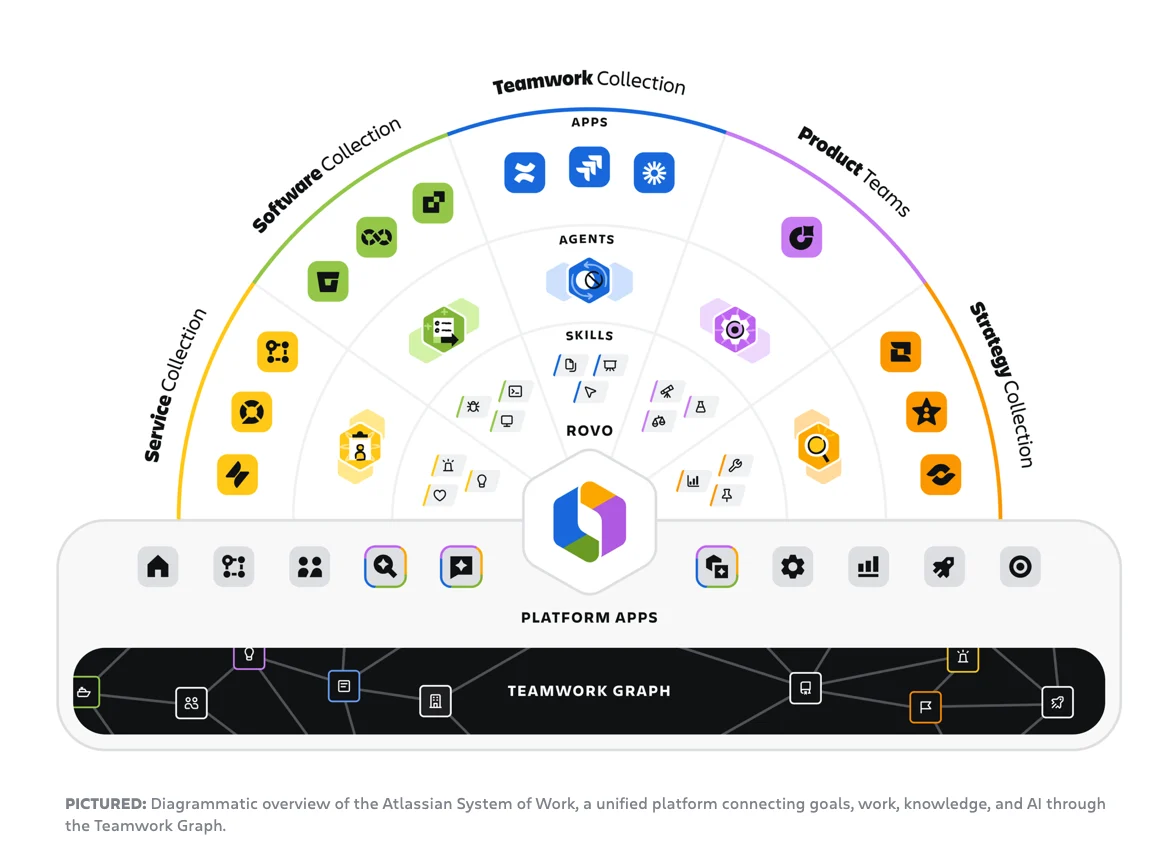
The company emphasizes that the efficacy of its AI is rooted in the Atlassian Teamwork Graph. Atlassian maintains that a fragmented operating model is the primary barrier to realizing value from artificial intelligence, as AI tends to amplify the underlying quality of the data it processes. By first connecting the operating model—linking work, strategy, and money—organizations can use AI to significantly improve the quality and velocity of their decision-making processes.
Another critical challenge addressed in this update is the maintenance of strategic alignment during cross-team requests. In many organizations, the "thread" from a request to an outcome is broken when a team member makes a request through an informal side channel, such as email or chat, causing the work to lose its link to the original strategic priority. To solve this, Atlassian introduced "Focus: Asks."
Focus: Asks provides a structured environment for capturing requests from anywhere in the organization and routing them directly against strategic priorities. This ensures that every task, from its inception as a "need," remains tied to the specific initiative it serves. Colton Kosicek, Assistant Vice President of Global Agile Operations at CNA Insurance, stated that the rollout of the Strategy Collection has allowed every team member to see in real time how their specific execution work contributes to the insurance provider’s overall strategy and success.
The timing of these innovations is particularly relevant as the industry moves through 2026, a year many experts view as a proving ground for corporate AI. Atlassian asserts that AI cannot provide meaningful insights if it is reasoning over work that is disconnected from financial constraints or strategic goals. By closing the gap between priorities, work, money, and outcomes, the Strategy Collection provides the necessary foundation for AI to move beyond mere summarization. Instead of simply reporting on what has already occurred, the integrated system allows AI to flag priorities that are likely to slip or budgets that are about to be exceeded, providing a window for corrective action.
The new capabilities are currently available to all Strategy Collection customers. Atlassian has confirmed that there is no waitlist for these features, which include both General Availability (GA) releases and open beta versions. Organizations are encouraged to begin implementation by identifying a specific strategic outcome they wish to improve and utilizing the integrated tools to align their teams and finances accordingly. By unifying the operating model on the Teamwork Graph, Atlassian aims to provide a live, accurate picture of the enterprise, replacing the fragmented and manual processes that have historically hindered strategic execution.