 11

In a significant economic development that has sent ripples through financial markets, the United States economy added a robust 162,000 nonfarm payroll jobs in August, a figure that dramatically outpaced economists’ consensus expectations of approximately 56,000 jobs. This unexpectedly strong labor market performance has introduced a new layer of complexity to the ongoing debate surrounding the Federal Reserve’s future interest rate policy, a critical factor influencing asset prices, including Bitcoin (BTC).
Following the release of the August jobs report on Friday, Bitcoin experienced a notable price correction. The cryptocurrency dipped from a high of $81,300 to a local low of $78,600, before stabilizing around $79,500 at the time of reporting. This price action underscores the sensitivity of digital assets to macroeconomic indicators and shifts in monetary policy expectations.
The significance of recent economic data cannot be overstated, particularly as the Federal Open Market Committee (FOMC) prepares for its upcoming meeting on September 15-16. The outlook on interest rates remains sharply divided, adding a layer of uncertainty to the market. Historically, under previous Federal Reserve chairs, expectations surrounding FOMC decisions were generally well-anchored, providing a degree of predictability for investors. However, the current environment, characterized by a perceived lack of explicit forward guidance from Chair Kevin Warsh and the potential for dissenting opinions within the committee, has amplified market speculation and volatility.
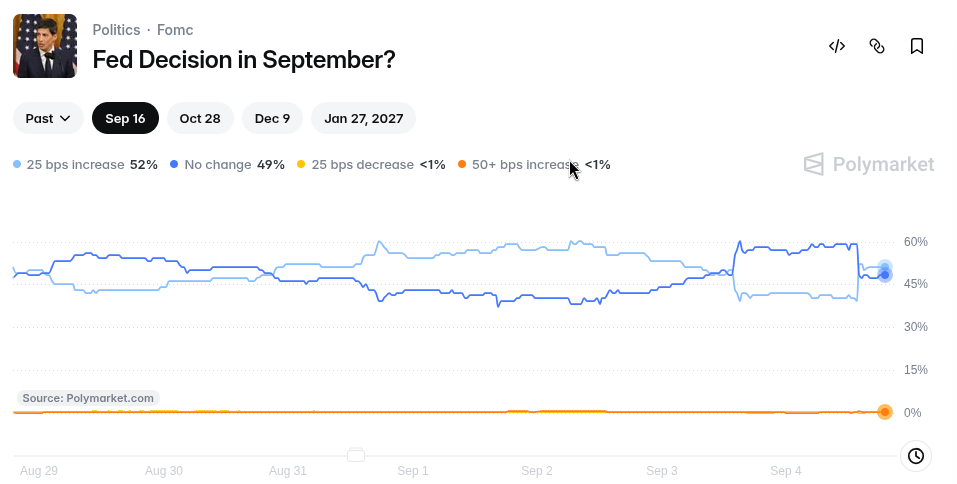
Adding to the discourse, Fed Governor Christopher Waller’s comments on Thursday indicated a preference for a rate pause, pending further analysis of upcoming inflation data. This statement had a tangible impact on market sentiment, with Polymarket probabilities shifting to favor a pause at 60%, while a 25 basis-point interest rate hike was seen at 40%. However, the release of the stronger-than-anticipated August labor market data on Friday subsequently recalibrated these probabilities, pushing them back towards a near 50/50 split between a pause and a hike. This fluctuating sentiment highlights the delicate balance the Federal Reserve must strike in navigating economic data to determine its next monetary policy move.
The robust jobs report also reignited calls for interest rate reductions from US President Donald Trump. In a post on Truth Social, he urged the Federal Reserve to "get smart" and "be patriots," arguing that high interest rates place the United States at a significant and unfair disadvantage. Trump, who had previously been vocal in his criticism of former Chair Jerome Powell for not cutting rates, extended his critiques to the current leadership, signaling his strong conviction that lower interest rates are essential for the nation’s economic well-being. His statements reflect a broader concern within some political circles about the impact of monetary policy on the economy and its competitive standing on the global stage.
In parallel to the macroeconomic developments, the Bitcoin network has witnessed a significant event related to a proposed upgrade, BIP-110, which aimed to implement a user-activated soft fork (UASF). The activation of BIP-110 on August 7 led to a brief divergence in the Bitcoin network, creating two competing chains: one adhering to the new BIP-110 rules and another continuing under the pre-existing protocol. The chain enforcing BIP-110 experienced a significant stall, primarily due to a perceived lack of sufficient mining power dedicated to extending it.
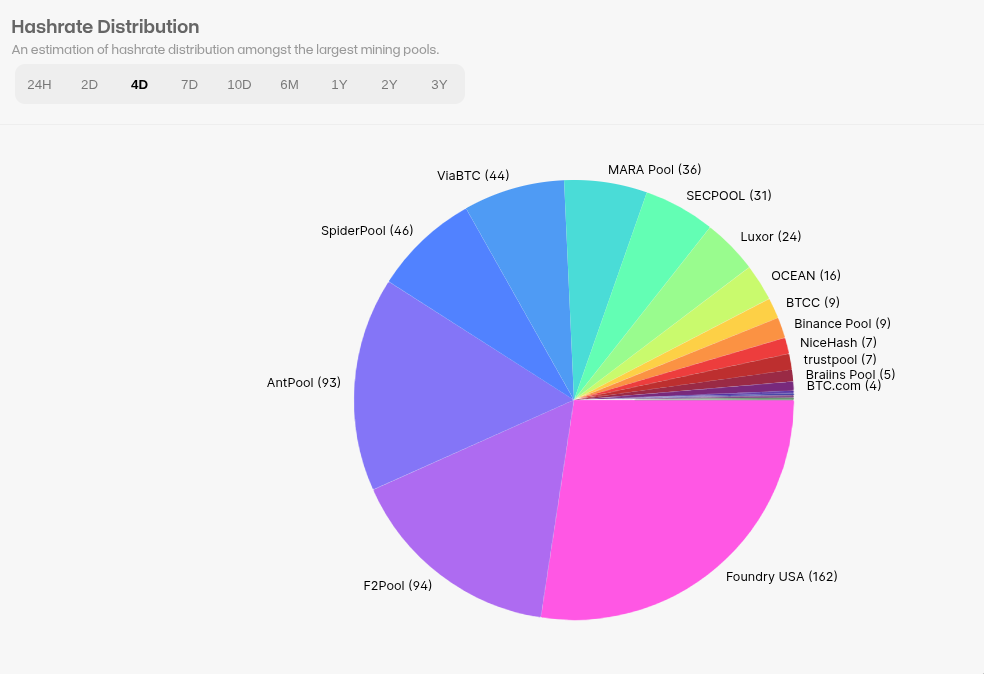
This outcome was interpreted by proponents of BIP-110 as a stark illustration of the increasing centralization within Bitcoin’s mining layer. Their criticism was further amplified by the absence of a coordinated counter-effort from the Bitcoin Core community, such as a user-rejected soft fork (URSF). The concentration of hashrate power among a small number of mining pools – with five pools reportedly controlling the majority of Bitcoin’s computational power – grants them considerable influence over which chain is prioritized and which transactions are ultimately included in blocks. This consolidation of power raises concerns about the decentralized ethos of Bitcoin.
In response to this perceived centralization and the stalled BIP-110 chain, a segment of BIP-110 supporters, reportedly led by LukeDashjr, have initiated a new path forward. They have opted to continue the BIP-110 chain by implementing a change to the proof-of-work algorithm, transitioning to Blake2b. This strategic shift aims to foster the emergence of a new, more decentralized mining ecosystem by leveraging DATUM gateway technology. The corresponding hard fork was initiated on August 30. Crucially, any address that held SHA-256 Bitcoin prior to August 7, and potentially thereafter, is expected to possess an equivalent amount of the new Blake2b version of Bitcoin.
Currently, Neoxa stands as the sole exchange listing this Blake2b-powered Bitcoin. While liquidity for this new variant remains thin, initial trading data indicates that Blake2b coins are trading at approximately $350 against USDC, with a reported spread of 1.1%. This development represents an attempt to create a more distributed mining landscape, addressing concerns about the concentration of power within the existing Bitcoin mining infrastructure. The success of this new chain will likely depend on its ability to attract a broader and more distributed base of miners and users, thereby establishing a more robust and decentralized network.
The interplay between macroeconomic data, central bank policy expectations, and technological developments within the cryptocurrency space highlights the dynamic and interconnected nature of modern financial markets. The surge in US job creation has undoubtedly complicated the Federal Reserve’s decision-making process, while the emergence of alternative Bitcoin protocols reflects ongoing efforts to address fundamental aspects of decentralization and network governance.






