 11
11
The Women’s National Basketball Association (WNBA) is currently grappling with an increasingly fervent and complex debate surrounding the participation of transgender athletes in women’s sports. This contentious discussion has recently taken an unexpected turn, intertwining the outspoken views of Indiana Fever guard Sophie Cunningham, the emergence of a French transgender basketball player, and the resurfacing of a years-old, controversial joke from former President Donald Trump. Trump’s 2022 remark, suggesting NBA superstar LeBron James could transition and dominate the women’s league, has added a layer of political and cultural complexity to a conversation already fraught with strong opinions.
The catalyst for this renewed focus within the WNBA came last month when Indiana Fever star Sophie Cunningham made headlines with her unequivocal stance on transgender women in sports. Cunningham, a prominent player for the Indiana Fever, publicly called for the "protection of young girls" in locker rooms and sports, articulating a viewpoint that quickly garnered significant attention, including praise from high-ranking political figures. Her remarks ignited a firestorm of debate, drawing both fervent support and sharp criticism from various corners.
The White House, through press secretary Karoline Leavitt, publicly endorsed Cunningham’s position, stating that the issue is one "the president feels strongly about." Leavitt went further, criticizing those who had voiced opposition to Cunningham’s statements, underscoring the political weight now attached to the sports debate. This official backing from the White House amplified the conversation, signaling that the issue had transcended the boundaries of sports and entered the national political discourse.
The narrative gained new momentum this week when an old comment made by Donald Trump about the WNBA, dating back to 2022, went viral on X (formerly Twitter). Simultaneously, a French basketball player, Julie Tétart, found herself unexpectedly drawn into the American debate, primarily due to the actions of OutKick, a Fox News-owned sports and culture outlet known for its conservative leanings.
Julie Tétart, a 34-year-old transgender woman, currently plays for Monaco in France’s second-tier women’s basketball Ligue 2. Her involvement began when OutKick reached out to her directly. Tétart reportedly responded to a direct message from the outlet, admitting her willingness to answer any call from the WNBA. However, she tempered her aspiration with a dose of realism, reportedly stating, "you have to be realistic: I’m old, and there are far better players than me!" This candid response, intended to convey humility and practicality, was then framed by OutKick in a manner that fueled their critical narrative against the WNBA.
Following Tétart’s comments, OutKick published an article that sharply criticized the WNBA. The piece, titled in a way to provoke, essentially slammed the "inclusive" WNBA for its perceived failure to recruit Tétart, despite her reportedly "dominating season" in France’s second division. The implication was that if the WNBA truly valued inclusivity for transgender athletes, it should be actively seeking out players like Tétart. OutKick founder Clay Travis, a prominent conservative media personality, further escalated the rhetoric, taking to X to label the WNBA as "transphobic" for not having extended an offer to Tétart.
The result of OutKick’s campaign was immediate and harsh for Tétart. She quickly became a focal point for intense online scrutiny and a target for transphobic attacks across Elon Musk’s social media platform. Her personal aspirations and identity were unfortunately weaponized in a broader cultural and political struggle, transforming her into an unwilling symbol in a debate far removed from her professional basketball career in France.
Historically, the WNBA, its players, and coaches have largely managed to steer clear of the intense controversies surrounding transgender participation that have engulfed other sports. This relative quietude was primarily due to the simple fact that there haven’t been many openly transgender women seeking to play in the league. Consequently, the league has never issued an official declaration or established a clear policy on whether transgender athletes would be allowed to compete. This lack of a formal stance left the door open for individual interpretation and, for a long time, many individual players expressed general support for the idea of inclusion. This informal consensus, however, shattered with Sophie Cunningham’s outspoken remarks.
Cunningham, who has been dubbed "MAGA Barbie" online by some for her conservative views, took a firm public stance last month. She articulated a desire to "protect women’s sports," asserting that individuals assigned male at birth should not be permitted to play in the WNBA. Her reasoning, as conveyed to ESPN, was explicit: "I want to protect young girls in a locker room, or young girls in sport who shouldn’t have to go against biological men." These comments resonated deeply with a segment of the public that shares concerns about fairness and competitive equity in women’s sports, particularly concerning physiological differences between sexes.
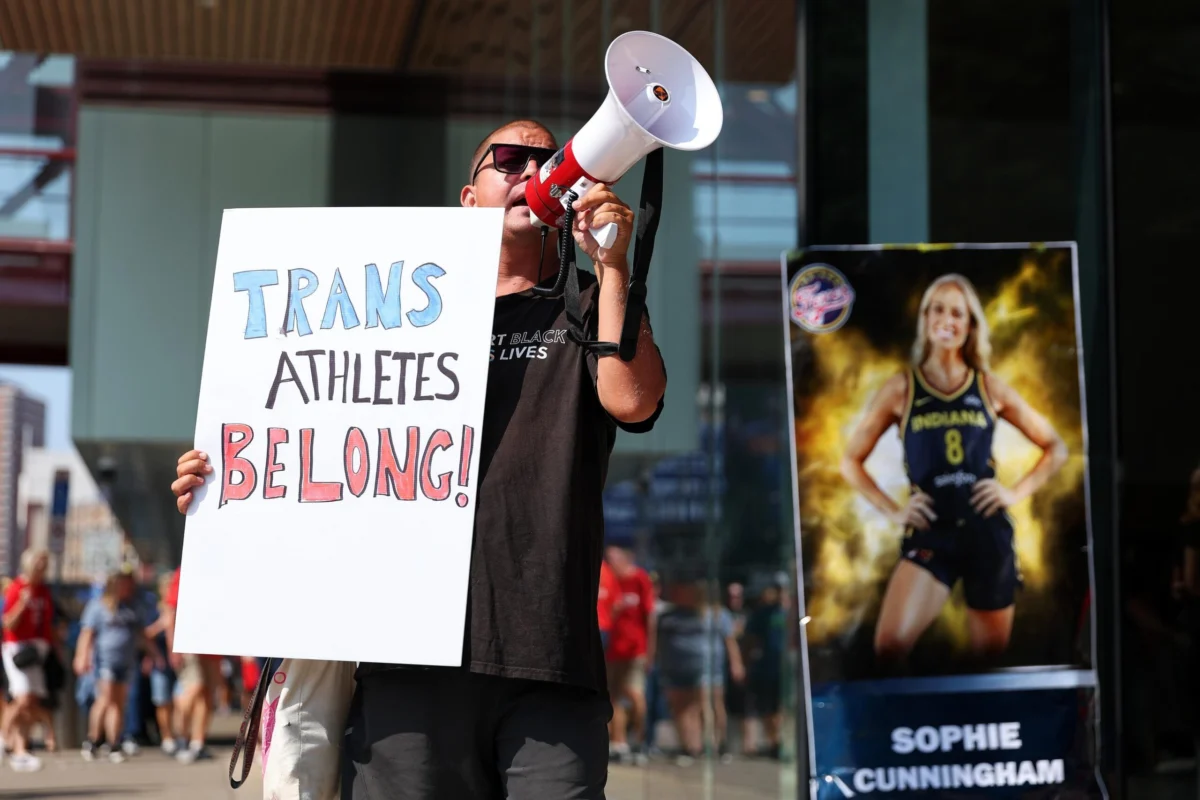
Cunningham’s remarks have since had tangible repercussions, triggering both pro- and anti-Cunningham rallies at WNBA games, highlighting the deep divisions the issue has created among fans and the broader public. These demonstrations underscore the passionate nature of the debate, transforming WNBA arenas into venues for social and political protest. Furthermore, several prominent figures within the WNBA community have publicly pushed back against Cunningham’s position. Minnesota Lynx coach Cheryl Reeve and Golden State Valkyries coach Natalie Nakase have both voiced support for transgender athletes, emphasizing inclusivity and advocating for policies that would allow them to compete. Their statements represent a counter-narrative within the league, ensuring that the debate remains multifaceted and contested.
Donald Trump’s connection to the immediate controversy surrounding Cunningham and Tétart is, in many ways, indirect. While he has been a vocal opponent of transgender women competing in women’s sports, his recent comments have not directly addressed the Tétart drama or the specifics of Cunningham’s statements, beyond Karoline Leavitt confirming his general interest in the story. However, as the discussions around Cunningham and Tétart gained significant traction online, a past comment Trump made about the WNBA in 2022 began to recirculate widely.
During Turning Point USA’s Student Action Summit in Florida that July, Trump delivered a joke that, in retrospect, takes on new significance within the current debate. He quipped that he would be the greatest women’s basketball coach ever. His strategy, he explained to the audience, would be simply to ask superstar LeBron James if he had any "desire to be a woman." The implication, clear to his audience, was that a transitioned LeBron James would physically dominate the WNBA, thereby illustrating Trump’s perspective on the competitive imbalance he believes exists when transgender women compete in women’s sports. The resurfacing of this comment serves to frame the current WNBA debate within a broader conservative political discourse, even if it didn’t directly instigate the present specific controversies.
The situation engineered by OutKick, by effectively goading Julie Tétart into participating in the American transgender athlete debate, has created an unenviable "lose-lose" scenario for the WNBA. The league now finds itself in an incredibly awkward and precarious position, with significant implications for its public image, its stated values, and its relationship with its fan base.
On one hand, if the WNBA chooses to decline pursuing Julie Tétart, or simply ignores her existence in the context of this debate, it opens itself up to accusations from critics, particularly conservative news outlets like OutKick, that its support for transgender athletes is merely performative. Such critics would argue that the league’s progressive stance on inclusivity is hollow if it doesn’t translate into action, especially when a self-proclaimed "dominating" transgender player is available. This would damage the league’s credibility among those who advocate for full transgender inclusion and could alienate a segment of its progressive fan base, who might perceive the league as buckling under conservative pressure.
On the other hand, if the WNBA were to actively seek out and sign Julie Tétart, it would undoubtedly be met with a different but equally vociferous backlash. The same critics, along with a broader segment of the public, would likely use such a move as evidence that the WNBA is willing to compromise the integrity and fairness of women’s sports for political reasons. Opponents of transgender participation in women’s sports argue that biological advantages cannot be fully mitigated, regardless of hormone therapy, and that allowing transgender women to compete undermines the very definition of women’s sports. Signing Tétart could be seized upon as a prime example of the league prioritizing political correctness over competitive equity, potentially alienating traditional sports fans and those who sympathize with Sophie Cunningham’s "protect women’s sports" mantra.
This dilemma forces the WNBA to navigate a treacherous path between competing values: the desire for broad inclusivity and the concerns about fairness and the biological realities of sex-segregated sports. Any decision the league makes will inevitably draw strong reactions and likely criticism from one side of the debate or the other, underscoring the profound challenge this issue poses to professional women’s sports in the current socio-political climate. The outcome, whatever it may be, will undoubtedly shape the future trajectory of the WNBA and its role in the larger conversation about gender, identity, and athletic competition.