11
11
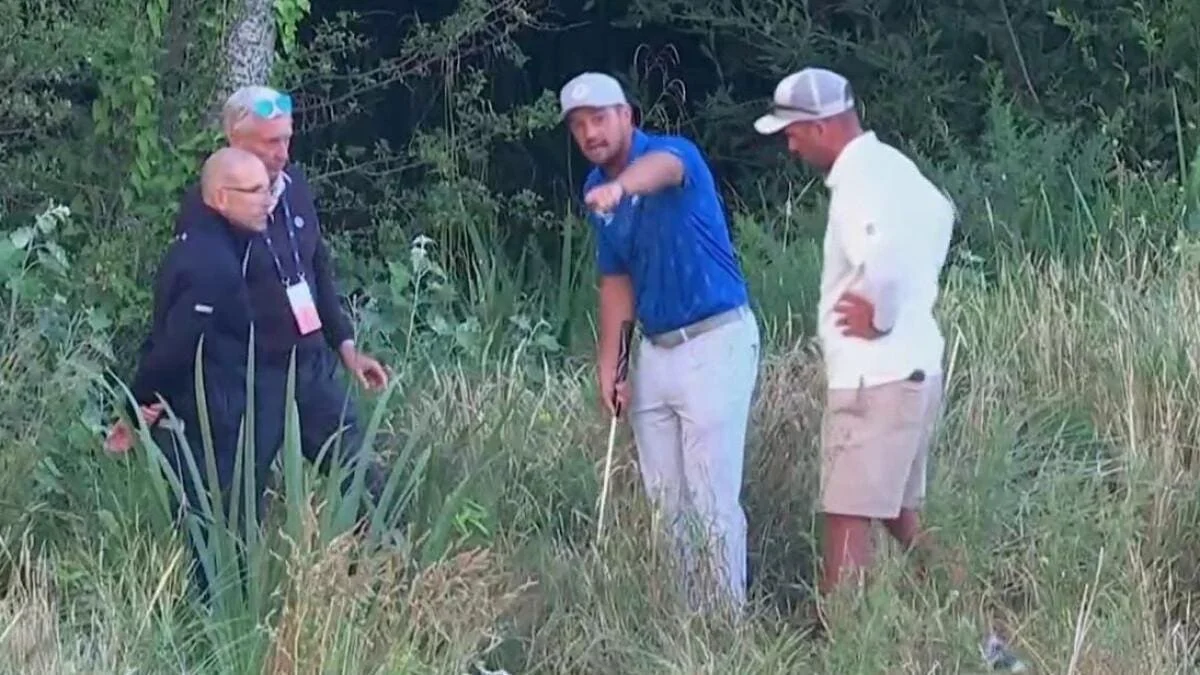
As the sun began to set on Friday’s second round of the 154th Open Championship at the historic Royal Birkdale Golf Club, a dramatic and highly controversial situation unfolded, placing one of golf’s most recognizable figures, Bryson DeChambeau, squarely in the spotlight and sparking a heated debate with the Royal and Ancient Club of St. Andrews (R&A), golf’s governing body. The incident not only overshadowed an otherwise stellar round by DeChambeau but also ignited discussions about rule enforcement, player conduct, and the underlying tensions within professional golf.
DeChambeau, often dubbed "The Scientist" for his analytical approach to the game and renowned for his powerful drives and unconventional techniques, had seemingly capped off an exceptional performance. He birdied both the challenging 17th and 18th holes, propelling him to a seemingly impressive seven-under-par total for the tournament, placing him just one shot off the lead and firmly in contention for the coveted Claret Jug heading into the weekend. However, this promising position was soon jeopardized by events from earlier in his round.
Upon entering the scoring area, a situation rapidly escalated as video footage began to circulate, highlighting a potential rules infraction from DeChambeau’s play on the 5th hole. The R&A, vigilant in its oversight of the game’s integrity, quickly took notice, initiating an inquiry that would soon plunge the championship into a maelstrom of contention.
The core of the controversy revolved around DeChambeau’s second shot on the par-5 5th hole. The question was not whether DeChambeau had improved the lie of his ball – a clear violation – but rather, if he had inadvertently or intentionally matted down the fescue grass directly behind his ball in a manner that could improve the takeaway path of his swing. Fescue, a characteristic feature of links courses like Royal Birkdale, is known for its tall, wispy, and often dense nature, making it particularly challenging when a ball comes to rest within it. Any action that makes hitting the ball easier from such a difficult lie, even if seemingly minor, can constitute a breach of the rules. Rule 8.1a, specifically, prohibits a player from improving the area of their intended swing, the line of play, or the lie of their ball. Crucially, intent is not always a prerequisite for a penalty; an act can be deemed an infraction even if performed accidentally, if it results in an improvement of conditions.
Before rendering a decision, the R&A rules officials embarked on a highly unusual and visibly tense procedure. DeChambeau was driven back out to the 5th hole, the very site of the alleged infraction, for a direct consultation and re-enactment of the incident. This on-site investigation, conducted under the watchful eyes of television cameras, served only to amplify the drama. DeChambeau, armed with a club, meticulously attempted to demonstrate to the officials that the grass which had been matted down was not, in fact, within his intended swing path. His argument was that he was merely positioning himself behind the ball to gain a proper sightline to the hole when some of the fescue grass was inadvertently pressed down.
The live television broadcast captured a highly animated DeChambeau, visibly frustrated and repeatedly raising his hands in disagreement with the R&A officials. The intensity of the exchange was palpable, and at one point, DeChambeau was reportedly heard stating, "I won’t play tomorrow" if a penalty was assessed. Further reports from the scene suggested that, in the heat of the moment, he referred to the rules officials as "crooks" before being driven back to the scoring area, leaving little doubt about his strong disapproval of the ongoing inquiry.
After an extensive deliberation that stretched for more than 30 minutes, keeping both DeChambeau and golf fans worldwide in suspense, the R&A finally announced its decision. Bryson DeChambeau was assessed a two-stroke penalty for the infraction. This ruling had immediate and significant consequences for his position on the leaderboard. His score for the second round adjusted from -7 to -5, causing him to plummet from outright second place down to a tie for fifth position heading into the crucial weekend rounds. The R&A later released a statement on X (formerly Twitter) confirming the penalty and citing the relevant rule, though the full details of their reasoning beyond the rule itself were not immediately elaborated upon in the provided context.

The incident, however, quickly transc transcended the immediate penalty and ignited a broader debate within the golf community, focusing not just on whether DeChambeau broke the rule, but critically, on the timing and consistency of its enforcement. Many fans and commentators were quick to point out that in modern professional golf, players are frequently observed walking around their ball in deep fescue, often inadvertently matting down grass, without facing penalties. This perceived inconsistency fueled the controversy, with comparisons drawn to similar situations that have gone unpunished.
A prominent example cited by fans involved Wyndham Clark, the reigning U.S. Open champion, earlier this year. During his victory at the U.S. Open, video footage surfaced showing Clark in a similar situation where he appeared to improve his lie or area of intended swing in heavy grass, yet he was not penalized by the United States Golf Association (USGA), the governing body for golf in the U.S. and Mexico. This stark contrast in rulings between the USGA and the R&A, particularly for what many saw as a comparable infraction, intensified questions about the uniformity of rule application across major championships and governing bodies.
The underlying motivations behind the R&A’s decision to penalize DeChambeau at this particular moment remain a subject of intense speculation. Some argue that the decision could be politically charged, given DeChambeau’s prominent role in the Saudi-backed LIV Golf tour and his significant, often polarizing, presence on platforms like YouTube. The ongoing fragmentation and tension within professional golf, particularly between the established tours and LIV Golf, led some to interpret the R&A’s stern enforcement as a subtle message or a means of asserting authority over a player associated with the rival league.
Conversely, others contend that the R&A was simply taking a firm stance on a rule that, in their view, players have been increasingly disregarding or bending with impunity. From this perspective, the penalty served as a necessary reminder of the strict adherence required to the Rules of Golf, emphasizing the importance of maintaining the integrity and spirit of the game, especially in a major championship setting. Time will tell if the R&A provides further clarification or elaborates on its broader philosophy regarding such rules going forward.
Despite the highly emotional exchange and his initial threat not to play, DeChambeau quickly confirmed his participation in the subsequent round. He took to X on Saturday evening, stating his intention to tee it up, indicating that while he might disagree with the ruling, he would not let it deter him from competing.
Regardless of one’s personal opinion of Bryson DeChambeau, his distinctive playing style, or the events of Friday afternoon, the stage is now undeniably set for high drama. When DeChambeau tees it up in Saturday’s third round of The Open Championship, every shot will be scrutinized, and his performance will be watched with heightened anticipation, promising an electrifying spectacle for golf fans worldwide.
Mike is a founding member of Break80 Golf and a contributing golf and sports writer for Forbes with PGA Tour and LIV Golf media credentials. Mike can be reached at [email protected] for inquiries or story leads.