 11

A groundbreaking report from blockchain analytics firm Chainalysis has unveiled a staggering reality for global tax authorities: at least $457 billion in potentially taxable cryptocurrency activity occurred onchain in 2025, yet international reporting rules, specifically the Organisation for Economic Co-operation and Development’s (OECD) Crypto-Asset Reporting Framework (CARF), are likely to capture only a fraction of this immense sum. The findings highlight a significant and growing tax gap within the rapidly evolving digital asset economy, raising concerns about compliance and revenue collection for governments worldwide.
The United States alone accounted for an estimated $112.6 billion of this onchain taxable activity, underscoring the significant role of American participants in the global crypto market. Regionally, North America emerged as the leader, with a substantial $134.6 billion in potentially taxable onchain transactions. This was closely followed by the European Union, which registered an estimated $125.1 billion. These figures paint a clear picture of the concentrated economic activity in these major crypto hubs.
Chainalysis’s comprehensive analysis included a broad spectrum of onchain activities across six major blockchains. These encompass realized gains from trading, income generated through activities such as cryptocurrency mining, staking, and lending, and crypto-denominated payments used for goods and services. Crucially, the report excludes any trading or other activities conducted exclusively within centralized cryptocurrency exchanges. This distinction is vital, as it focuses on the direct, peer-to-peer, and protocol-level interactions that occur on the blockchain itself, often outside the direct purview of traditional financial intermediaries.

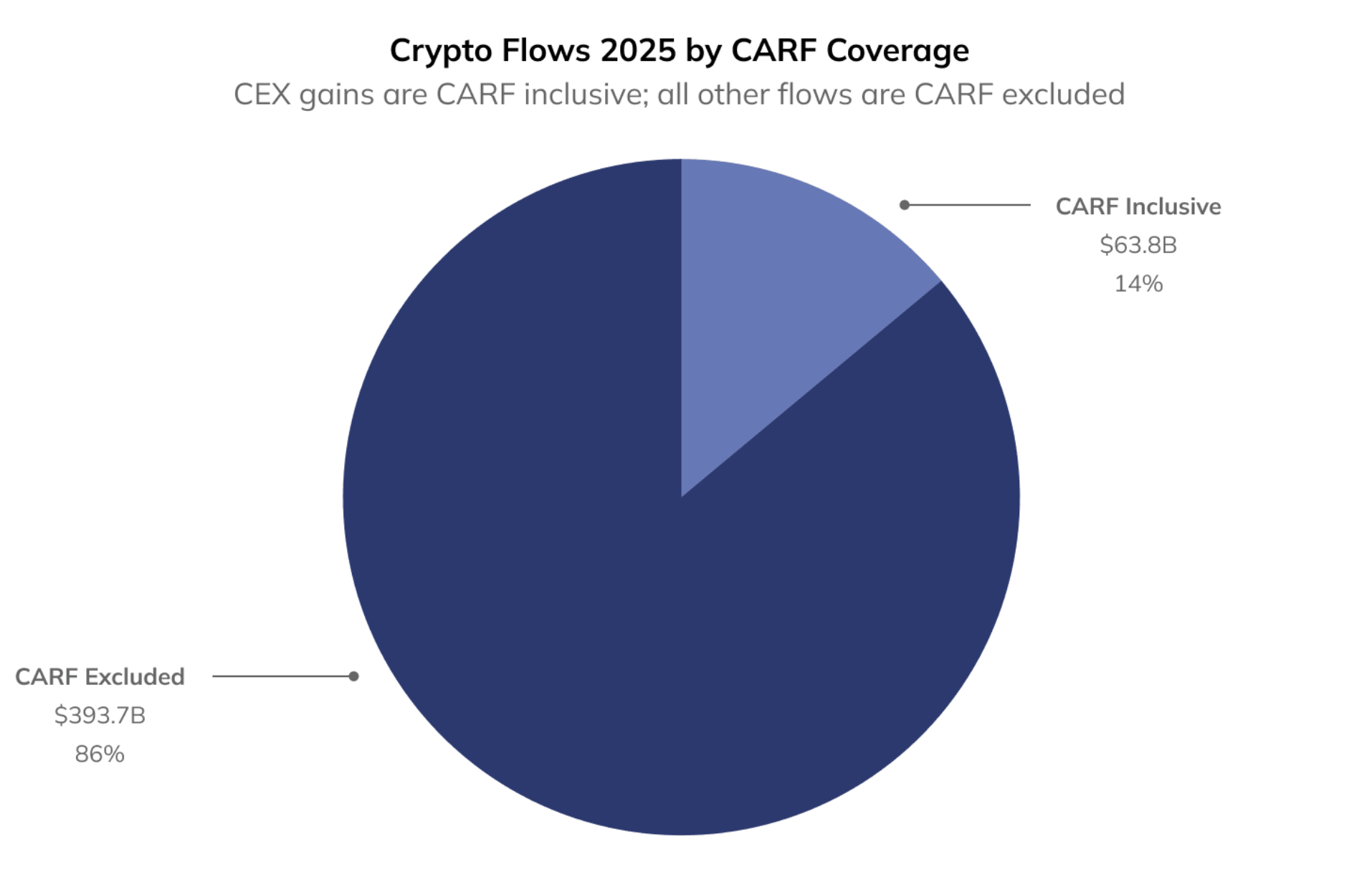
The report’s most alarming revelation is the stark disparity between identified taxable onchain activity and what is currently covered by the CARF. Chainalysis estimates that transactions falling under the scope of CARF account for a mere 14% of the total onchain taxable activity it identified. This leaves a colossal 86% of potentially taxable onchain transactions outside the current reporting framework. This overlooked 86% includes a diverse range of activities, such as transactions on decentralized exchanges (DEXs), direct peer-to-peer transfers between individuals, income streams derived from decentralized finance (DeFi) protocols, and payments made using cryptocurrencies.
The CARF, developed by the OECD and formally introduced in 2022, is designed to enhance tax transparency in the crypto-asset space. Its core mechanism requires covered crypto service providers to report customer transaction data to tax authorities. This data is then intended to be shared across borders through international agreements, enabling tax administrations to gain a more comprehensive view of their citizens’ crypto holdings and transactions.
However, the Chainalysis report clearly demonstrates the inherent limitations of CARF’s current design when applied to the dynamic and often decentralized nature of onchain cryptocurrency activity. The framework’s reliance on identifying and obligating specific entities to report data inherently struggles to encompass the entirety of the onchain ecosystem.
The CARF framework officially commenced its data collection phase on January 1, 2026, in 48 participating jurisdictions, including significant markets like the United Kingdom and the European Union. Under its provisions, crypto providers deemed "in-scope" are mandated to collect detailed customer information, including their tax residency, and subsequently report this transaction data to their respective domestic tax authorities. These authorities, in turn, are empowered to exchange this information internationally.
The primary reason for the significant gaps highlighted by Chainalysis lies in CARF’s focus on crypto intermediaries. Colby Mangels, a former advisor to the OECD who played a role in the development of CARF, previously explained to Cointelegraph that the framework was intentionally designed with the operational models of centralized intermediaries in mind. These are entities that facilitate crypto transactions as a business and have clear points of contact for regulatory oversight.
Consequently, a substantial portion of decentralized finance (DeFi) activities remains outside the current reporting perimeter. This is largely because many DeFi protocols operate without a centralized operator or a traditional custodial relationship. In such decentralized environments, it is often challenging, if not impossible, to identify a single entity upon whom reporting requirements can be imposed. The very ethos of DeFi, which emphasizes disintermediation and user control, presents a significant hurdle for traditional regulatory reporting mechanisms.
While the current framework may struggle, the landscape is not static. Tax authorities are actively monitoring developments in the regulation of decentralized platforms. Mangels indicated that regulators are paying close attention to advancements in anti-money laundering (AML) regulations, particularly efforts to define when and under what circumstances DeFi platforms or their key operators might be classified as regulated crypto service providers. Such a classification could, in the future, bring a wider range of DeFi activities under a reporting obligation.
The Chainalysis report serves as a critical wake-up call for governments and tax authorities worldwide. The sheer volume of untracked onchain crypto activity signifies a substantial potential loss of tax revenue and poses a challenge to ensuring fair taxation across all economic sectors. As the cryptocurrency market continues its rapid expansion and innovation, particularly within the decentralized space, policymakers and regulators face the urgent task of adapting and evolving reporting frameworks to effectively capture this complex and borderless digital economy. The gap identified by Chainalysis underscores the need for continued dialogue, technological solutions, and potentially new regulatory approaches to address the challenges of taxing a decentralized future.






