11

The rapid integration of generative artificial intelligence into the modern workplace has introduced a phenomenon known as "AI polish"—the process of using Large Language Models (LLMs) to transform fragmented notes, rough ideas, and unrefined drafts into clean, professional-looking documents. While this capability is often celebrated for its efficiency and the "professional veneer" it provides, new research from Atlassian’s Teamwork Lab suggests that this aesthetic improvement may carry significant hidden costs. According to a controlled study involving over 900 knowledge workers, AI-generated polish can create a psychological blind spot, making it substantially harder for colleagues to identify foundational flaws and provide the critical feedback necessary for project success.
The study, conducted by Atlassian’s Teamwork Lab, sought to answer two primary questions: Does the professional appearance provided by AI make it more difficult for reviewers to identify problems in early-stage drafts? And if so, how can teams mitigate this "polish effect" without sacrificing the benefits of AI assistance? The researchers hypothesized that the "rough edges" typically found in early drafts—such as abbreviations, minor typos, or informal formatting—act as subconscious signals to a reader. These signals indicate that the work is in progress and requires a more rigorous, critical review. When AI removes these signals, the reader’s internal "guard" drops, leading to a more passive reading experience.
To test this premise, Teamwork Lab researchers designed a controlled experiment. They recruited 950 full-time knowledge workers, ultimately analyzing 903 responses after filtering for quality and consistency. Participants were asked to act as reviewers for a draft proposal aimed at reducing IT support tickets within a company. The proposal was intentionally designed with two fundamental, project-breaking flaws. First, it lacked an adoption strategy; while the proposal outlined the construction of a self-help hub for employees, it failed to provide a plan for how to direct employees to use it. Second, the success metrics were fundamentally misaligned with the project’s goal, measuring website traffic to the hub rather than an actual reduction in the volume of IT support tickets.
Participants were randomly assigned to one of three experimental groups. The first group received an "unpolished" version of the proposal, characterized by raw notes and informal structure. The second group received an "AI-polished" version, where the content was refined into a professional, cohesive document. The third group received the same "AI-polished" version but with a specific warning cue: a label at the top stating "Status: Early Draft" along with an explicit request for feedback. After reviewing their assigned version, participants answered a series of questions to evaluate the quality of the proposal and their perception of the colleague who authored it.
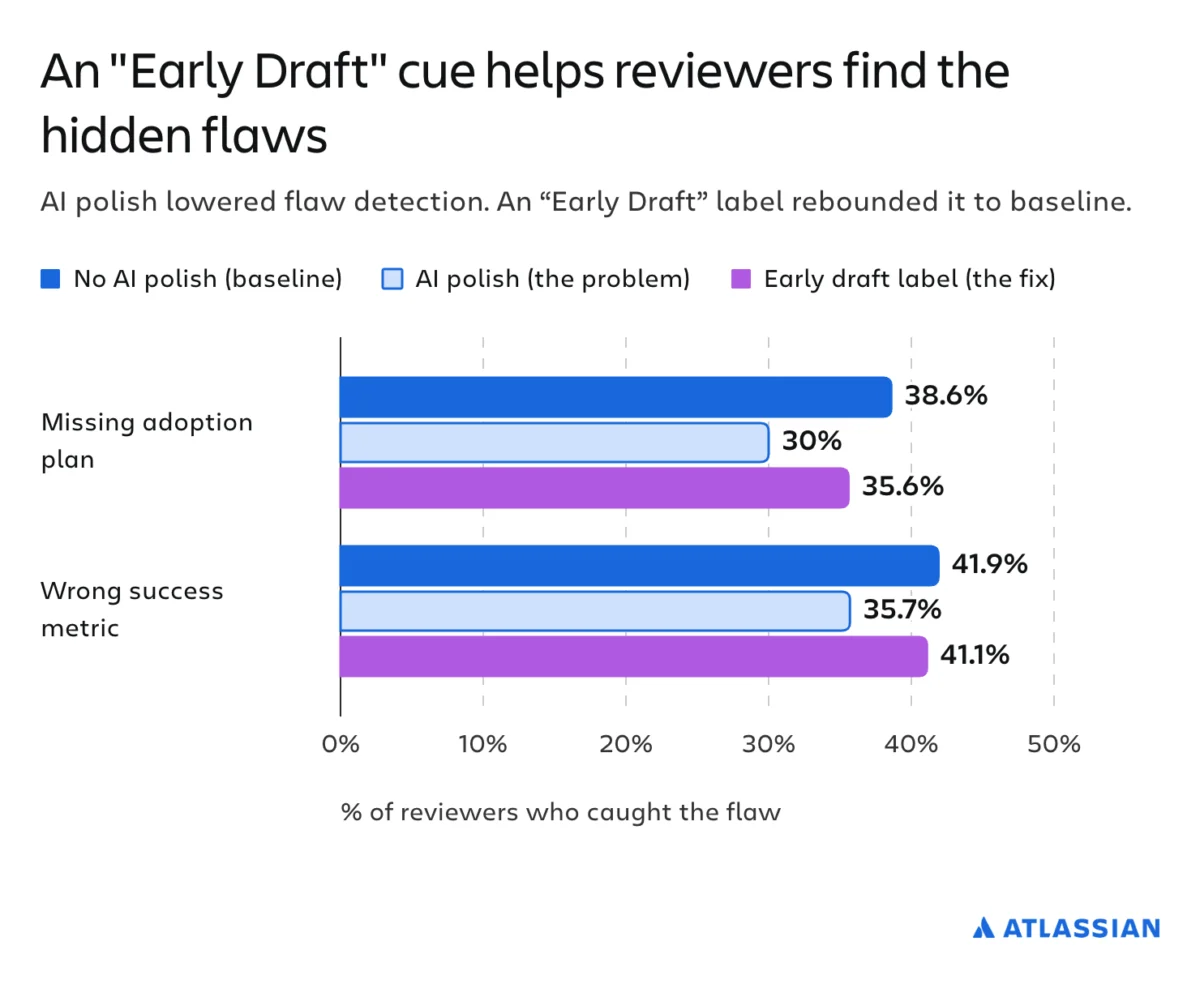
The findings revealed a consistent trend: AI-polished work is significantly harder to review effectively. Across the board, participants who reviewed the polished draft without a label were less likely to identify the two intentional flaws. The professional formatting and clear syntax of the AI-polished version acted as a powerful psychological signal that the work was nearing completion. This perception of "finality" caused reviewers to skim the content rather than engage in deep, critical analysis. Consequently, the very tool meant to improve communication quality ended up masking structural weaknesses that could lead to project failure.
However, the effects of AI polish were not entirely negative. The study found that polish serves as a strong indicator of "perceived effort." When a document looks professional, reviewers are more likely to believe the author has put in a high level of work. In the experiment, the colleague who sent the AI-polished draft was rated as having invested more effort than the colleague who sent the unpolished, raw version. This creates a professional dilemma: while unpolished drafts invite better feedback, they can inadvertently signal a lack of effort or professionalism to the team.
The most significant discovery from the Teamwork Lab research was the effectiveness of a simple "Early Draft" label. When the AI-polished draft was paired with a clear warning cue—"Status: Early Draft"—the negative effects of the polish were almost entirely negated. Reviewers who saw this label were alerted to the fact that despite the document’s professional appearance, the content was still in its formative stages. This simple intervention restored the reviewers’ critical focus, allowing them to spot the missing adoption strategy and the flawed success metrics at rates similar to those who reviewed the unpolished version.
Crucially, the "Early Draft" label did not diminish the author’s perceived effort. Reviewers still credited the writer for the professional quality of the document, but they did not mistake that quality for finality. This suggests a "best of both worlds" approach for modern professionals: employees can use AI to clean up their notes and present a professional image, provided they are transparent about the document’s stage of development. By explicitly labeling a polished document as an early draft and requesting critique, authors can maintain their professional reputation while still receiving the rigorous feedback required for high-quality outcomes.
The study also highlighted significant demographic differences in how AI polish is perceived. Perhaps most notably, older employees (Gen X and above) and those in management or leadership positions appeared to be largely immune to the "AI polish effect." Their professional experience and history of reviewing documents seemed to act as a "firewall," allowing them to identify the fundamental flaws regardless of whether the document was polished or raw. In contrast, Gen Z and Millennial employees—who are often more comfortable with AI tools—were more susceptible to being misled by the professional veneer of the polished drafts. This suggests that while younger workers may be faster at adopting AI, they may also be more vulnerable to the psychological biases it introduces.
From an organizational standpoint, these findings have broad implications for workflow and team culture. As AI becomes a standard digital copyeditor, the traditional signals of "work in progress" are disappearing. In the past, a manager could tell a document was in its early stages just by looking at it; today, every draft can look like a final report. This shift necessitates a new set of digital etiquette rules. The Teamwork Lab suggests that labeling early drafts should become a standard workflow addition to prevent serious problems from being overlooked until it is too late.
The "bottom line" for knowledge workers is a matter of strategic communication. If the goal is to receive meaningful, deep critique on a complex idea, sending an unpolished version may actually be more efficient, as it signals to the reader that the "foundation" is still being built. However, if a professional appearance is necessary to maintain credibility or if the author is only seeking a quick review, AI polish is a valuable tool. In the latter case, the inclusion of an "Early Draft" label is essential to ensure that the professional veneer does not come at the expense of accuracy and critical thinking.
The research concludes that while generative AI tools are powerful allies in the writing process, they must be used judiciously. The "polish" they provide is a double-edged sword that can enhance an individual’s professional image while simultaneously degrading the collective quality of a team’s output. By understanding the psychological signals of AI polish and implementing simple fixes like status labeling, teams can harness the benefits of AI without falling into the trap of superficial excellence. As Morgan Weaving, Senior Workplace Researcher at Atlassian’s Teamwork Lab, noted, the fix is easy: "Polish your draft, then tell people it’s early. You get the credit for the effort without losing the chance for meaningful feedback."