11

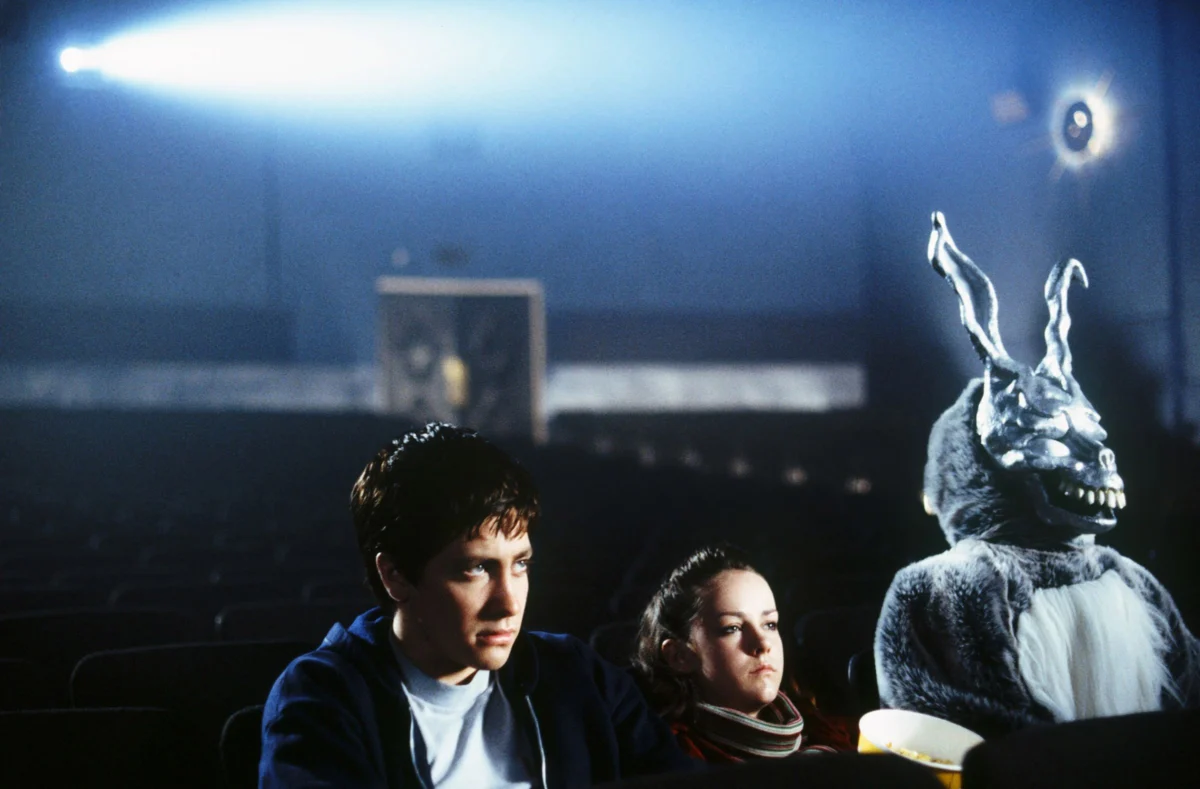
For a diehard fan of Richard Kelly’s seminal film Donnie Darko, the mere prospect of meeting its director and screenwriter is a profound experience. To first encounter him not in a brightly lit room but as a compelling silhouette in the hushed expanse of a darkened movie theater evokes an almost Lynchian sense of disorientation, akin to becoming a character unmoored by indefinite space and physics within one of his own enigmatic narratives, prompting an altered perception of reality.
The setting for this introspective conversation was Santa Monica’s historic Aero Theatre on a sweltering Friday in mid-August. Kelly, now 51, chose the beloved repertory venue for its deep connection to Donnie Darko, a location that notably features in his remarkable debut feature. Released in October 2001, Donnie Darko faced an uphill battle for recognition. Its marketing campaign was virtually nonexistent, overshadowed by the tragic events of 9/11 that occurred just weeks prior – a poignant irony given the film’s plot, which intricately hinges on a plane accident. Consequently, the movie struggled to gain traction at the box office. However, its fortunes dramatically shifted in the months and years that followed, as it found a vibrant second life on the home video market, gradually accumulating a fervent cult following drawn to its unique blend of supernatural mystery, psychological depth, and unsettling suburban malaise.
In a significant milestone, Donnie Darko is set to enjoy another limited theatrical run, commencing on October 2. This date is deeply symbolic, marking the in-film launch of mentally disturbed suburban teenager Donnie Darko (portrayed by Jake Gyllenhaal) on a surreal journey that blurs the lines between reality and hallucination, possibly leading to the end of the world. Kelly recently completed recording an introduction for the new 4K restoration, snippets of which played silently on the big screen, a ghostly backdrop to his reflections.
With a wry smile, Kelly alluded to the film’s infamous pop psychology, joking, "My memories of this film run the entire spectrum from fear to love." He quickly clarified that this particular occasion was unequivocally about the "love," expressing profound gratitude to "all the people who have continued to support" his distinctive work over the past quarter-century.
Fans of Kelly’s intricate storytelling have even more to anticipate. On December 15, he is slated to publish his colossal first novel, The Philosophy of Time Travel, which is currently available for preorder. This ambitious 800-page volume is designed to pick up directly where the original movie concluded, serving not only as a literary expansion of the Donnie Darko universe but also as a foundational narrative intended to set the stage for a potential film sequel. Kelly articulated his satisfaction, stating, "It’s been very inspiring for me to remain focused on continuing the journey that began 25 years ago, on my own creative terms. This film has defined my entire career, but at the same time, it’s set a benchmark in the sense of the movies that I want to continue to make." Through this novel, the auteur revisits the unforgettable dreamscape that initially propelled him onto the cinematic map, while simultaneously considering the myriad artistic possibilities that lie ahead.
On When Donnie Darko Became a Cult Hit:
Kelly pinpointed a specific moment in March 2002 when the film’s burgeoning cult status became undeniable. While walking through New York City’s East Village, he noticed a Donnie Darko poster hanging prominently in the window of a pizza restaurant called Two Boots. Intrigued by this unusual sight, he inquired within. The manager explained that the restaurant housed a small theater, The Pioneer, where Donnie Darko was being screened every Saturday night at midnight, consistently selling out. "I was like, ‘What’s going on? This is bizarre. Why does a pizza restaurant have a movie poster?’" Kelly recalled. "I went inside and I asked the manager, and he said, ‘Well, we have a little theater in the back, the Pioneer, and we’re playing your movie every Saturday night at midnight—and it’s selling out.’"
Skeptical, Kelly decided to attend the following Saturday. Arriving around two in the morning as the film concluded, he expected a sparse audience of perhaps ten people. Instead, he found a packed house, a testament to the manager’s claim. The scene was surreal: "there were people with camcorders and lights in my face, and Michael Musto from the Village Voice was there." This overwhelming reception completely "bowled [him] over." It was then he realized that "there were people who cared, who were really, really connecting with the movie. That was the moment I knew that it wasn’t over, that the movie was going to have a second wind."
On How Drew Barrymore and Jason Schwartzman Saved the Screenplay from Hollywood Purgatory:
The journey of Donnie Darko from script to screen was fraught with challenges, a tale Kelly attributes significantly to key early attachments. "It all started with Jason Schwartzman," Kelly explained. Schwartzman’s initial attachment to play Donnie proved instrumental, propelling the script into a new round of industry consideration. For about a year prior, the screenplay had languished, circulating with the prevailing industry whispers: "Oh, the writer won’t sell it. He wants to direct. It’s his first movie, it’s too ambitious. It’s just a writing sample, he’s never gonna get that movie made. He won’t let anyone else take it away from him."
However, the script eventually found its way to Nancy Juvonen, Drew Barrymore’s partner at Flower Films. Juvonen "read it and flipped out and wanted to meet me," Kelly recounted. Their meeting took place on the set of Charlie’s Angels, where Barrymore was filming. "We went into Drew Barrymore’s trailer, and she was finishing the script, and we just immediately hit it off." In a pivotal moment, Kelly asked Barrymore, "Drew, would you like to play the English teacher, Mrs. Pomeroy?" Her response was equally direct: "Will you let my company, Flower Films, produce the movie with you?" Kelly readily agreed. With Barrymore committed, a tight production window emerged: a single week in August 2000 before she was scheduled to begin filming Penny Marshall’s Riding in Cars with Boys. The team had to meet this strict deadline to shoot Barrymore’s scenes. Ultimately, Jason Schwartzman faced a scheduling conflict, opening the door for Jake Gyllenhaal to step into the role of Donnie. Kelly credits Nancy Juvonen, Drew Barrymore, and Jason Schwartzman for their crucial roles: "Nancy and Drew really deserve an enormous share of the credit in getting this whole thing off the ground—and Jason Schwartzman, too. Had he not attached, I would not have a career."
On Having Real-Life Siblings Jake and Maggie Gyllenhaal Anchor a Fictional On-Screen Family:
The casting of Jake Gyllenhaal as Donnie and his real-life sister Maggie Gyllenhaal as his on-screen sibling, Elizabeth, was a stroke of genius that significantly enhanced the film’s familial authenticity. Kelly learned of Maggie through his "wonderful casting directors," Joseph Middleton and Michelle Morris Gertz, who informed him that "Jake has an older sister, her name is Maggie Gyllenhaal, and she’s a brilliant actress." At that point, Maggie had only one film credit, a small cameo in John Waters’ Cecil B. Demented, but she boasted extensive theater experience and was clearly an immense talent, much like her brother. Kelly instantly recognized the potential synergy: "once I realized there was a possibility of getting her, I was just like, ‘We have to get Maggie. It will anchor the family with real siblings, and Maggie will be this great foundation for Jake, and for the whole cast, and she was just so essential.’" He reflected on the serendipitous nature of filmmaking, where "sometimes the cards are dealt in your favor in terms of who’s available, who is interested, and so much of filmmaking is just the timing. It’s a miracle that any movie gets made."
On Giving Seth Rogen His First Film Role (as a High School Bully):
Donnie Darko also notably marked the film debut of Seth Rogen, who played one of the high school bullies. Kelly recalled Rogen’s impressive early career trajectory, noting that he had already appeared in Freaks and Geeks and was performing as a standup comedian in comedy clubs. "Seth was one of these prodigy kids, really wise beyond his years and ahead of the game," Kelly remarked. At approximately 19 years old during the shoot—the same age as Jake Gyllenhaal—Rogen was "incredibly observant, very articulate and funny young actor and writer and comedian," already pursuing multiple creative avenues. Kelly attributed their access to such talented young actors to the timing of the shoot: "We shot in Los Angeles, it was the summer of 2000, and there was a commercial [actors] strike where all of the commercials were dark," allowing many "cool LA kid actors" to be available for film projects.
On Creating the 1980s Setting of Donnie Darko:
Crafting the 1980s setting for Donnie Darko presented a unique challenge, given the relatively short span of time between the film’s production and its depicted era. "When we were doing the ‘80s, it was the year 2000, and we were capturing 1988, which is completely insane," Kelly observed. "That’s 12 years." To illustrate the aesthetic shift, he drew a contemporary parallel: "So you subtract 12 years from 2026 and we are in 2014, which seems completely insane to do a period piece about 2014, because things don’t look that different than they did in 2014—but the disparity between 2000 and 1988 aesthetically was pretty significant. The cars looked completely different, the TVs looked different, the clothing looked different."
Kelly and his team aimed for a subtle, authentic representation of the era, deliberately avoiding overt kitsch. "In terms of the ‘80s aesthetic, we wanted it to feel subtle, we didn’t want a lot of big ‘80s hair, and we didn’t want someone wearing a ‘Beat It’ Michael Jackson jacket," he explained. "We didn’t want it to be kitschy." He lauded the contributions of their "incredible, Oscar-nominated costume designer," April Ferry, who passed away a few years ago. Ferry was "so wonderful in bringing the ‘80s fashion for Mary McDonnell and Beth Grant—you see them with the shoulder pads and the different ‘80s suburban costuming," capturing the era’s everyday look rather than its flamboyant extremes.
On the Movie Reference from His Original Script That Didn’t Make It to the Screen:
A memorable scene in Donnie Darko features Donnie and Gretchen at a movie theater, watching Sam Raimi’s The Evil Dead. However, this wasn’t Kelly’s initial choice. "In the original script, Donnie and Gretchen went to go see C.H.U.D., just because I thought it was a funny ‘80s horror movie," Kelly revealed. The plan hit a roadblock when Linda McDonough, an executive at Flower Films, attempted to secure licensing permission for C.H.U.D. as the shoot date for the Aero Theatre scene loomed. She was "getting nowhere" with "one of the big studios," encountering a licensing representative who was adamant: "You’re never getting this." Despite C.H.U.D. being a relatively obscure horror film, the studio demanded an exorbitant sum.
With only "three days from shooting the scene, and we didn’t have a movie to show," a solution emerged from an unexpected quarter. "Linda, to her enormous credit, said, ‘Richard, I am friends with the producers at the studio that owns The Evil Dead, they own the negative. Sam Raimi is a great guy, and they will let us have the poster to show at the front in the lobby of the theater. They’ll let you show any clip from The Evil Dead you want, the music, you can have it basically for free.’" Kelly described this as a "deus ex machina in the form of Sam Raimi," which serendipitously led to the iconic Evil Dead sequence in the movie, proving to be "so perfect." The team then found it "an easier ask" to feature The Last Temptation of Christ on the marquee, as they only needed to display the title, not clips or posters from the Scorsese film.
On the Influential Soundtrack of Post-Punk and New Wave Music:
The soundtrack of Donnie Darko, renowned for its evocative blend of post-punk and new wave tracks, played a crucial role in establishing the film’s unique atmosphere. Kelly admitted his initial approach to music selection was straightforward: "I wasn’t thinking that deep. I was just like, ‘I love this song.’" He cited Tears for Fears’ "Head Over Heels" as a prime example, a song he meticulously wrote into the script. "I knew that when Donnie and his friends jump out of the school bus, when Donnie’s feet hit the pavement, that first big piano note of ‘Head Over Heels’ starts. When the camera flies through the window and you see all the kids sitting down and Drew Barrymore gathering the class together… ‘Time flies.’ I had to get from the feet hitting the pavement to when they said, ‘Time flies,’ and I had to edit the song down. It was just me doing a music video and loving that song and the vibe and the energy of it."
Kelly extended "enormous amount of credit" to his music supervisors, Manish Raval and Tom Wolfe, who "really expanded the canvas of the music in the movie to include Joy Division and Echo and the Bunnymen. It really did form a cohesive musical narrative." They were particularly fortunate, he noted, because "no one was really trying to license a lot of that music in the year 2000." However, not all musical aspirations were realized. The original choreography for the Sparkle Motion dance scene was set to a Pet Shop Boys track, but "that was a no-go, we could not afford it, so we replaced it with Duran Duran."
On the Dialogue That Has Had a Surprising Impact:
Among the film’s memorable lines, one in particular has achieved unexpected cult status: "Sometimes I doubt your commitment to Sparkle Motion," delivered by actor Beth Grant with perfect suburban exasperation. Kelly expressed his amusement at its enduring popularity: "It’s so ridiculous. You never know it’s gonna connect. Literally that’s gonna be in my obituary, that line of dialogue, the only thing people remember that I wrote. Beth Grant is the best."
On What the Social Media Reaction Would Be Like If Donnie Darko Came Out Today:
Considering the modern landscape of online discourse, Kelly pondered how Donnie Darko might be received if released today. "I can’t even wrap my head around it," he admitted. He views online discussion as "terrifying" and something he tries to "stay away from," believing that "any filmmaker that gets too caught up in online discourse, that can only have a negative impact on one’s art." He stressed the importance of artistic autonomy: "You have to be cognizant of what’s going on in the world, but I think you need to curate your own art as the artist. We need more of that, art that is purely what the artist wants to say."
Despite his reservations about social media, Kelly expressed optimism about evolving audience habits: "But I’m emboldened and excited about the younger generation going back to the theaters and reading books." He highlighted the immense effort involved in writing his novel, The Philosophy of Time Travel: "Launching a book, the enormous amount of work that’s gone into writing a novel—it’s very gratifying to get to the finish line on something like that because you realize how a novel can help be the engine for something that is very difficult to get made because of the budget."
On the Newer Films and Filmmakers to Catch His Eye:
When asked about contemporary cinema, Kelly mentioned several works and creators that have captured his attention. "Like everyone else, I saw Obsession," he stated, adding, "I thought it was terrific. Incredibly well done for such a small budget. The performances were great." He also expressed admiration for the work of "Ari Aster’s work" and "Jane Schoenbrun’s work." He noted, "I’ve not seen [Sex and Death at] Camp Miasma, that’s next on my list."
On the Movie He Most Wants to Make (Besides a Sequel to Donnie Darko):
Beyond the ongoing saga of Donnie Darko, Kelly has a deeply personal and ambitious project he yearns to bring to the screen: a Rod Serling biopic. He lamented the many scripts he’s written and projects that have encountered "roadblocks for various reasons." The Serling film, however, holds particular significance. "I would love to get my Rod Serling biopic made," he shared. "That is a very ambitious project that tells the life story of Rod Serling using a fantasy and science-fiction language, in conjunction with his daughter Anne Serling and her memoir about her father."
Kelly acknowledged the substantial challenges inherent in such a film, particularly its financial demands. "It’s an expensive movie to make, given the fantasy elements and the period elements and the scope." He cited a diverse array of cinematic influences that inform his vision for the project, including "Rod Serling biopic, they would be Defending Your Life, the Albert Brooks film, A Matter of Life and Death by Powell and Pressberger, and All That Jazz by Bob Fosse," suggesting a film that blends the fantastical with poignant biographical introspection.