 11

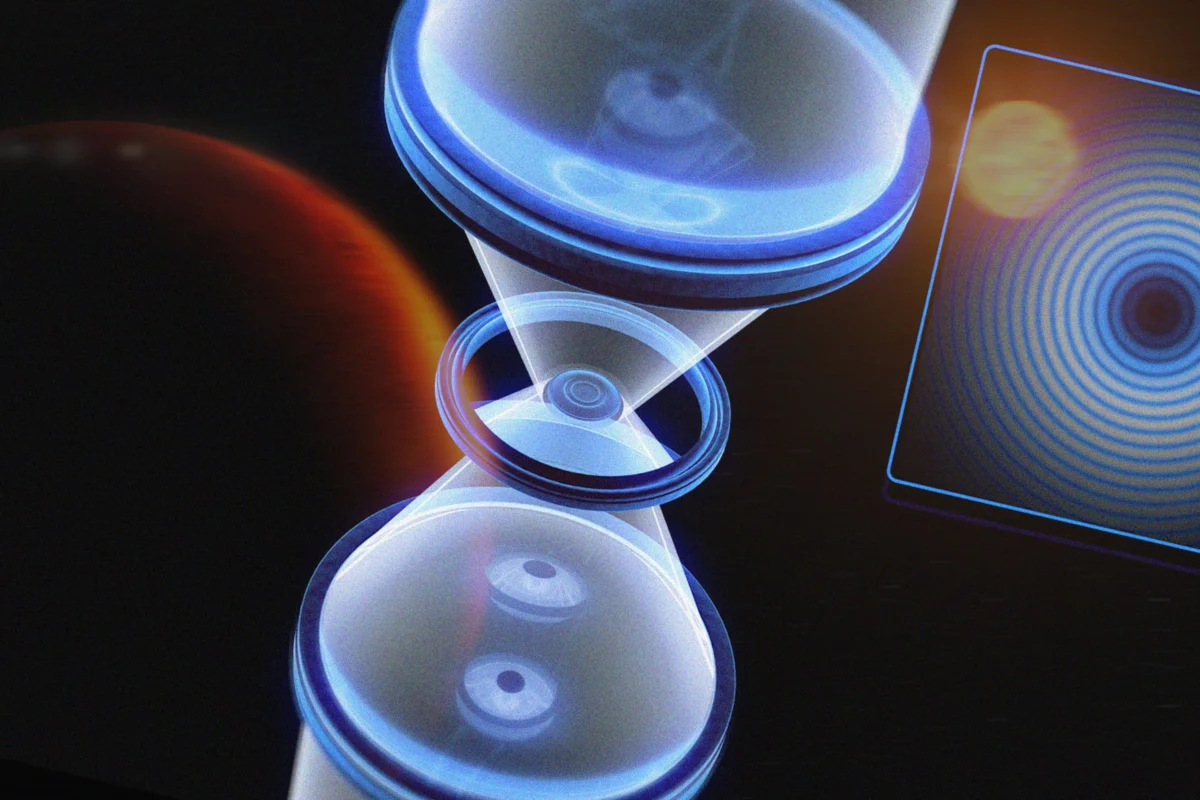
Two mirrors, each small enough to fit in the palm of your hand, are poised to fundamentally alter humanity’s understanding of the cosmos. These aren’t just any mirrors; they are at the heart of an experimental instrument aboard NASA’s forthcoming Nancy Grace Roman Space Telescope, an observatory designed to push the boundaries of astrophysical discovery. While the Roman Telescope’s primary mission is to explore dark energy, dark matter, and conduct wide-field infrared surveys that will inform virtually every area of astrophysics, it also carries a specialized coronagraph. This cutting-edge apparatus represents a monumental leap in the quest to directly image exoplanets, aiming to capture starlight reflected off a planet’s surface for the very first time.
The ambitious project is a critical precursor, designed by NASA to lay the groundwork for a future generation of space telescopes. These successors could one day offer an unprecedented glimpse of an Earth-like planet orbiting a Sun-like star, a feat currently far beyond the capabilities of existing engineering. "We’ll test them in space for the first time, and we’ll understand what work still is left to go," explains Vanessa Bailey, an astrophysicist at NASA’s Jet Propulsion Laboratory and the instrument scientist for the Roman coronagraph. This initial deployment on Roman is essentially a high-stakes test run for a technology that could redefine exoplanet research.
At its most fundamental level, a coronagraph functions as a sophisticated sunshade, meticulously engineered to block out the overwhelming glare of a bright star, thereby revealing much fainter objects that would otherwise be lost in its brilliance. While coronagraphs have previously flown in space—both the venerable Hubble Space Telescope and the revolutionary James Webb Space Telescope are equipped with them—Roman’s version represents a significant evolutionary leap. It is "light-years more sophisticated than its predecessors," according to experts, primarily due to the incorporation of advanced technology known as adaptive optics.
Adaptive optics works by actively deforming a telescope’s mirror to counteract and cancel out light distortions. This innovative approach is standard on advanced ground-based telescopes, such as the Very Large Telescope (VLT) in Chile and the twin Keck Observatory in Hawaii. On Earth, adaptive optics systems continuously monitor the interference caused by our planet’s thick, shifting atmospheric layers, which inevitably muddy starlight. By rapidly adjusting the mirror’s shape in response to these atmospheric turbulences, ground observatories can capture images with a sharpness that rivals, and sometimes even surpasses, those taken from space.
Traditionally, space telescopes have not required adaptive optics because they operate beyond the distorting effects of Earth’s atmosphere. However, the unprecedented challenge of directly imaging exoplanets—particularly older, cooler planets illuminated solely by reflected starlight—demands a level of precision that even the vacuum of space cannot guarantee on its own. The sheer contrast between a star’s luminosity and the faint light reflected by an orbiting planet is staggering. NASA likens the task facing Roman’s coronagraph to attempting to photograph a firefly perched next to a floodlight from across an entire country. The light from the star can be billions of times brighter than the light from its planet.
"Any little bit of starlight that gets in the wrong place could just destroy a whole portion of the image," warns Margaret Turnbull, an exoplanet scientist at the SETI Institute, a nonprofit research organization in California, who leads a Roman coronagraph science team. This extreme sensitivity necessitates an instrument of unparalleled accuracy.
The ingenuity of Roman’s coronagraph lies in those two palm-sized mirrors. Each mirror is not a static piece of glass but a dynamic surface rigged with approximately 2,300 tiny actuators. These actuators are piezoelectric devices that expand or contract when a small electrical charge is applied. By precisely controlling these individual actuators, the mirror’s surface can be infinitesimally reshaped in real-time, effectively reversing the distortions in the incoming starlight wavefront. This marks the first time NASA has ever flown active deformable mirrors of this kind in space, pioneering a technology that is crucial for the future of direct exoplanet imaging.
However, these deformable mirrors, impressive as they are, cannot operate in isolation. The entire system requires supersensitive detectors capable of amplifying the signal from individual photons. This is an absolute necessity, given the incredibly small number of photons that the instrument will manage to capture from any distant exoplanet. Furthermore, at the heart of any coronagraph are its star shades—the physical masks designed to block starlight. In Roman’s case, these are not the simple, "brute force" pieces of metal used by older telescopes like Hubble. Instead, Roman employs a set of exquisitely detailed and intricately shaped masks. Bruce Macintosh, an astronomer who leads the University of California Observatories and is part of a Roman coronagraph science team, describes them as "beautiful, complicated shapes," unlike anything currently in space. These complex designs leverage principles of diffraction to more effectively cancel out starlight, creating a deeper and cleaner "dark hole" where faint planets can be observed.
During the Roman coronagraph’s operational phase, engineers will meticulously gather vast amounts of test data. This information will be crucial for evaluating its performance in the space environment, identifying any unforeseen problems, and informing design improvements before similar technology is deployed again. Scientists will also put the coronagraph through its paces by attempting to spot a handful of known exoplanets. "If we go through the whole thing and we don’t see them, then we know something is wrong with the coronagraph, because those planets are there," Turnbull affirms.
Beyond known targets, the instrument will also observe several stars that are surrounded by clouds of dust or debris. These observations could reveal subtle gaps within these circumstellar disks—evidence of nascent or orbiting planets that current methods cannot yet directly detect. This research promises to offer scientists a completely new perspective on how common or cluttered our own solar system’s level of debris might be, providing valuable context for planetary system formation.
The insights gained from Roman’s coronagraph will be instrumental in shaping the development of future telescopes aimed at detecting ever-smaller exoplanets, including the elusive Earth-sized worlds. One such ambitious project is the Habitable Worlds Observatory, which NASA hopes to launch possibly in the 2040s. This observatory will require a coronagraph up to 100 times more effective than Roman’s. Moreover, a coronagraph equipped with adaptive optics and nearly as sensitive as Roman’s is also slated to fly on the planned Lazuli Space Observatory, an initiative announced in January by ex-Google CEO Eric Schmidt’s research institution.
While the prospect of directly seeing alien worlds, potentially even habitable ones, remains the most tantalizing application, coronagraphs have broader utility. They could someday enable astronomers to resolve close binary stars that currently appear as a single point of light, or to study objects hiding near the incredibly bright cores of quasars.
Roman represents a critical, foundational step toward this exciting future of exoplanetary exploration. The scientific marvels it may unveil along the way will undoubtedly bolster the case for continued investment in these advanced technologies, as Julie McEnery, an astrophysicist at NASA’s Goddard Space Flight Center in Maryland and senior project scientist for Roman, aptly summarizes: "Obviously, the best way of demonstrating that something works is to do something interesting scientifically." The data and discoveries from Roman’s groundbreaking coronagraph will illuminate the path forward, bringing humanity closer to answering one of its most profound questions: Are we alone in the universe?






