11

The marketing landscape has undergone a transformation more profound in the past year than in the preceding decade. This seismic shift is driven by the advent of generative artificial intelligence, a force reshaping marketing practices with the same disruptive power that the internet once wielded. The buyer’s journey is now fundamentally different, with consumers increasingly relying on AI tools for research and even purchasing, bypassing traditional search engine results pages. Concurrently, the tools and methodologies employed in marketing are evolving rapidly, as AI enables the generation, construction, and automation of numerous tasks. This evolution is also leading to a redefinition of marketing roles, with new positions emerging and existing ones being reimagined.
These observations are not speculative but are grounded in firsthand experience and supported by tangible evidence, notably reflected in search interest. Trends in what terms people look up, the tools they are actively seeking, and the fluctuating demand in the market all indicate a significant reorganization of marketing around AI.
1. The Real-Time Invention of New Marketing Job Titles
The emergence of new channels and tools invariably leads to the creation of new roles. As the definition of "effective marketing" rapidly changes, so do the expectations placed upon marketing professionals, and consequently, job titles are being rewritten in real time. The common characteristics of these emerging roles involve an AI-native approach, the systematization of workflows, and a higher level of strategic thinking. A prime example is the evolution from content marketing to content engineering, where the focus shifts from individual article creation to designing the overarching systems that produce high-quality content.
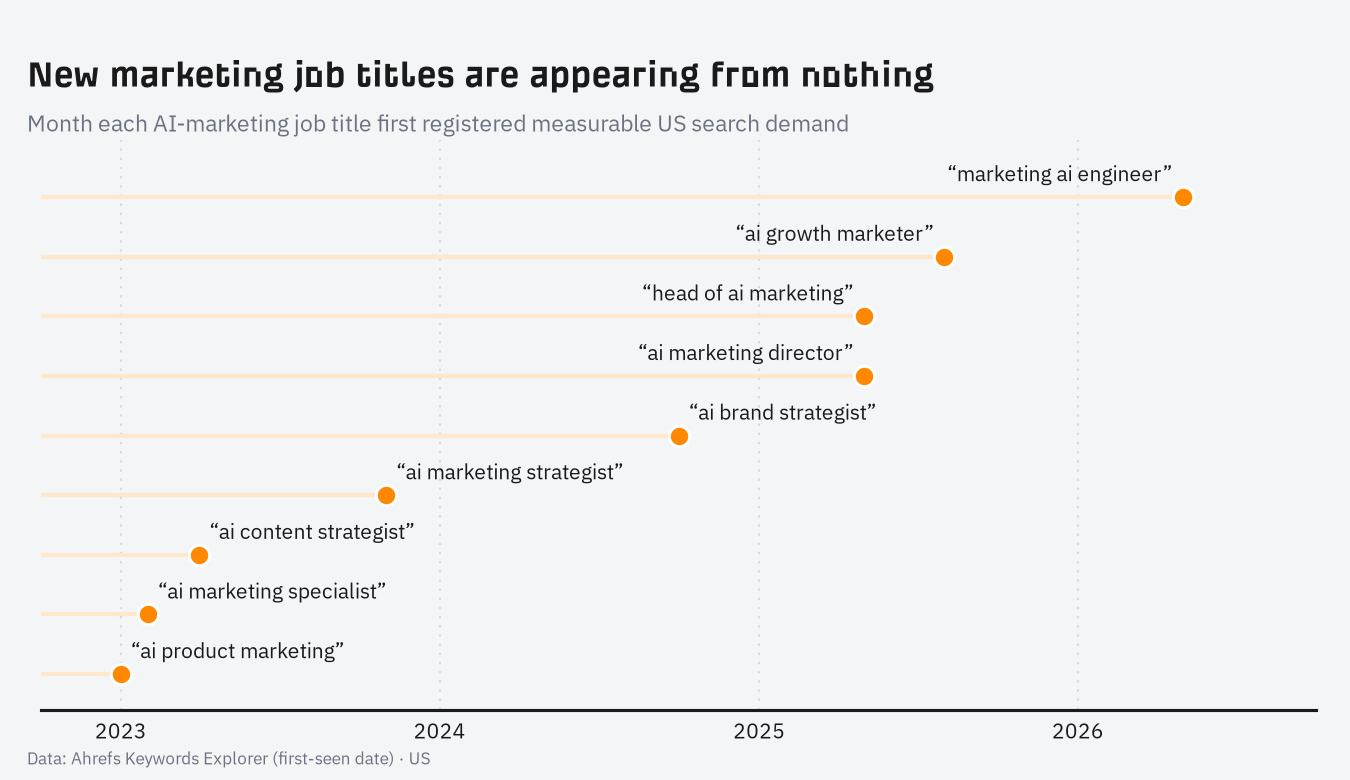
Search data illustrates this phenomenon clearly. Job title searches that were non-existent just a few years ago, such as ‘ai marketing director,’ ‘head of ai marketing,’ and ‘marketing ai engineer,’ began to register measurable demand between 2025 and 2026. While search volumes are currently modest due to the novelty of these roles, the vocabulary itself is materializing from thin air. Conversely, ‘prompt engineer,’ which was a prominent AI job title in 2023, is now being absorbed into other roles. While specific titles will continue to shift, the enduring need will be for marketers who can design and systematize their work at a more abstract level than direct production.
2. AI Content Generation Achieves Mainstream Adoption
AI content generation has officially entered the mainstream. After a period of quiet adoption and limited public discussion, it is now a standard component of most marketing teams’ operations. This widespread integration is attributed to two key developments. Firstly, the capabilities of AI tools have significantly improved. Advancements in skill files, agentic models, and supporting infrastructure now allow for the production of genuinely high-quality content rather than generic filler. Secondly, the perceived risks associated with AI-generated content have largely diminished. Google has publicly stated its acceptance of AI-generated content, and the primary concern has always been the publication of low-quality content at scale, an issue predating AI.
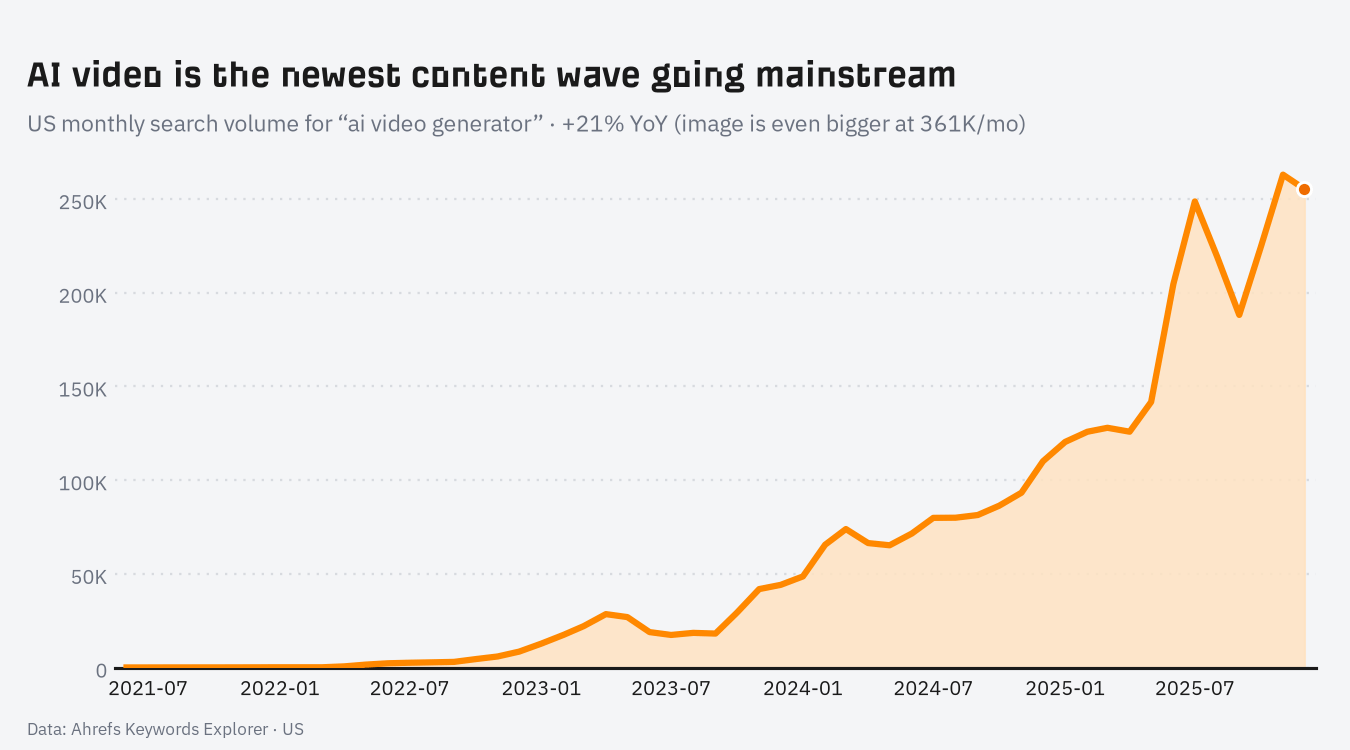
Research analyzing a million pages across 100,000 search results confirms this trend, finding AI-generated content ranking across the board, including in top positions, with fully AI-written pages appearing at number one. While there is a slight correlation between heavier AI use and marginally lower rankings, this appears to be a quality-driven effect rather than a direct penalty on AI itself. In essence, Google penalizes poor content, not AI-generated content per se. Consequently, AI generation is now a standard tool, extending beyond text to include image and video generation, which currently exhibits the highest search demand in this domain. Virtually every company is now employing some form of AI content generation; those that are not are becoming the exception.
3. A New Marketing Frontier: AI Visibility, GEO, and AEO
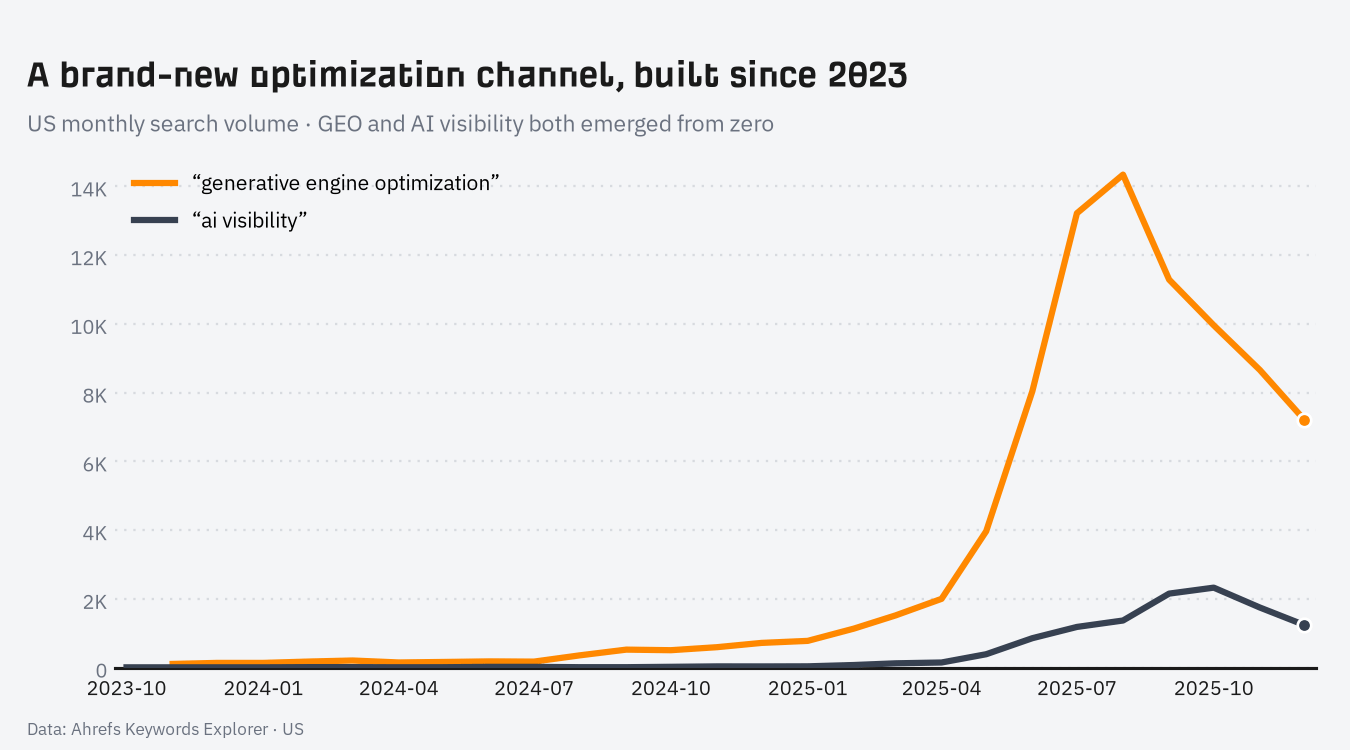
AI-powered search engines have become integral to web navigation, with many users now initiating their searches through platforms like ChatGPT or AI Overviews, bypassing traditional blue links. This shift has given rise to entirely new marketing channels focused on achieving visibility within these AI interfaces, a trend clearly reflected in search data. The emergence of new disciplines such as Generative Engine Optimization (GEO) and Answer Engine Optimization (AEO) signifies the growing importance of being cited and recommended within AI-generated answers. Searches for GEO have increased by 84% year-over-year, reaching 7,200 monthly searches, with related terms also experiencing upward trends.
Complementing these disciplines, an entire ecosystem of AI visibility tools has materialized, predominantly since 2025. Searches for ‘ai visibility tools’ have surged by 266% year-over-year, with ‘ai visibility tracker’ up 156%, and ‘ai visibility’ itself increasing by 145%. While some traditional channels may be experiencing declines, the more significant narrative is the opening of new avenues. The AI landscape remains largely uncharted, with widespread efforts to establish early and dominant visibility.
4. Agentic Everything: AI-Driven Actions in Marketing, Commerce, and Search
With the advancement of agentic harnesses, skill files, and increasingly sophisticated capabilities, AI agents are now demonstrably capable of researching and purchasing products on behalf of users, a feat that seemed futuristic just a year ago. Most major AI platforms now incorporate browsers that AI models can control, enabling them to navigate the web, compare options, and complete transactions autonomously. Websites are also adapting to accommodate these agents, much like they optimize for human visitors.
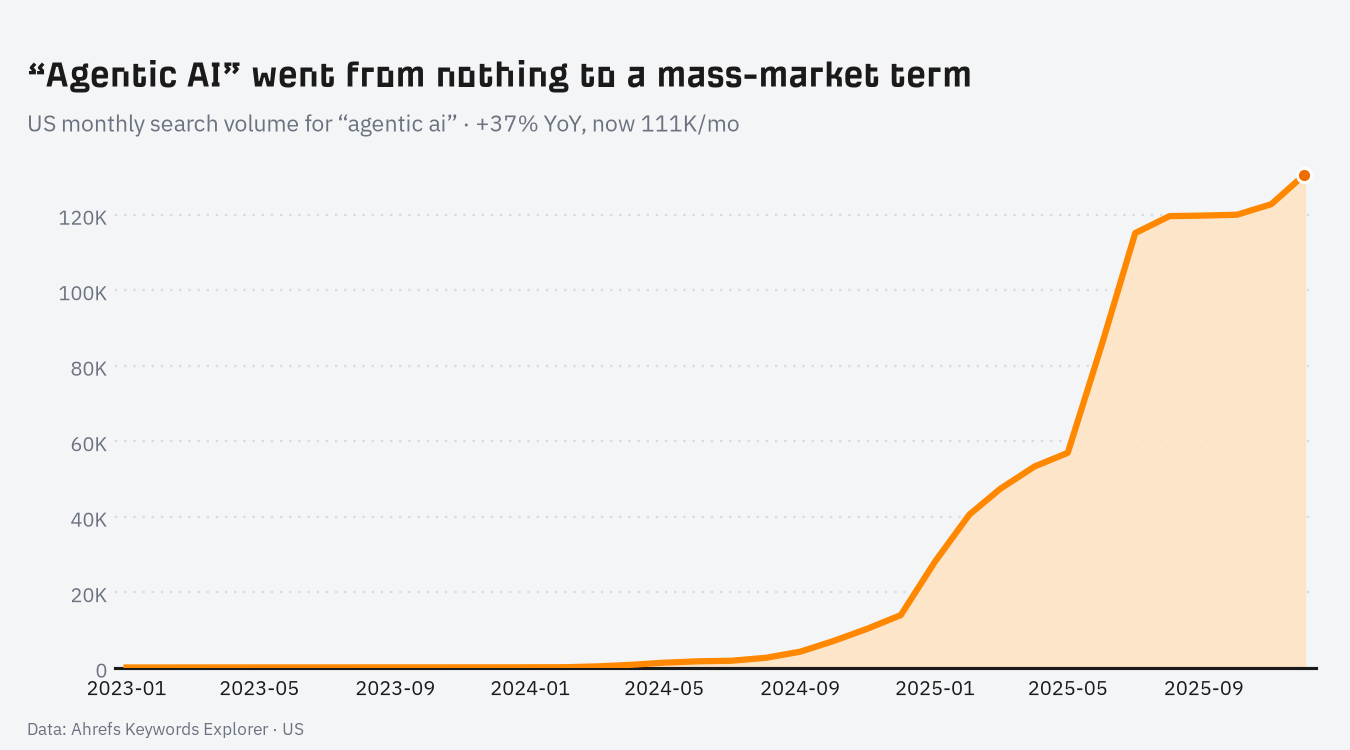
Search interest in this area is substantial, with ‘agentic ai’ registering 111,000 monthly searches, a 37% year-over-year increase, and ‘ai agents’ at 46,000 monthly searches. Agentic commerce is also experiencing growth. The specific field of marketing to agents is still nascent, with terms like ‘marketing to ai agents’ and ‘agent experience optimization’ only beginning to appear in 2025 and registering minimal search volume. This represents a new, largely unclaimed territory. The purchasing process is increasingly migrating into AI models, shifting away from direct human interaction. Marketers must now not only persuade consumers but also the agents that conduct research and make recommendations on their behalf, necessitating early preparation for this evolving dynamic.
5. The Democratization of Tool Building: Build vs. Buy Redefined
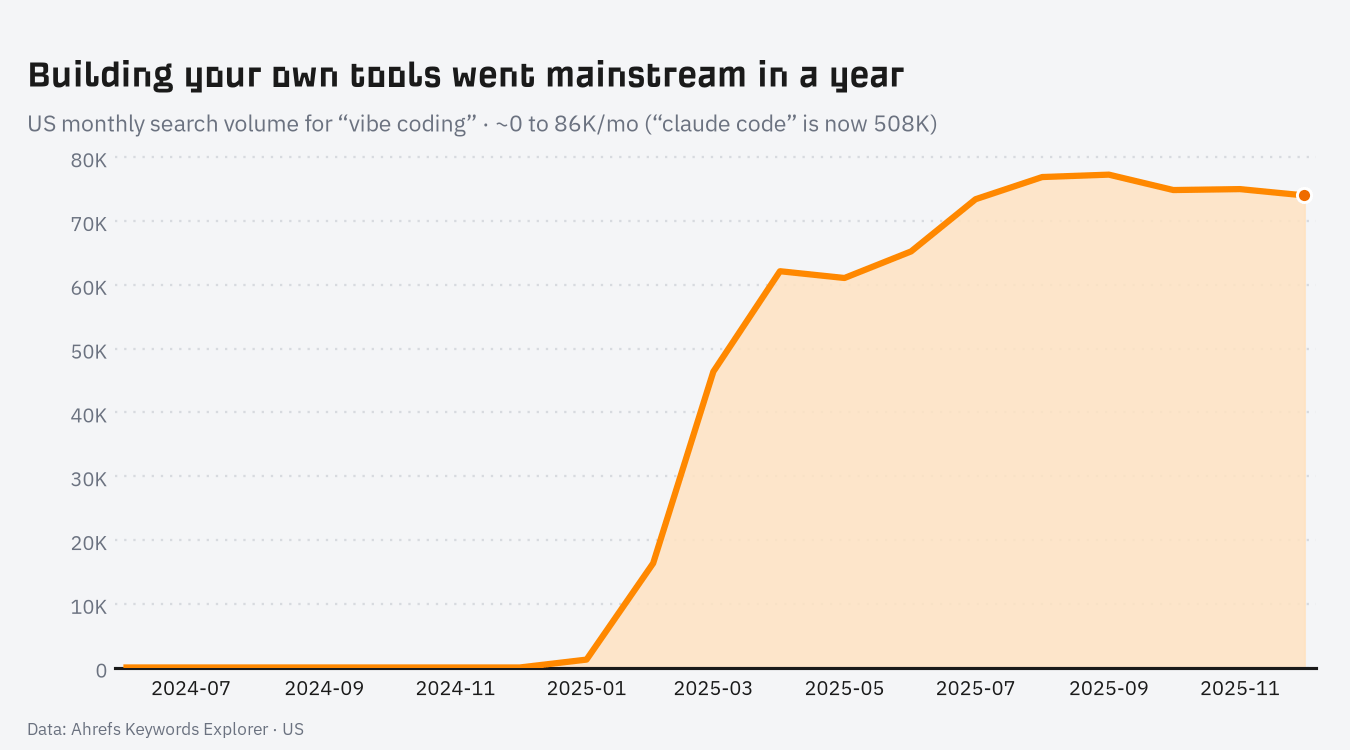
Businesses have perpetually faced the choice between purchasing existing solutions or building their own tools. Historically, building was often impractical due to the significant investment in developer time, ongoing maintenance, and support. However, this paradigm has shifted, making it remarkably accessible for individual marketers to create precisely the tools they need. Search data underscores this trend, with terms like ‘claude code’ (508,000 monthly searches), ‘vibe coding’ (86,000), ‘cursor ai’ (83,000), and ‘lovable’ (23,000, emerging in 2024) indicating a growing adoption beyond traditional developers.
This shift has direct implications for software vendors. When potential clients can develop functional versions of tools themselves in a short period, vendors must clearly articulate the unique value proposition and advantages their products offer over DIY solutions. The ability to integrate seamlessly with existing custom-built tools is becoming a critical differentiator and a new form of competitive advantage.
6. The Challenge of Attribution in an AI-Influenced Landscape
Marketing attribution has always presented challenges, even for channels perceived as highly measurable. The influence of AI further complicates this, as consumers increasingly engage with information and make purchasing decisions within AI environments without generating trackable clicks. Google’s AI Overviews, for instance, have been shown to reduce clicks to top-ranking results by an average of 58%. Similarly, platforms like ChatGPT process and deliver content directly to users, obscuring attribution.
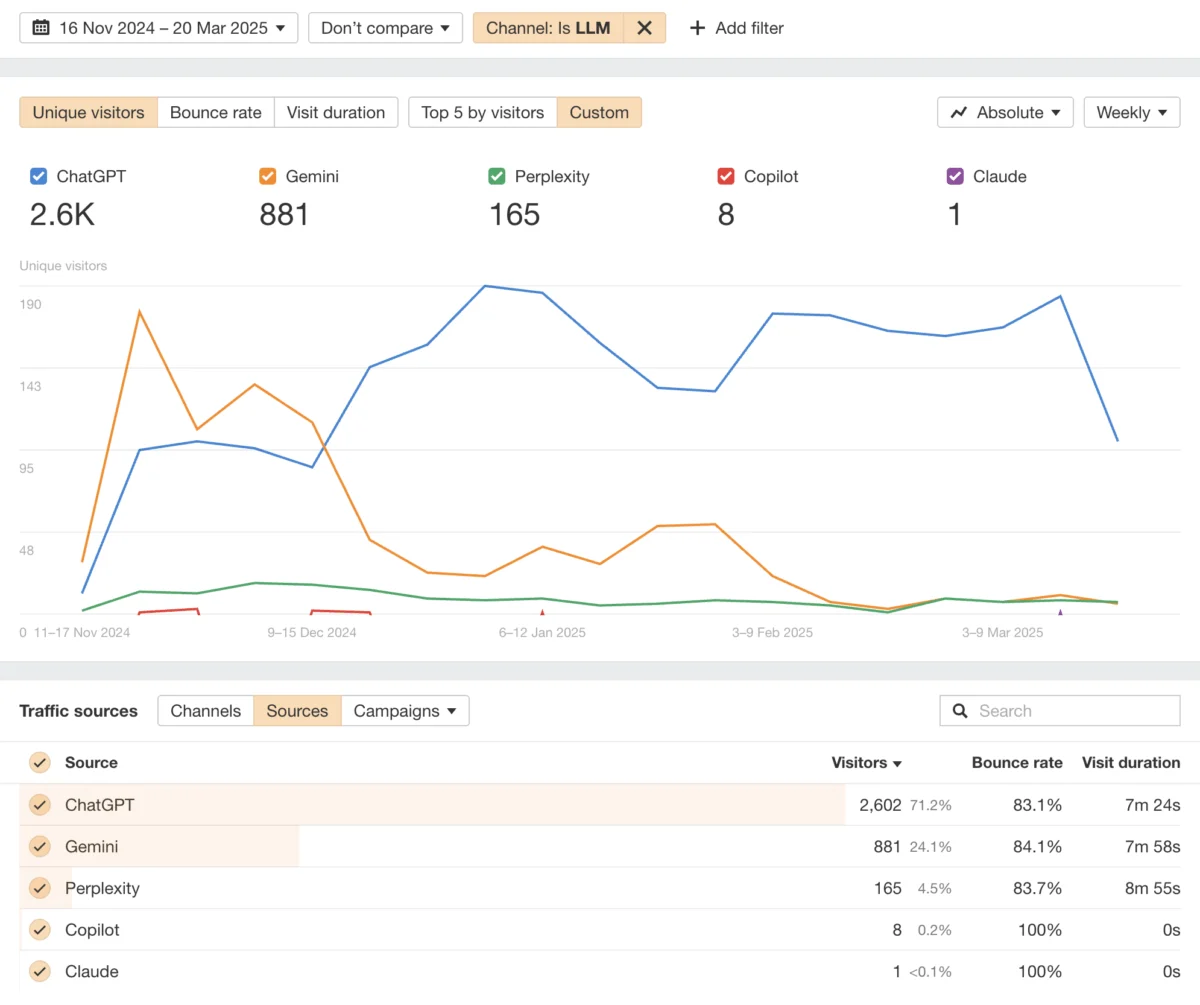
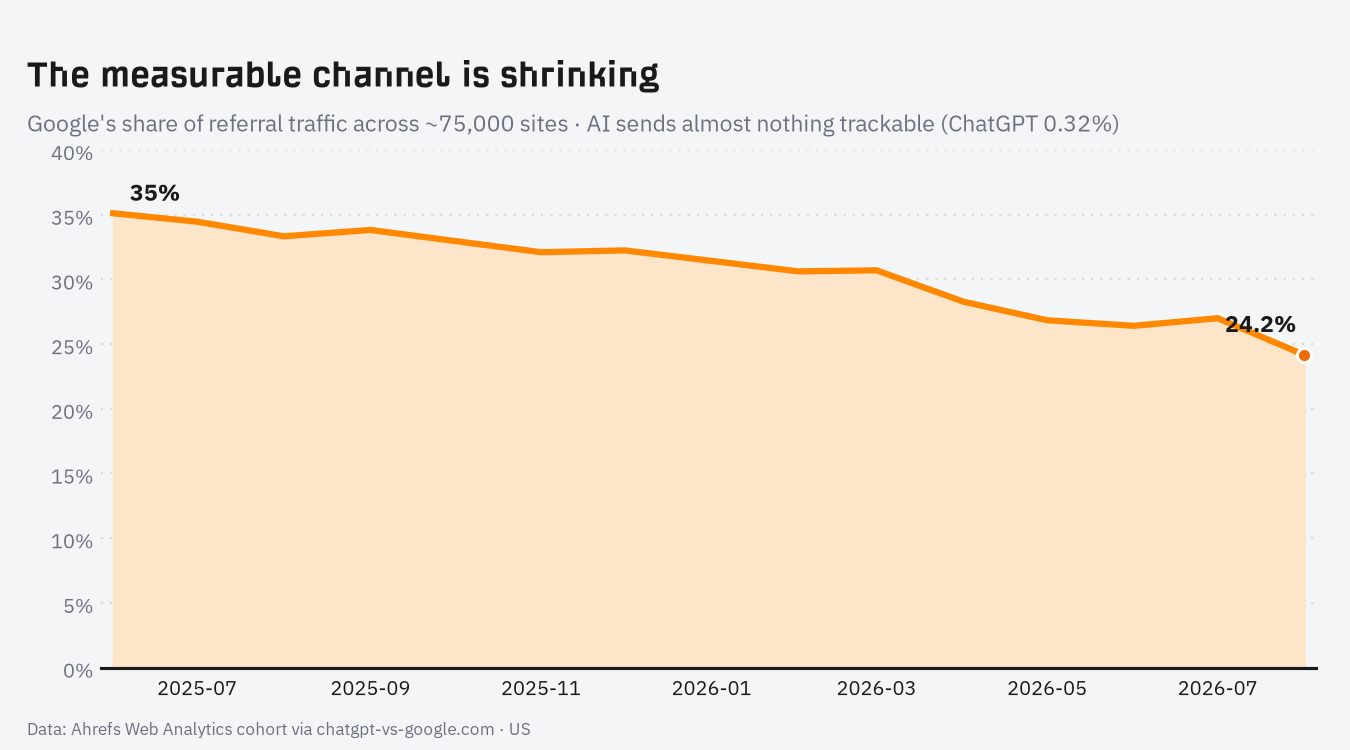
Analysis of approximately 75,000 websites indicates a decline in Google’s share of referral traffic from 35% to 24% over roughly a year, with AI tools contributing minimal measurable referral traffic. While consumer demand may be increasing due to AI-driven efficiency, traditional attribution models are becoming less reliable. Marketers must increasingly rely on their judgment and a holistic understanding of their marketing efforts, rather than solely on attribution dashboards. Tools like Ahrefs Web Analytics offer a privacy-friendly approach to regain some visibility, allowing for the tracking of traffic from LLM channels and identifying content that earns AI referrals.
7. AI-Native Tactics: Synthetic UGC, Avatars, and Influencers
A key marketing strategy involves identifying and leveraging channels with compounding growth and diminishing returns in other areas. Currently, AI-native tactics are emerging as significant tailwinds. Two prominent examples are AI influencers and AI-generated User-Generated Content (UGC). Brands are increasingly creating synthetic creators and user-style content at a minimal marginal cost, bypassing traditional creator fees. Search interest supports this trend, with ‘ai ugc’ up 36% year-over-year, ‘ai avatars’ up 13%, and ‘ai influencers’ up 12%. Although search volumes are still relatively low, the direction is clearly upward.
While the current execution of these tactics may appear rudimentary, the economic advantages are compelling. The ability to produce an endless stream of on-brand creative assets and a persistent brand persona at near-zero cost presents a powerful incentive for performance-driven teams. Experimenting with these AI-native tactics is advisable before they become commonplace.
8. Cross-Functional Collaboration Intensifies as AI Blurs Departmental Lines
Generative AI is subtly compelling marketing departments to collaborate more extensively than before. AI visibility, whether through ChatGPT, AI Overviews, or other AI platforms, is not the product of a single team’s efforts. It is the cumulative outcome of work traditionally divided among siloed departments. The factors contributing to AI visibility—content quality, SEO authority, digital PR mentions, and paid and brand marketing efforts—each fall under different departmental umbrellas. Developers play a foundational role in ensuring site accessibility for AI crawlers.
A definitive playbook for AI marketing does not yet exist; it is being collaboratively written in real time. Similarly, a distinct AI marketing department has not been established. New roles and functions will continue to emerge, merge, and disappear. The practical imperative for marketers is to foster collaboration with counterparts in other departments. Brands that successfully align SEO, PR, paid media, content, and engineering efforts will be best positioned to achieve visibility and impact in the evolving AI-driven marketing landscape.