 11

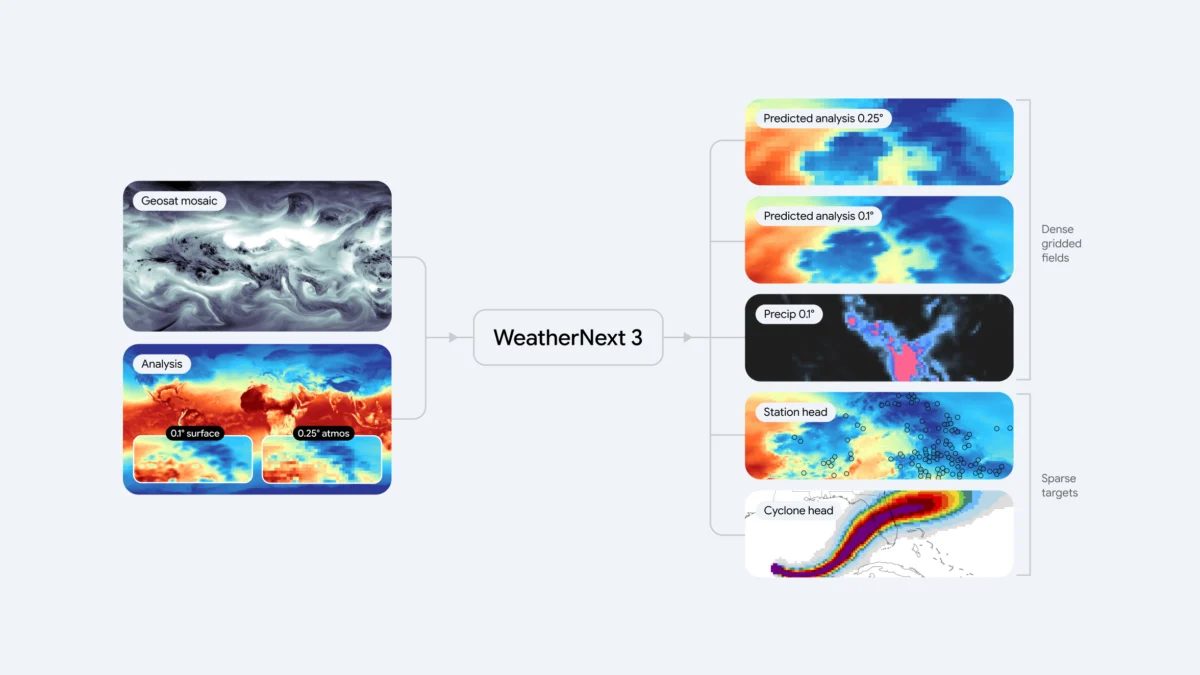
Scientists at Google DeepMind and Google Research have today announced the release of WeatherNext 3, a groundbreaking artificial intelligence model poised to revolutionize weather forecasting. This innovative model promises to perceive our dynamic atmosphere with unprecedented clarity and predict its behavior with greater frequency and accuracy than ever before. It marks the latest significant advancement in meteorology, driven by sophisticated deep learning techniques that are fundamentally reshaping how we understand and forecast weather phenomena.
WeatherNext 3 is not merely an incremental update but represents a profound wave of change in the field, leveraging the power of deep learning to process and interpret vast datasets of atmospheric information. Google has confirmed that the core variables and predictions from WeatherNext 3 will soon be integrated into various Google products, including the weather information displayed in Google Search, Google Maps, and the AI assistant Gemini. Beyond consumer applications, the model will also be made available to external users and researchers via Google’s robust cloud platforms, fostering further innovation and application in scientific and commercial sectors.
Samier Merchant, a senior staff engineer at Google, emphasized the significance of this integration, stating, "This is going to be the first time that some of the core variables feed and power a lot of the Google products." This strategic move underscores Google’s commitment to embedding advanced AI capabilities directly into the daily lives of its users, offering more precise and timely weather insights that can inform decisions ranging from daily commutes to long-term planning. The accessibility through cloud platforms also positions WeatherNext 3 as a foundational tool for a wider community seeking to leverage cutting-edge weather intelligence.
The new AI model has already demonstrated its superior capabilities, establishing itself as the most accurate among leading contenders in rigorous testing. Its performance was evaluated on Operational WeatherBench, a specialized utility developed by the startup Brightband for comparing AI forecasts. This platform meticulously assesses metrics critical to weather prediction, such as temperature, wind speed, and humidity. The results are compelling, showcasing WeatherNext 3’s ability to outperform a broad spectrum of existing models.
Remarkably, WeatherNext 3 not only surpassed other deep-learning models developed by major tech players like Google’s previous iterations, Microsoft, and Nvidia, but also outshone those from the highly respected European Center for Medium-Range Weather Forecasting (ECMWF). Crucially, its accuracy extends beyond its AI peers, as it also proved superior to traditional forecasts produced by both the US National Weather Service and the ECMWF – institutions renowned for their long-standing expertise and sophisticated, physics-based forecasting systems. This achievement highlights a pivotal moment where AI-driven models are demonstrably exceeding the performance of conventional methods. The visual representation of its dominance is captured in an image from Brightband, illustrating its consistent lead as a "30-day weather champion."

Historically, most weather forecasts have relied on government-owned supercomputers. These massive machines painstakingly process complex mathematical equations designed to describe the intricate physics of weather. While these traditional systems have achieved remarkable accuracy over decades of development, they are inherently expensive to operate and comparatively slow in their computation. The landscape began to shift significantly in 2018 when the ECMWF made more than half a century of its rich weather data publicly available. This unprecedented release provided deep learning researchers with the vast datasets necessary to train AI models capable of making predictions far more quickly and with accuracy comparable, and now superior, to traditional government tools.
Ferran Alet, a staff research scientist manager at DeepMind, articulated the inherent challenges of weather prediction and how machine learning addresses them. "Weather is chaotic, and so small differences really start to perturb massively… Machine learning targets the problem we are really solving, which is approximate noisy physics from incomplete information and finite compute, and so it learns patterns from a lot of data." This perspective underscores the core advantage of AI: its ability to discern complex, often non-linear patterns within vast and noisy datasets, which is particularly well-suited to the chaotic nature of atmospheric dynamics.
Since the initial breakthrough in AI-powered weather forecasting, model-makers have consistently focused on mitigating the key weaknesses inherent in early AI models. These challenges primarily included a tendency to forecast over wider areas – typically 15 to 25 square kilometers – which often lacked the granular detail truly useful for localized predictions. Furthermore, early AI models were not always adept at accurately forecasting precipitation, particularly rain events. A significant hurdle also remained in their dependency on the pre-formatted datasets produced by government agencies, rather than being able to directly process raw observational data.
WeatherNext 3 has made significant strides in addressing all three of these long-standing challenges. Researchers involved in its development told TechCrunch that the model can now predict key variables down to an impressive resolution of 5 kilometers, offering substantially more localized and precise forecasts. Its evaluations for rain prediction have shown a remarkable 60% improvement compared to its predecessor, WeatherNext 2, significantly enhancing its utility for agriculture, disaster preparedness, and daily planning. Moreover, the model can now produce hourly forecasts, a substantial upgrade from the standard prediction interval of every six hours, providing users with more frequent and up-to-date information. An accompanying image from Google showcases a "Surface temperature still image," illustrating the detailed outputs of the model.
These substantial improvements are the direct result of deliberate and sophisticated design choices made by the development team. WeatherNext 3 is a considerably larger model, boasting 2.4 times more parameters than its predecessor. This increased complexity allows it to learn and represent more intricate atmospheric patterns. The designers also meticulously tailored the targets for the model’s decoder heads to yield more useful and specific answers. While most weather forecasts typically output metrics averaged across a 3D grid, DeepMind researchers have previously earned recognition for tuning their models to visualize complex phenomena like cyclone paths, demonstrating their innovative approach to forecast presentation.
Crucially, in this iteration, the designers specifically trained WeatherNext 3 to target its forecasts to individual weather data stations. This strategic choice is pivotal for two reasons: it enables the model to offer more granular, hyper-local predictions directly relevant to specific locations, and it provides a robust mechanism for evaluating the model’s accuracy against specific, ground-truth data collected at those stations. Daniel Rothenberg, an atmospheric scientist at Brightband, highlighted the importance of this approach, stating, "The idea, with a lot of AI applications, is to try to run tasks as end-to-end as possible. Adding a capability where this model is now also predicting, say, what Denver’s airport’s weather station is going to measure on an hourly basis, just connects that forecasting task closer to the core." This direct connection to ground-truth data significantly enhances the model’s practical utility and verifiable accuracy.

The ability of WeatherNext 3 to forecast more frequently, specifically on an hourly basis, stems from its capacity to ingest real-time weather satellite data collected hourly. Feeding AI models with raw empirical observations, rather than relying solely on the pre-analyzed data produced by traditional weather supercomputers, holds the promise of even more accurate forecasts. However, getting AI models to effectively work with unformatted, raw data has historically presented significant technical challenges. Google asserts that WeatherNext 3 is the "first" AI model to directly incorporate raw observations for a high-resolution global forecast. However, the AI weather startup WindBorne has stated that its model, WeatherMesh 6, has been incorporating raw observations from its fleet of weather balloons and other sources since late 2025. When questioned about this, Google clarified that its forecasts achieve higher resolution across the entire globe. Regardless of who achieved the "first" for specific applications, both models still rely to some extent on national weather datasets to perform comprehensive forecasts, indicating that further work will be required for true, fully independent direct data assimilation from purely raw sources.
While large language models (LLMs) currently capture the majority of public and media attention, the "transformer revolution" – a deep learning architecture particularly effective for sequential data – in meteorology has proven to be equally, if not more, impactful for specific scientific and practical applications. Major European and US weather agencies are already beginning to integrate AI models into their existing forecast products, recognizing the immense benefits. The inherent speed and lower operational cost of AI models promise to bring substantial economic impact, particularly to poorer regions of the world where the prohibitive expense of high-quality sensors and powerful supercomputers has historically placed accurate, reliable forecasts out of reach.
Bill Gates recently highlighted AI-powered weather forecasting as a crucial benefit of the technology, specifically noting how better forecasts can significantly improve crop yields in developing countries, a critical factor for food security and economic stability. Ferran Alet, the DeepMind researcher, further elaborated on the practical applications, suggesting that higher-resolution forecasts of wind, rain, and cloud cover will be instrumental in making renewable energy projects, such as wind and solar farms, more dependable and efficient by optimizing their operations based on precise weather predictions.
Ultimately, the driving force behind these innovations aligns with Google’s broader mission. As Alet concluded, "At the end of the day, I think Google is about providing useful information to the user, and a lot of what users are looking for has to do with the weather in some way or another." WeatherNext 3 represents a significant leap forward in fulfilling this objective, promising to deliver more accurate, timely, and granular weather information that will benefit individuals, industries, and vulnerable communities worldwide.






