 11
 1
 2
 3
In a significant development for the cryptocurrency space, the eCash network, a long-awaited Bitcoin hard fork spearheaded by Paul Sztorc, founder of LayerTwo Labs, has officially gone live. This launch occurred on October 29, strategically positioned between the high-profile Binance hack and the United States midterm elections. Sztorc, a prominent advocate for Bitcoin Drivechain proposals BIP300 and BIP301, has engineered eCash as a distinct blockchain derived from Bitcoin’s foundational code, aiming to unlock new functionalities for payments, privacy, and a broader range of decentralized applications.
Sztorc articulated a clear vision for eCash, stating, "We need to actively sabotage the ‘degrowth’ policies killing Bitcoin. We want to find the true Bitcoin builders and give them the tools to actually innovate. We just need the open-minded, risk-taking contrarians to come and build." This sentiment underscores a desire to foster a more dynamic and innovative ecosystem, moving beyond what he perceives as stagnation within Bitcoin’s development.
A key feature of this hard fork is the airdrop mechanism, which provides eligible Bitcoin holders with an equivalent balance in the new eCash network’s native token, ECX. This offers a direct windfall to those who controlled their private keys at the time of the fork. The launch of eCash raises crucial questions about the benefits it offers to developers and the practical utility for Bitcoin holders who have received these new coins.
Understanding the eCash Network
Developed by LayerTwo Labs, eCash is not merely a clone of Bitcoin but a separate hard fork designed to address what Sztorc identifies as "complacency narratives" and "cult-like toxicity" hindering Bitcoin’s progress. At its core, eCash introduces Drivechains, an innovative system that empowers developers to construct independent sidechains. These sidechains can host a variety of features and applications without necessitating modifications to the eCash base-layer protocol. This modular approach is intended to accelerate experimentation and the deployment of new functionalities.
Developers on eCash can leverage this framework to build applications for payments, enhance privacy features, create digital assets, and establish prediction markets. Furthermore, miners are incentivized to support these sidechains by earning additional transaction fees, thereby potentially maximizing their revenue streams. The initial launch of eCash’s mainnet was accompanied by five sidechains: BitNames, BitAssets, Thunder, Truthcoin, and zSide. Two more, the quantum-resistant Photon and the decentralized exchange CoinShift, are slated for future development.
Sztorc has dedicated over a decade to advocating for Drivechains, believing that Bitcoin’s historically conservative development approach has limited its full potential. He asserts, "Anything that isn’t maximizing network usage is simply a distraction. Users, the ones who actually pay transaction fees to miners, will win in the long run." This perspective highlights a focus on user adoption and transaction-driven value as the primary metrics for success.
Accessing and Utilizing ECX Tokens
The eCash hard fork occurred at Bitcoin block 973,728. Individuals who held control of their private keys for their Bitcoin holdings at the precise moment of this block snapshot are entitled to an equivalent amount of ECX tokens. LayerTwo Labs explained, "If you held the keys to your BTC at that exact block, you now own the exact same amount of ECX. It is that simple, and you can access them right now."
However, the process of accessing and separating ECX from BTC requires careful execution, particularly for users who self-custody their cryptocurrencies. Bitcoin holders will need to utilize a wallet that specifically supports eCash and meticulously follow the provided procedures. A critical concern arising from the shared transaction history between Bitcoin and eCash is the potential for transaction replay attacks. LayerTwo Labs strongly advises users to "Never move your BTC first, as an ordinary, unprotected BTC spend can easily be replayed on the ECX network." While replay protection mechanisms are integrated into the eCash protocol, the recommended practice is to move ECX tokens first before transacting with BTC to mitigate any risks.
For Bitcoin holders who kept their assets on centralized exchanges, the distribution of ECX tokens is subject to the exchange’s policies. Such users are advised to verify whether their respective exchanges support the eCash fork or have announced plans for ECX distribution.

Trading ECX Tokens: Availability and Market Performance
While obtaining ECX is a direct consequence of holding Bitcoin at the fork, the ability to trade these new tokens is still evolving. Currently, ECX is not yet widely available on major cryptocurrency exchanges. The tax implications of Bitcoin forks can vary by jurisdiction, and users are encouraged to research these before filing their tax returns.
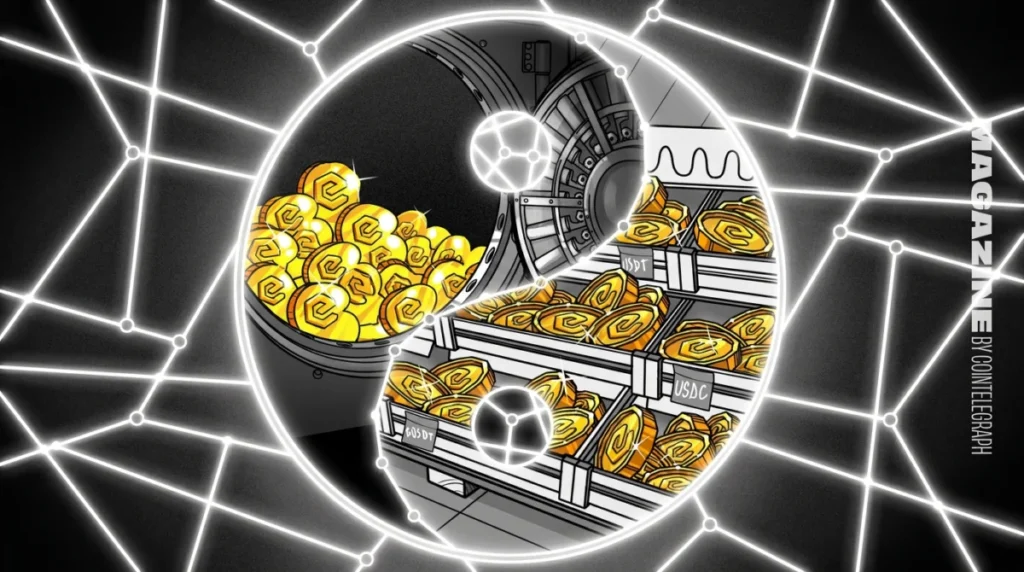
As of the launch date, NeoxEX announced the commencement of native ECX deposits, withdrawals, and trading, offering pairs such as ECX/USDT, ECX/USDC, and ECX/BTC. CoinW has also indicated plans to distribute ECX to eligible Bitcoin holders, with further announcements regarding deposits, withdrawals, and trading to follow. An alternative avenue for trading is available through Orca, a decentralized exchange on the Solana blockchain, where users can swap USDC for wrapped ECX (wECX) via a liquidity pool. This option, however, involves a wrapped token on a different blockchain rather than direct trading of native ECX on the eCash network.
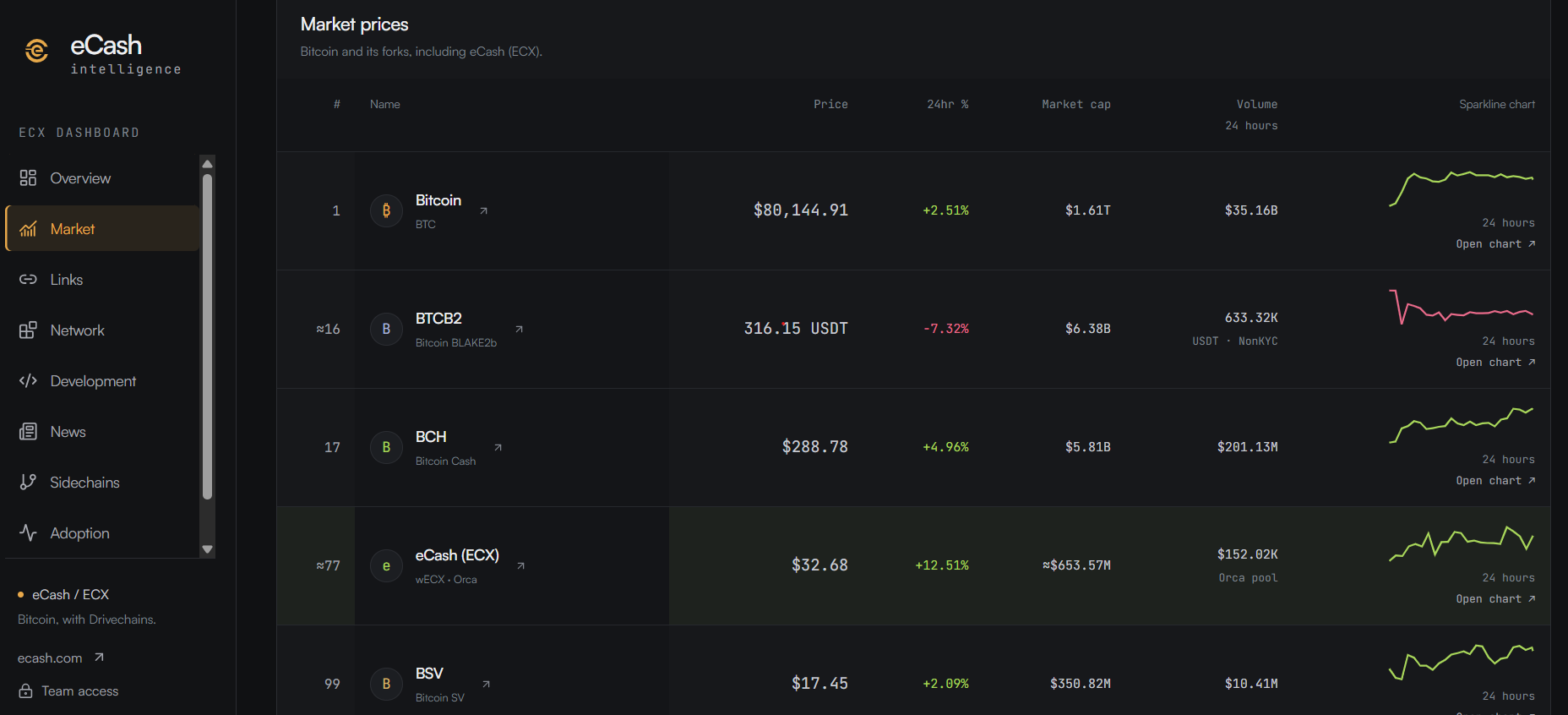
Market data for ECX remains somewhat fragmented. CoinMarketCap reported ECX at $32.63 with approximately $355,000 in 24-hour trading volume as of November 5. CoinGecko lists ECX as a preview listing, with no price data or tracked exchange markets available at present. Crypto market data provider Kaiko also does not track ECX, contributing to limited independent market analysis.
LayerTwo Labs has noted that early trading saw ECX prices fluctuate between $40 and $50, though specific order book depth and trading volume figures were not provided. Instead, they pointed to the total value locked in the Orca pool as an indicator of available liquidity. Sztorc expressed optimism about the potential for significant liquidity, drawing a parallel to the initial performance of Bitcoin Cash (BCH), stating, "If our fork replicates even a fraction of [Bitcoin Cash] BCH’s initial performance, the liquidity will be staggering." He also reassured concerned users that they could hold their coins and make decisions later, adding, "We are actively adding new exchanges and trading pairs, so the user experience will only improve. Otherwise, you’re welcome to take your free money and leave."
A Divergent Vision for Bitcoin’s Future
Paul Sztorc believes that the long-term value of eCash will be determined by its ability to attract developers to build useful applications and, crucially, by users willing to pay for these services. The project’s primary success metrics for its inaugural year are expected to be the acquisition of paying customers and the generation of transaction fee revenue.
Sztorc remains unfazed by criticisms of Drivechains’ security model, particularly the concerns regarding miners potentially colluding to steal funds from sidechains. He dismisses these as "superstition," arguing, "If you genuinely believe miners will torch their own billion-dollar operations for a short-term theft on an L2, then you shouldn’t trust Bitcoin’s L1 either."
In essence, the eCash network provides Bitcoin holders with a new digital asset and developers with a novel platform for innovation. The ultimate success and broader impact of ECX will hinge on its adoption and the actual utility it provides to its users.