 11


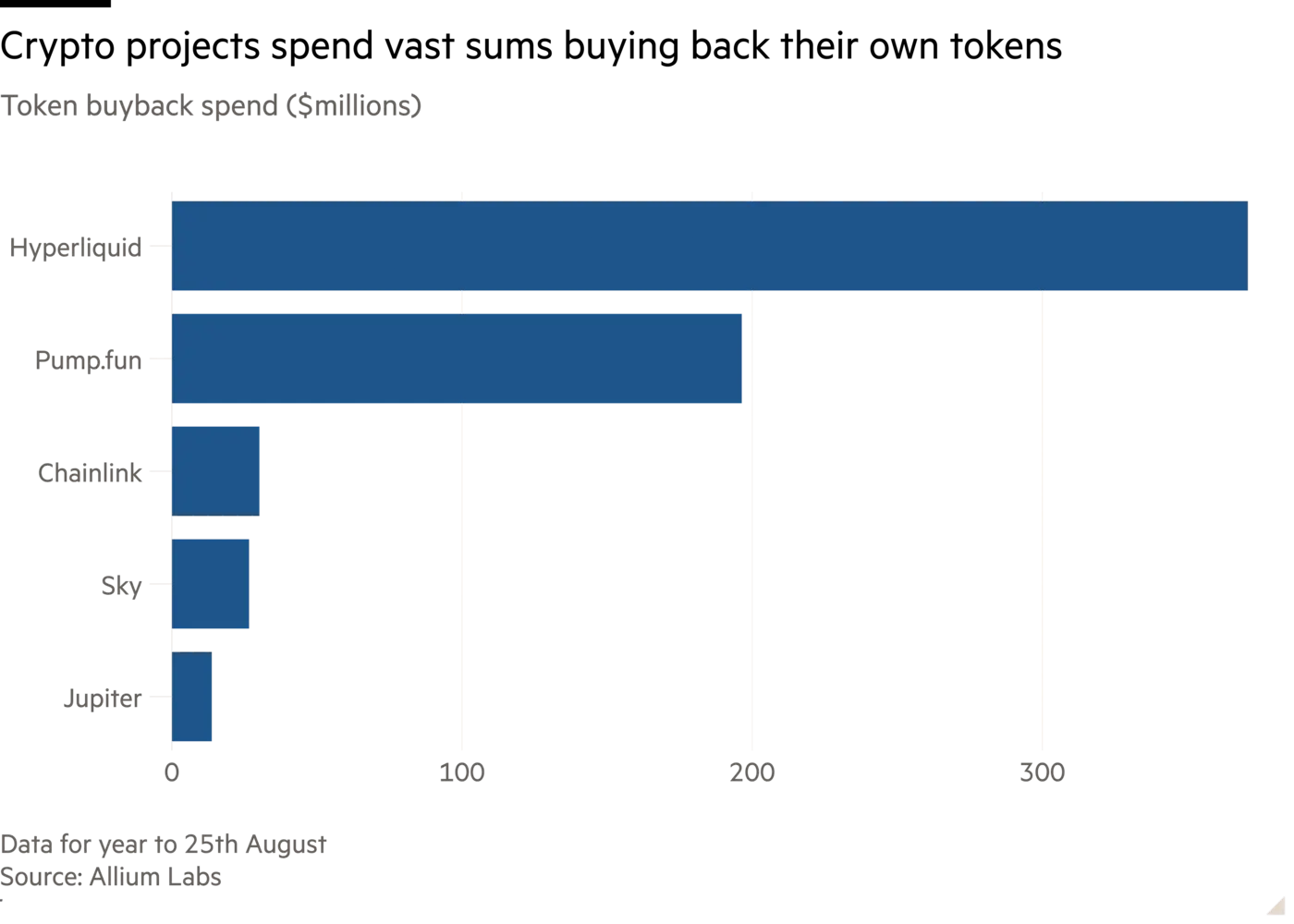
Cryptocurrency projects have collectively executed a record-breaking $638 million in token buybacks year-to-date, a significant surge from previous years and a strategy increasingly employed to bolster token valuations and reward stakeholders. This substantial expenditure, as reported by Allium Labs and cited by the Financial Times, highlights a growing trend within the digital asset space mirroring traditional financial markets’ share repurchase programs. Decentralized exchange Hyperliquid and memecoin launchpad Pump.fun have emerged as dominant players in this trend, accounting for nearly 90% of the total buyback volume.
The data reveals a dramatic increase in buyback activity, with $638 million spent so far in 2026, a notable leap from $545 million during the same period in 2025, and a stark contrast to a mere $366,000 in 2024. Of the $638 million total, Hyperliquid was responsible for approximately $370 million in token repurchases, while Pump.fun contributed nearly $200 million. This concentration of buyback activity by these two platforms underscores their significant role in shaping the current market dynamics.
Token buybacks function analogously to share buybacks undertaken by publicly traded companies. In traditional finance, corporations repurchase their own stock to support share prices, reduce the number of outstanding shares, and consequently increase earnings per share and returns for existing shareholders. In the cryptocurrency realm, token buybacks serve a similar purpose: to reduce the circulating supply of a token, theoretically increasing its scarcity and thereby its value. This can also be interpreted as a mechanism to redistribute value back to token holders by enhancing the token’s price performance.

While token buybacks are still a relatively nascent practice within the broader crypto industry, their adoption is gaining momentum. An illustrative example of this burgeoning trend is the recent proposal by the Ethena Foundation. On Thursday, the foundation initiated a vote on a fee-switch proposal that would allocate 95% of the net revenue generated from its core business lines to the repurchase of its native token, Ethena (ENA). The immediate market reaction to this proposal was positive, with the ENA token experiencing a 10.7% increase in value on the day the vote was opened. This suggests that the market views such revenue-reinvestment strategies favorably.
The impact of these aggressive buyback strategies is demonstrably evident in the performance of the tokens involved. Both Hyperliquid (HYPE) and Pump.fun (PUMP) have significantly outperformed the broader cryptocurrency market decline year-to-date. According to TradingView data, the HYPE token has seen a remarkable 145% increase in value, while PUMP has risen by 109%. In stark contrast, Bitcoin (BTC), the flagship cryptocurrency, has experienced a 10% price decline, and the total cryptocurrency market capitalization has contracted by 11.9% over the same period. This divergence in performance highlights the direct influence of substantial token buybacks on individual token valuations, even amidst a generally bearish market sentiment.
Hyperliquid, in particular, has demonstrated an aggressive commitment to its buyback strategy, dedicating approximately 99% of its revenue to token repurchases. The platform reported $169 million in revenue for the second quarter, with an impressive $141 million of that amount being channeled into HYPE buybacks. This substantial allocation of revenue underscores the platform’s focus on enhancing the value proposition for its token holders.
Pump.Fun, the memecoin launchpad, has also adopted a significant buyback strategy, allocating around 50% of its net protocol revenue towards token repurchases. Based on its average daily revenue over the past 90 days, Pump.Fun currently boasts an annualized revenue of $420 million. This revenue generation capacity, coupled with its commitment to buybacks, positions it as a key driver of the current buyback trend.
The broader implications of this trend were recently articulated by Matt Hougan, Chief Investment Officer at Bitwise. Earlier in August, Hougan suggested that crypto valuations could potentially double within the next two years. He attributed this optimistic outlook to the increasing tendency of protocols to utilize their revenue for token buybacks and burns. These actions, he posits, effectively return more value to investors, thereby enhancing the overall attractiveness of the crypto asset class.
The data from Allium Labs, as presented in the Financial Times report and visually represented in accompanying charts, provides a clear picture of the substantial financial commitment cryptocurrency projects are making towards token buybacks. The significant year-over-year growth in this expenditure, coupled with the outperformance of tokens actively engaged in these programs, suggests that token buybacks are becoming a more integral component of project treasury management and investor relations strategies within the evolving cryptocurrency landscape. As more protocols consider similar revenue-reinvestment strategies, the trend of token buybacks is likely to continue shaping market dynamics and potentially influence overall crypto valuations.






