 11


The digital asset industry, its advocates, and lawmakers are facing a familiar predicament akin to "water, water everywhere and not a drop to drink" as the CLARITY Act, a crucial piece of legislation aimed at establishing market structure for digital assets, has encountered a significant roadblock in the U.S. Senate. Despite a year of intense negotiations, amendments, and political maneuvering, the bill failed to secure the necessary 60 votes for cloture, a procedural vote to end debate and advance the legislation. While the setback is substantial, the CLARITY Act is not entirely dead, but rather "walking wounded," with a slim possibility of revival before the end of the current legislative session.
The immediate cause of the bill’s faltering was a last-minute procedural vote switch by Republican Senator Thom Tillis. His decision to vote against advancing the bill, however, was not a definitive rejection of its substance but rather a strategic parliamentary maneuver. Tillis filed a motion to reconsider, preserving a potential pathway for the CLARITY Act to return to the Senate floor. Ryan Eagan, director of US federal affairs for the Crypto Council for Innovation (CCI), explained that this motion "would provide an opportunity to revisit CLARITY’s cloture vote at any point this session." He noted that the desire to preserve this opportunity is "in part due to the progress made over the past week," indicating that some momentum had been building prior to the vote.
However, the Senate is facing a rapidly shrinking timeline. Deep divisions persist between Democrats and Republicans, particularly concerning ethics provisions related to President Donald Trump. Supporters of the bill acknowledge that a more collaborative and bipartisan negotiating process may now be essential to overcome these obstacles. The core question remains: can the CLARITY Act be resuscitated, and if so, how much of its original form will need to be significantly altered to achieve passage?
The failed cloture vote, which saw CLARITY fall short with a 49-50 tally, does not signify the definitive end of its legislative journey. The requirement of 60 votes in the Senate underscores the need for broad bipartisan consensus. Senator Tillis’s motion to reconsider offers a lifeline, but it is confronting a formidable practical challenge: time. The Senate is slated to adjourn for recess on October 2, returning after the midterm elections. The House of Representatives has already recessed for the election period, creating a complex scenario for moving legislation through both chambers before the year concludes.
Congressman Shri Thanedar, a Democrat who supported the CLARITY Act when it passed the House in July 2025, described the timeline as a "major barrier" to reaching an agreement. He stated, "There are only 20 legislative days left in this Congress, all of them after the midterms, making odds of a 2026 compromise, unfortunately, very low."

While "very low" does not equate to impossible, the crypto industry has a historical precedent for such comebacks. The Guiding and Establishing National Innovation in US Stablecoins (GENIUS) bill, which failed cloture by a narrow margin of 48-49 in May 2025, successfully cleared a second cloture vote just 11 days later with a decisive 66-32 margin, eventually passing the Senate the following month. However, Kyle Chassé, founder of crypto investment firm MV Global, cautioned that the GENIUS bill’s comeback was facilitated by a pre-existing deal, a luxury the CLARITY Act currently lacks. "GENIUS came back from a failed cloture in 11 days. But GENIUS had a deal. This one has a calendar and no votes. Miss Jan. 3, and it restarts from zero in 2027 with a House that is probably Democratic," Chassé explained. A "lame-duck" session after the November elections could offer CLARITY another opportunity, but this is not the same as having a finalized agreement ready for passage.
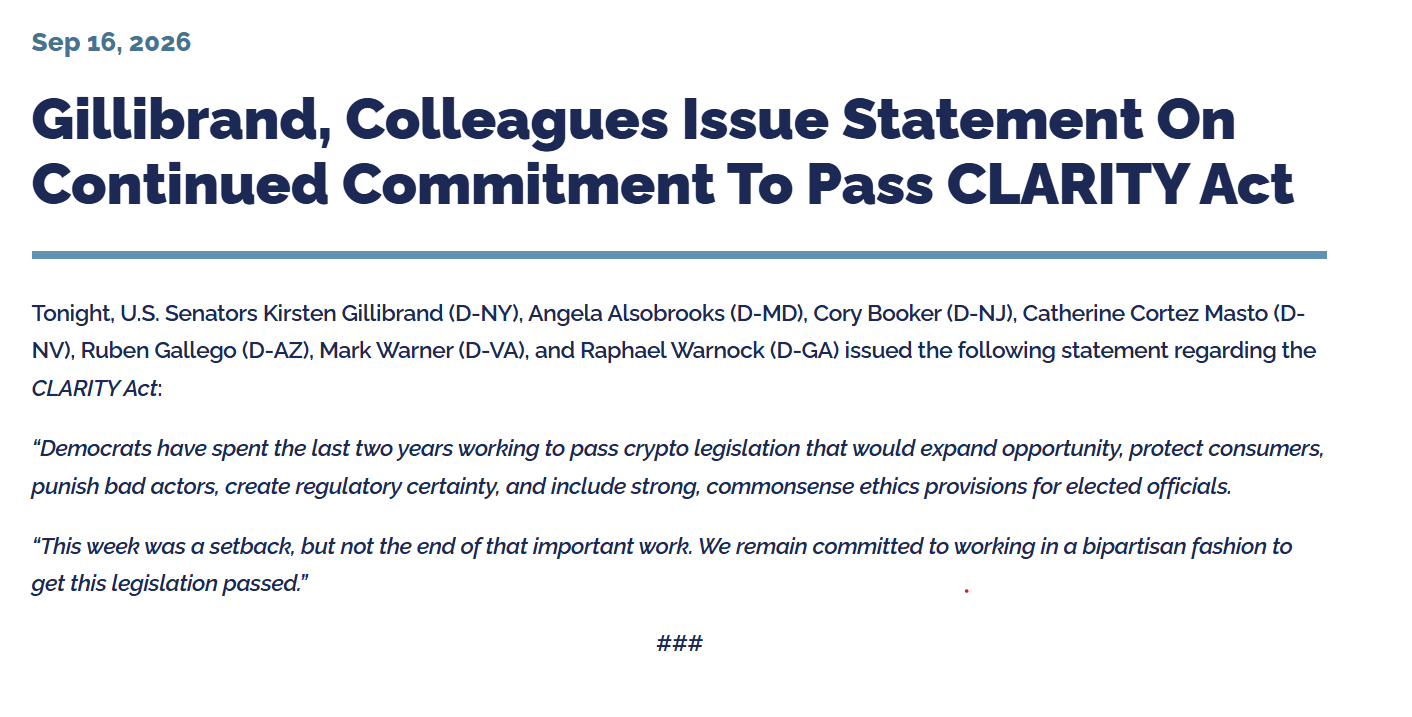
The fundamental challenge lies in securing the elusive 60 votes, which is intrinsically linked to the bill’s negotiation process. Notably, not a single Democratic senator voted to advance the CLARITY Act. Chassé highlighted this, stating, "Every one of the 49 was a Republican. Zero Democrats voted to even open debate." Despite this, a statement released on Wednesday by seven Democratic senators, all of whom had voted against advancing the bill, affirmed their "continued commitment to pass CLARITY Act." Among them was Senator Angela Alsobrooks, who had previously supported the bill in committee. Alsobrooks emphasized the pressing need for digital asset regulation, stating, "it’s clear that now is the time to regulate digital assets," and expressed willingness to negotiate on the ethics provisions. She further alleged that "Republican leadership shut it down at the very last minute after it became clear that we were on a path to a successful vote."
Senator Tillis, in his remarks on Wednesday, expressed his intention to "convince the Democrats to get on board" and "put pressure on them to own it." His procedural vote switch was specifically designed to keep this possibility alive, as he feels "very strongly that this is an unregulated marketplace and that we need some guardrails on." The current impasse is not over the necessity of establishing crypto regulations, but rather whether the existing legislative package adequately addresses the concerns to garner bipartisan support.
Congressman Thanedar, while supporting the bill in its current form, acknowledged that the recent vote underscores the need for further bipartisan collaboration. He stated, "I do believe that the failed CLARITY vote on Tuesday demonstrates that a more bipartisan drafting process would lead to a higher likelihood of creating the bipartisan, supermajority coalition that passing this legislation into law would require."
If salvaging the CLARITY Act necessitates significant revisions, the question arises as to what provisions will survive. Chassé suggests that the core issue has transcended technical drafting and is now entangled with President Trump’s cryptocurrency holdings and related ethics provisions. "This stopped being a drafting problem. It’s a referendum on the President’s crypto holdings six weeks before an election, and the text as written can’t survive that," he argued. Republicans had already incorporated 126 substantive changes requested by Democrats prior to the vote, including stricter limitations on public officials profiting from crypto ventures and granting state attorneys general enforcement roles.
Despite these concessions, Thanedar indicated that Democrats are seeking further restrictions "on the President’s ability to use his office for personal gain." He cited President Trump’s reported $1.4 billion in crypto earnings for 2025 as evidence that "guardrails are necessary to both hold the President accountable and protect the long-term health of the digital asset market."
Beyond ethics, Chassé pointed to stablecoin yields as another potential point of contention. He suggested that "some kind of cap or circuit breaker on yield" would likely be "the price of the bank-side senators and a chunk of Democrats," alongside "tighter illicit finance and state enforcement language." Conversely, Chassé advised the crypto industry to defend its positions on self-custody and developer protections, areas that have been fiercely debated throughout the negotiations, particularly concerning the extent to which non-custodial developers should be shielded from financial and anti-money-laundering requirements.
Even if the CLARITY Act remains stalled in Congress, the landscape of U.S. crypto regulation is not static. Eagan confirmed that the Securities and Exchange Commission (SEC) and the Commodity Futures Trading Commission (CFTC) have demonstrated a commitment to reducing uncertainty through guidance, rulemaking, no-action relief, and exemptions. CCI anticipates that the agencies’ crypto agendas will proceed "in robust fashion regardless of the CLARITY Act," with the implementation of the GENIUS Act also continuing at the Treasury and among banking regulators.
Michael Saylor, executive chairman of Strategy, echoed this sentiment, noting that the SEC, CFTC, and Treasury can continue to advance rules under existing laws. "Progress need not wait for Congress," he stated. However, agency actions, while significant, do not carry the same permanence as legislation. Regulatory guidance can be subject to change with administrations, whereas enacted laws are more difficult to repeal.
The CLARITY Act may still have a chance to be revived and make its way back to the Senate floor. However, the critical question remains whether lawmakers can muster the necessary 60 votes without fundamentally altering the bill to the point of being unrecognizable.






