 11


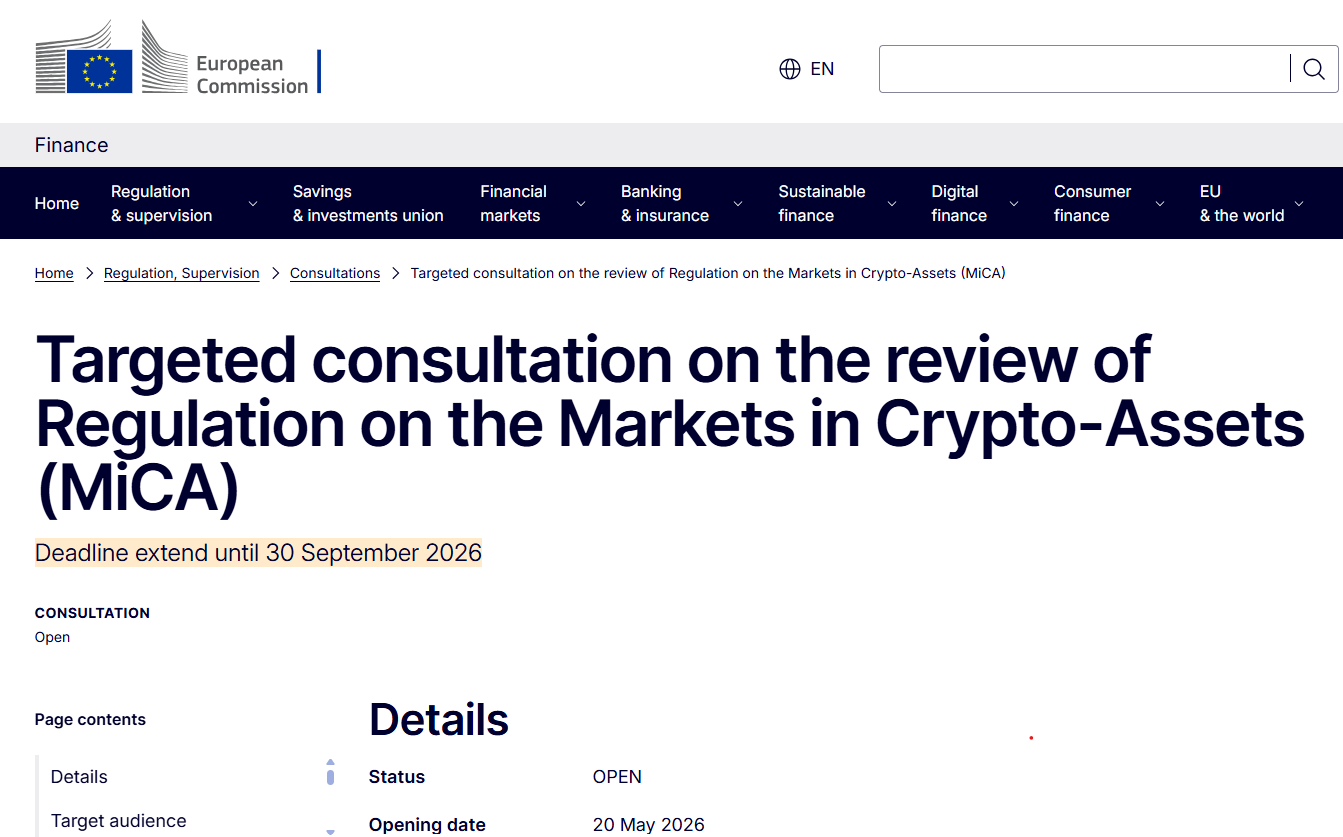
The European Commission is actively exploring the inclusion of crypto lending and decentralized finance (DeFi) within the scope of the Markets in Crypto Assets (MiCA) regulation, signaling a potential shift in how these burgeoning sectors of the digital asset economy are governed. On May 20, 2026, the Commission launched a targeted consultation, inviting stakeholders to provide input on areas that were deliberately excluded from MiCA’s original framework. Prominent among these are the complexities surrounding DeFi and the mechanisms of crypto lending and borrowing.
A key area of discussion revolves around lending vaults, financial instruments that can facilitate the movement of billions of dollars through on-chain credit markets without necessarily presenting as traditional lending entities. Currently, their legal classification often relies on non-binding interpretations suggesting they fall outside the purview of both MiCA and existing EU fund regulations. This ambiguity is a significant concern for regulators aiming to establish clear rules for the digital asset space.
Yuriy Brisov, an EU digital assets lawyer and partner at Digital & Analogue Partners, highlighted the current legal uncertainty surrounding these vaults. He explained, "EU law has no category called a ‘vault.’ A lawyer therefore defines it the way a regulator would qualify it: by function, not by label." This functional approach to classification is complicated by the fact that vaults can perform the core economic functions of lending while distributing other operational aspects across smart contracts and multiple participants, rather than consolidating them within a single corporate entity, as is typical in traditional finance. The question of whether and how to regulate these structures, if Brussels decides to bring lending under the regulatory umbrella, poses significant challenges for DeFi and the protocols and individuals involved.

The intricate nature of these structures is exemplified by decentralized lending protocol Morpho. Its lending infrastructure, particularly its Vault V2 architecture, illustrates why defining regulatory boundaries for such systems is exceptionally difficult. Morpho’s vaults divide responsibilities among distinct roles: an owner, a curator, an allocator, and a sentinel. The curator is responsible for configuring strategy and risk parameters, the allocator executes investment decisions, and the sentinel is empowered with risk mitigation functions. While none of these roles explicitly constitute a regulated lending service under MiCA as currently defined, this distributed model makes it challenging to identify a single, identifiable "provider" in the way one would with a conventional financial institution. This complexity is further compounded by the fact that these vaults can engage in a range of activities, from channeling liquidity for lending to directly buying and selling crypto assets, suggesting that a one-size-fits-all regulatory approach might be inappropriate.
Jonathan Galea, a partner at Cahill Gordon & Reindel, has extensively analyzed the regulatory positioning of lending vaults within the EU’s financial regulatory landscape. His research indicates that these structures can interact with MiCA, stablecoin regulations, and European fund law in intricate ways. Galea cautions policymakers against treating all lending vaults as a monolithic category, emphasizing that "lending vaults solve more practical problems than they create." He argues that while some vaults are designed to consolidate fragmented liquidity for lending markets, others may focus on asset trading and should therefore be subject to different regulatory considerations. "Bring ‘DeFi lending’ into the perimeter as a single label, and structures that deserve opposite answers risk ending up captured together," Galea warned. This distinction is crucial, as a broad "DeFi lending" category could inadvertently encompass protocols with vastly different economic functions and levels of centralized control.
MiCA currently excludes crypto asset services provided in a "fully decentralized manner," although it can apply when only a portion of an activity is decentralized. The challenge for regulators lies in establishing clear dividing lines. One potential approach is to use decentralization as a primary determinant, but Galea suggests this could disadvantage newer, more innovative protocols. He argues that decentralization exists on a spectrum and evolves over time, and a decentralization test might penalize emerging protocols while favoring established players that have had more time to distribute control.
Brisov proposes focusing on the structural characteristics of the vault and the degree of control wielded by individuals. "The safer ground is structural: there is no undertaking, no appointed manager, the holder has a direct coded claim on the pool, and the user can exit before any parameter change takes effect," he stated. He advocates for explicitly adding lending and borrowing to the list of regulated crypto asset services if they are deemed to require oversight, rather than expanding the definition of a crypto asset service provider broadly.
Michael Egorov, the founder of Curve Finance, underscores the necessity of differentiating DeFi lending from conventional finance in any regulatory framework. "If DeFi lending is ever brought into the scope of regulation, it should be treated completely differently," Egorov asserted. He believes DeFi lending does not require all the safeguards inherent in traditional lending, while simultaneously needing certain protections not typically found in conventional systems. Egorov suggests a "really careful" approach to regulation, proposing a dedicated framework that could enhance security and broaden access for new users, while avoiding rules that might be technically infeasible for certain protocols due to their underlying architecture.
The European Commission’s consultation period concludes on September 30, 2026. The outcome of this review is expected to significantly influence the regulatory future of lending vaults, potentially bringing them under MiCA’s purview or leading to the creation of a new, tailored regulatory framework. For Brussels, the central task is not merely to decide whether to regulate DeFi lending, but to devise rules that can accurately distinguish between the diverse forms of on-chain lending and identify the individuals, if any, who ultimately exercise control over these operations.






