 11
11
Bitcoin (BTC) reached its highest levels in eight days leading into Friday’s Wall Street open, as global markets braced for crucial US inflation data. The digital asset’s resilience in the face of Middle Eastern conflict and its subsequent impact on oil supplies has positioned it as the strongest macro performer since the escalation of tensions in Iran.

Data from TradingView indicated that BTC/USD had surpassed the $72,000 mark on Bitstamp, a level not seen since March 5. This upward movement occurred against a backdrop of global uncertainty, yet Bitcoin managed to avoid a significant sell-off. Key macroeconomic data releases from the United States earlier in the week had largely aligned with expectations, thereby mitigating the risk of excessive market volatility.
Friday’s economic calendar was dominated by the release of the Personal Consumption Expenditures (PCE) Index for January. This particular metric is closely watched by the Federal Reserve, as it is considered their "preferred" measure of inflation. The preceding PCE print had exceeded forecasts, reaching its highest point since late 2023, adding another layer of significance to the upcoming data.

Despite the looming threat of rising inflationary pressures stemming from the oil crisis, former US President Donald Trump renewed his calls for the Federal Reserve to lower interest rates. He publicly urged Federal Reserve Chairman Jerome Powell to reduce rates "IMMEDIATELY, not waiting for the next meeting," in a post on his Truth Social platform. This sentiment comes at a time when the probability of a rate cut at the Federal Reserve’s March 18 meeting had fallen below 1%, as previously reported by Cointelegraph.
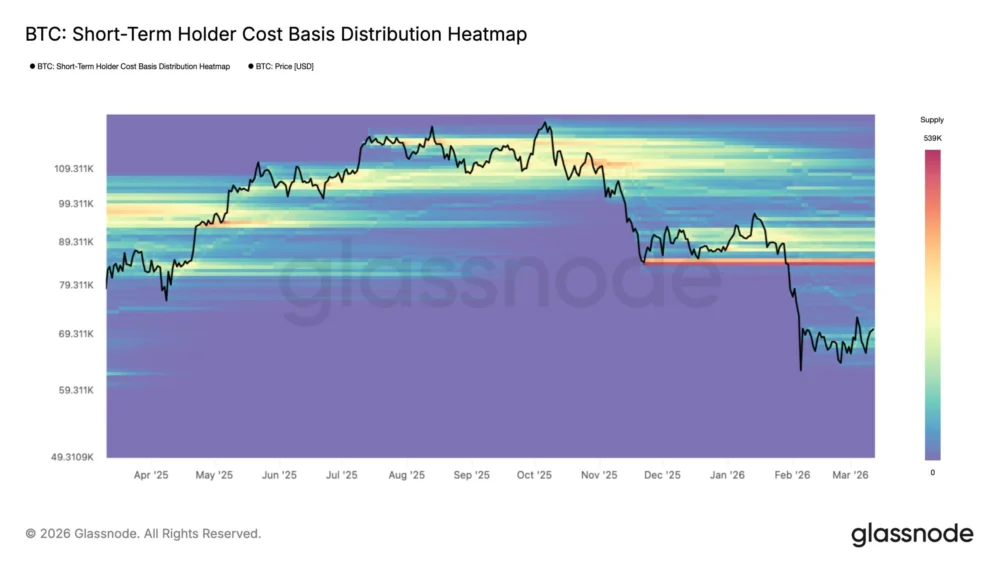
Within the Bitcoin market, the primary focus remained on the cryptocurrency’s price strength amidst broader macroeconomic turbulence. Onchain analytics firm Glassnode, in its latest newsletter "The Week Onchain," noted Bitcoin’s "surprising resilience" following the recent geopolitical shock. The firm’s analysis of options market activity suggested that traders were exhibiting reduced concern regarding short-term risks.

Glassnode further observed the formation of an "accumulation cluster" within the $62,000 to $72,000 range. However, the intensity of this accumulation was described as "modest relative to prior phases that preceded sustained expansions." This suggests that while conviction among investors is growing, the foundation for a significant mid-term breakout remains relatively thin. The analysis was based on the cost basis of investors who have held BTC for six months or less.
Independent market commentators also highlighted Bitcoin’s outperformance against other major macro assets since the onset of the recent events in Iran. Joe Consorti, head of growth at Bitcoin equity company Horizon, remarked that Bitcoin had successfully "passed the geopolitical stress test." He provided data indicating that Bitcoin had appreciated by 7.3% since last month’s strikes on Iran, while the S&P 500 and Nasdaq experienced declines of 1-2%. Gold saw a decrease of 3.7%, and silver suffered a more significant drop of over 10% during the same period.

The current market sentiment suggests that Bitcoin’s robust performance, even amidst significant geopolitical and economic uncertainties, is strengthening its position as a potential safe-haven asset or a reliable store of value. The upcoming PCE data will be a key determinant in shaping the short-term trajectory of both inflation expectations and potential monetary policy decisions by the Federal Reserve, which in turn will likely influence Bitcoin’s price action. The ongoing analysis of investor behavior and market dynamics will continue to provide insights into the potential for a sustained bullish breakout.