 11
11
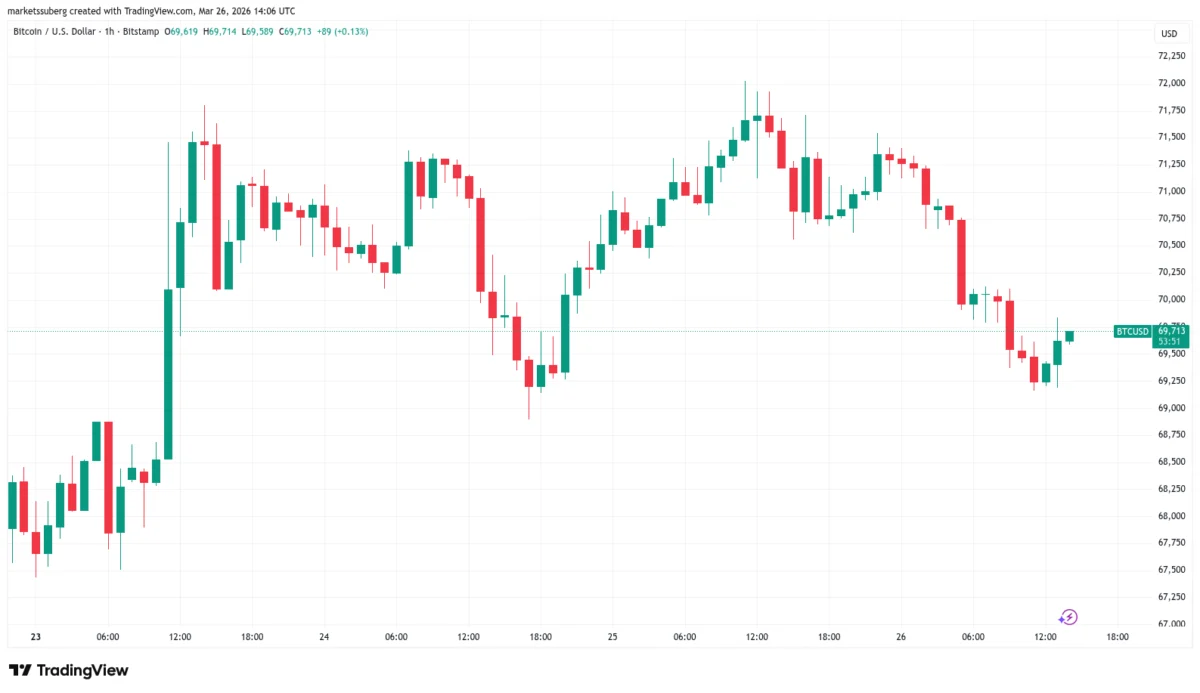
Bitcoin (BTC) experienced a notable downturn, with daily losses approaching 3% as Wall Street opened on Thursday. This price action coincided with heightened market anxiety stemming from escalating tensions between the United States and Iran, alongside growing concerns about persistent inflation in the US economy. Data from TradingView indicated that the BTC/USD trading pair was hovering near the $69,000 mark, a level not seen since Monday, signaling increased volatility as the US trading session commenced.
The market’s reaction was largely driven by fresh developments in the US-Iran relations. Reports emerged suggesting a lack of mutual understanding regarding a peace proposal, which was further intensified by strong statements from US President Donald Trump. In a post on his Truth Social platform, Trump characterized Iranian negotiators as "very different and ‘strange.’" He issued a stark warning, stating, "They better get serious soon, before it is too late, because once that happens, there is NO TURNING BACK, and it won’t be pretty!" This rhetoric contributed to a palpable sense of unease across global financial markets.

The impact of these geopolitical developments was immediately visible in the US stock markets, which turned negative at the opening bell. Beyond the immediate geopolitical concerns, attention also shifted to the longer-term implications of the ongoing conflict on inflation. Data compiled by trading resource The Kobeissi Letter and other outlets highlighted projections from the Organization for Economic Co-operation and Development (OECD). According to the OECD, US inflation was forecast to reach 4.2% in 2026, positioning it as the highest among G7 nations. This upward revision in inflation expectations has reignited discussions about potential interest rate hikes.
The Kobeissi Letter commented on X (formerly Twitter), stating, "Potential rate HIKES in the US and EU are now back on the table." This refers to the possibility of central banks, including the US Federal Reserve and the European Central Bank, increasing interest rates to combat rising inflation. A scenario of rising interest rates is typically viewed as a significant headwind for risk assets, including cryptocurrencies like Bitcoin. The CME Group’s FedWatch Tool, which tracks probabilities of Federal Reserve interest rate changes, showed shifts in market expectations, underscoring the growing sentiment for tighter monetary policy.
Earlier reporting by Cointelegraph had already indicated an increase in expectations for a US recession within the next 12 months. This backdrop of potential economic slowdown, coupled with persistent inflation and geopolitical instability, creates a complex and uncertain environment for investors. The correlation between traditional markets and Bitcoin has become increasingly pronounced, meaning that macroeconomic factors and geopolitical events are playing a more significant role in dictating the cryptocurrency’s price movements.

Despite the current downward pressure and the prevailing uncertainty, some market analysts suggest that Bitcoin’s price action is not overtly bearish. QCP Capital, a trading firm, emphasized Bitcoin’s "resilience" within the current challenging macro landscape. In their latest "Market Color" analysis, they noted that BTC was "hovering around $70k, and the price action still feels more like quiet consolidation than outright stress." This perspective suggests that while Bitcoin is experiencing some price depreciation, it is not exhibiting signs of panic selling or a complete loss of investor confidence.
QCP Capital further elaborated on the market sentiment, stating, "The broader macro backdrop remains fragile, with risk sentiment weighed by renewed Middle East headlines and oil still carrying a meaningful geopolitical premium, even after pulling back from the week’s highs." This highlights the interconnectedness of global events and their influence on financial markets. The price of oil, often a barometer of geopolitical risk, remains elevated due to the tensions in the Middle East, contributing to broader inflationary pressures.
The analysis from QCP Capital indicated that Bitcoin’s price activity is "not obviously bearish." They described the current trading behavior as characteristic of an asset where dips are being bought, but significant upward momentum is not yet evident. "For now, BTC is trading like an asset being accumulated on dips but not yet chased," they observed. The firm noted that Bitcoin’s trading range is holding, and the surface sentiment is defensive but orderly, implying that macro-economic factors are the primary drivers of price action.

The current market environment is one where many traders remain risk-averse, anticipating that a significant breakdown in the current trading range could lead to further declines in Bitcoin’s price, potentially testing new macro lows. This sentiment reflects a cautious approach, with investors closely monitoring economic indicators and geopolitical developments for clear signals of a sustained recovery or further deterioration.
As Cointelegraph continues to monitor the market, the interplay between inflation, interest rate policy, geopolitical events, and Bitcoin’s price remains a critical focus. The cryptocurrency’s ability to navigate these complex macro-economic currents will be a key determinant of its performance in the coming weeks and months. The ongoing consolidation around the $69,000 level, while indicating a degree of resilience, also suggests that significant upward or downward movement is contingent on clearer directional cues from the broader financial and geopolitical landscape. The market is in a state of watchful waiting, with investors and traders alike analyzing every piece of economic data and every geopolitical development for insights into the future direction of Bitcoin and other risk assets.