 11


Despite persistent skepticism within the Bitcoin community regarding the immediacy of the quantum computing threat, recent developments highlight significant progress in fortifying the Bitcoin blockchain against future attacks. Two key advancements surfaced this week: an experimental quantum-resistant transaction tested on the Bitcoin mainnet by StarkWare researcher Avihu Levy, and the publication of a Bitcoin Improvement Proposal (BIP) for the SHRINCS signature scheme by Blockstream researchers.
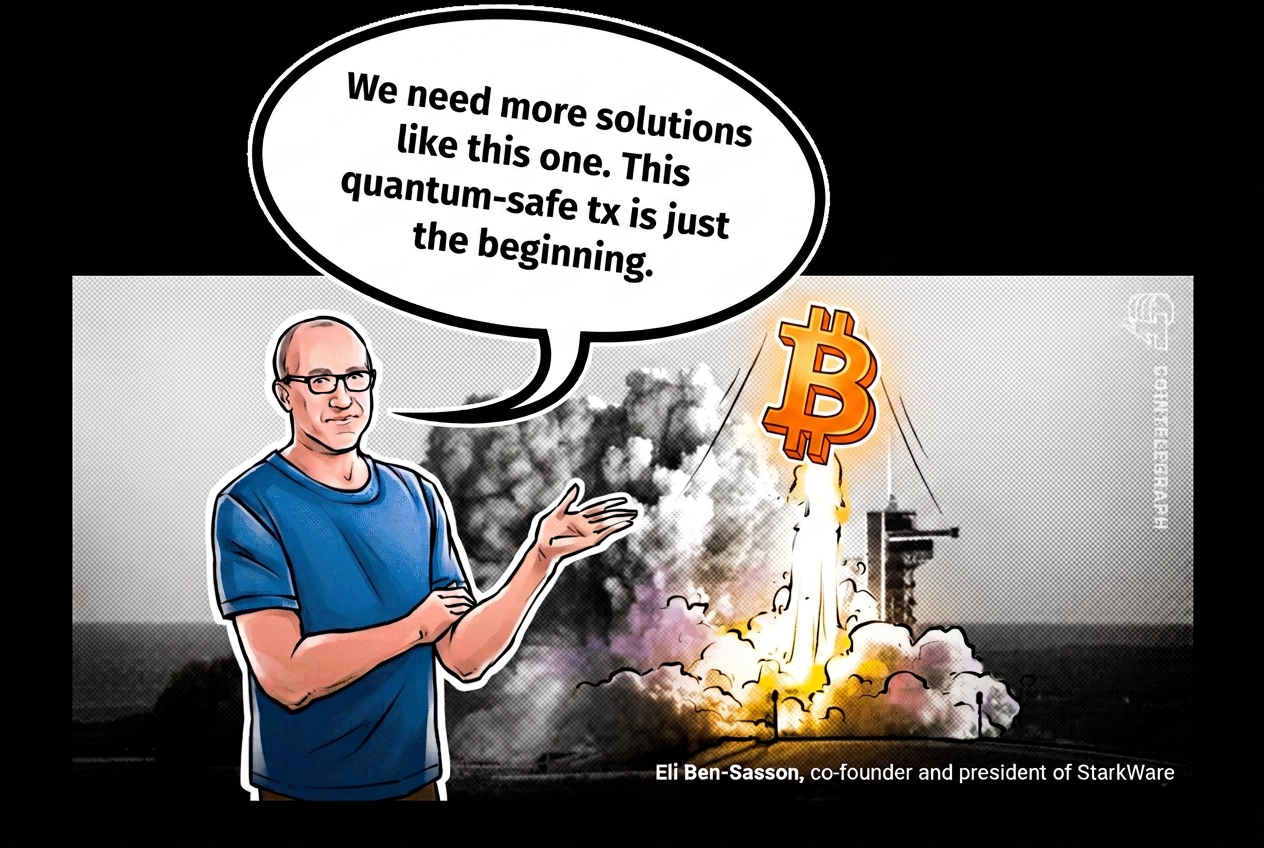
The experimental transaction, a demonstration of Levy’s Quantum Safe Bitcoin (QSB) scheme, successfully protected a 10,000-satoshi output during the brief period when public keys are exposed in the mempool. QSB combines hash-based one-time signatures with computational searches to bind authorization to a specific transaction. While effective, the current iteration is described as a last resort due to its significant time and cost implications, with each transaction taking hours and incurring expenses between $150 to $200. This proof-of-concept underscores the ongoing exploration of quantum-resistant cryptography within the Bitcoin ecosystem, even if practical widespread implementation remains a distant goal.

Concurrently, Blockstream researchers have put forth a concrete proposal for a more integrated, long-term quantum security upgrade. Their published Bitcoin Improvement Proposal introduces the SHRINCS signature scheme, a significantly slimmed-down version of a large, hash-based post-quantum signature. While still approximately nine times larger than Bitcoin’s current signatures, the reduction by about 13.23 times represents a substantial effort in making quantum-resistant cryptography more palatable for blockchain integration. Jonas Nick, a Blockstream Research scientist, described it as "the first concrete proposal for a post-quantum signature scheme designed specifically for Bitcoin," acknowledging its trade-offs but deeming it a "very good trade-off among the options we have now." This proposal signifies a crucial step towards a future-proofed Bitcoin network, though the practicalities of integrating such a scheme will involve extensive community discussion and consensus.
In parallel, Solana’s network has seen a significant governance decision as validators overwhelmingly voted to accelerate the network’s disinflationary schedule. A proposal, known as SGP-0002 or "Double Disinflation," was approved to double the annual disinflation rate from 15% to 30%. This decision is projected to reduce token issuance by approximately 18.9 million SOL over the next six years. The vote garnered substantial participation, with 60.7% of eligible stake voting, and a decisive 67% in favor, against 25.16% opposed and 7.84% abstaining. The impact of this change will be a more rapid convergence to Solana’s target terminal inflation rate of 1.5%, expected in roughly 2.8 years, a considerable acceleration from the previously estimated 5.7 years. This move comes amidst robust network activity, with on-chain data indicating Solana processed a record 4.2 billion transactions in July, a 13.5% increase from the previous month and a 91% surge since December.
The intersection of cryptocurrency and political figures has also taken center stage, with a report from nonprofit consumer advocacy organization Public Citizen alleging that U.S. President Donald Trump’s digital asset ventures have led to an estimated $4.7 billion in investor losses since 2022. The report details significant losses across various initiatives, including $3.2 billion from his Official Trump (TRUMP) memecoin, at least $1 billion from the World Liberty Financial governance token, $450 million from Trump Media’s digital asset treasury, and at least $9.3 million from his NFT trading cards launched in 2022. Notably, holders of the USD1 stablecoin reportedly experienced no losses. These findings are reportedly influencing legislative discussions, with Democrats pushing for stronger protections against elected officials issuing cryptocurrencies, impacting the passage of the CLARITY Act.
The cryptocurrency market has witnessed a notable Bitcoin rally, with its 23% surge over the past week outperforming many AI-linked infrastructure stocks. Bitcoin mining companies such as Canaan, American Bitcoin, and Cango saw gains ranging from 41% to 67%, significantly exceeding the performance of AI-focused firms like CoreWeave, Nebius, and IREN. This upward momentum has also been reflected in Bitcoin ETFs, which amassed over $3.3 billion in August, marking the strongest month since October 2025’s all-time high, although a nine-day inflow streak concluded with outflows on Friday. Wall Street analysts from Bernstein are optimistic, predicting the beginning of a new four-year cycle and forecasting Bitcoin to reclaim $125,000 by year-end, with potential peaks of $300,000 to $500,000 by 2029.
In stablecoin news, financial super-app Revolut has initiated a phased rollout of its first stablecoin, EURR, a euro-pegged token, to approximately 2 million customers in Denmark, Poland, and Portugal. The stablecoin, issued by Luxembourg-based Bridge Building S.A. (a Stripe-owned entity), is expected to expand to other European Economic Area (EEA) markets later this year. Initially launching on the Ethereum network, EURR will be integrated into Revolut’s retail app with plans to support multiple blockchain networks and external wallet transfers.
At the week’s close, Bitcoin (BTC) traded at $78,420, up 1.1%, while Ethereum (ETH) saw a 0.6% increase to $2,469, and XRP (XRP) experienced a 8.7% decline to $1.38. The total cryptocurrency market capitalization stood at $2.64 trillion. Among the top 100 cryptocurrencies, VeChain (VET) led the gains with an 18.5% increase, followed by SPX6900 (SPX) at 17.3% and Uniswap (UNI) at 15.2%. Conversely, Aptos (APT) was the top loser, down 16.4%, alongside Stable (STABLE) at 14.7% and Morpho (MORPHO) at 13.6%.

On the prediction front, CryptoQuant CEO Ki Young Ju has indicated that the Bitcoin bear market may be over, citing a positive reading on the platform’s Bull/Bear Market Cycle Indicator for the first time since early October. This indicator, which measures on-chain profitability metrics against a 365-day moving average, showed a positive reading of 0.042 as of August 26, moving from "extreme bear" conditions (-1.244 on February 5) into the "bull" bracket.
However, sentiment surrounding cryptocurrency in retirement plans remains cautious. A survey by The National Institute on Retirement Security revealed that 77% of Americans view crypto in workplace retirement plans as risky, with 46% considering it "very risky." Furthermore, 53% of respondents oppose employers offering crypto as an investment option.
In a separate development, Real Trump Coins has denied launching or promoting the Trump Digital GOLD token, which briefly appeared on its online platforms before collapsing. The entity blamed "third-party bad actors" for the unauthorized promotion and stated it is cooperating with authorities to investigate the matter.

Polygon has disclosed previously private security vulnerabilities that were addressed through recent hard forks. Flaws affecting its Bor and Heimdall clients, including denial-of-service risks and validator resource exhaustion, were fixed through the Austin and Kyoto hard forks, which were deployed privately and tested before public disclosure and activation on the mainnet.
In its top magazine stories, Cointelegraph explored the implications of the SHRINCS BIP for quantum-secure Bitcoin, the cybersecurity paradoxes inherent in open-weight AI models following the Hugging Face hack, and the complex legal liabilities arising when AI agents act autonomously.






