11

Atlassian has announced a major strategic shift in its approach to artificial intelligence within the software development lifecycle (SDLC), introducing a suite of features designed to move AI from experimental "cool demos" to enterprise-grade, scalable autonomous agents. The announcement follows the release of the company’s 2026 AI SDLC study, which revealed a stark disparity in the current state of engineering: while 94% of engineering leaders report that their teams are actively utilizing AI, a mere 6% have established the necessary systems and infrastructure to scale these technologies across the entire software lifecycle. This "scaling gap" has become the primary hurdle for modern engineering organizations, where AI agents often operate in silos, prone to breaking when introduced to complex, large-scale production environments.
The core of Atlassian’s new initiative, termed the "Agentic Pivot," focuses on three critical roadblocks identified in the study: the contextual vacuum in which agents operate, the inefficiency of prompt-based manual workflows, and the inability to measure the tangible impact of AI on engineering velocity. By addressing these issues, Atlassian aims to transition AI from a series of "individual magic moments"—such as basic code autocompletion—into a continuous, "always-on" engine that handles the heavy lifting of development while keeping human engineers in control of high-level decision-making and final approvals.
One of the most significant reasons AI agents fail in enterprise settings is a lack of localized context. Traditional LLMs are trained on public data but remain ignorant of a specific company’s unique architecture, historical design decisions, internal coding standards, and the "institutional memory" stored within team communications and documentation. When an agent lacks this "shared context layer," it produces code or suggestions that may be technically functional but are fundamentally incompatible with the organization’s specific environment.
To resolve this, Atlassian is grounding its agents in a comprehensive context layer. This system integrates data from documentation, communication channels, and historical project data to ensure agents understand the "world" they are operating in. Crucially, this is paired with "Agent Context Controls," a new governance feature that allows platform teams to manage exactly what an agent can see and touch. By baking governance directly into the context layer, organizations can ensure that agents adhere to security protocols and privacy standards, preventing sensitive information from being processed by unauthorized models or leaked across project boundaries. This control mechanism is designed to give platform engineers the confidence to deploy agents across hundreds of developers without risking architectural integrity.
The second major evolution introduced by Atlassian is the shift from session-based AI to "governed agentic execution." Currently, most AI interactions in development are reactive, occurring one prompt at a time in a terminal or IDE. Atlassian argues that the next phase of the AI SDLC requires agents to run as autonomous, background loops rather than one-off sessions.
Under this new model, engineering backlogs in Jira are being transformed into automated execution cycles. The workflow follows a structured "loop" designed to maximize efficiency while maintaining rigorous oversight. First, developers define their intent and set specific guardrails for a task. AI agents then execute these tasks in parallel, handling the repetitive and time-consuming aspects of the development process. Once the work is completed, developers and Product Managers (PMs) review the output. The final step—the actual merging of code or the shipping of a feature—remains a human-led action. This ensures that while agents remove the bottleneck of execution, the "merge button" remains under human control.
This loop is self-reinforcing: as agents complete work and developers review it, the agent updates the shared context layer based on the completed task. This continuous feedback loop ensures that the AI’s understanding of the codebase and project requirements evolves alongside the human team. By allowing agents to work on multiple tasks in parallel, Atlassian enables teams to scale their output without a linear increase in manual effort.
The third pillar of Atlassian’s update addresses the difficulty of proving the ROI of AI investments. For many engineering leaders, quantifying how AI improves team delivery has been an elusive goal. Without clear data, AI remains an experiment rather than a core business strategy. To bridge this gap, Atlassian has integrated accountability and visibility tools directly into its ecosystem.
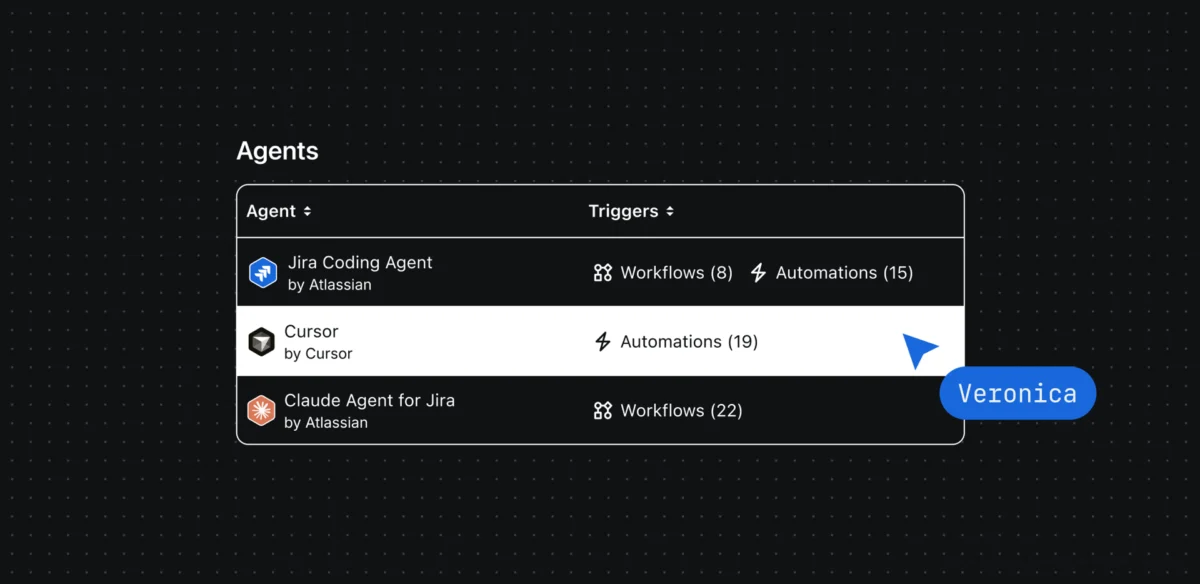
The centerpiece of this effort is the "Jira Agent Usage Dashboard." This tool provides team leaders with a granular view of which agents are being used, how they are integrated into specific workflows, and how they are impacting delivery velocity. By providing a clear, grounded way to understand where AI is helping and where it is failing, the dashboard allows leaders to refine their AI strategies and justify the use of autonomous agents to executive boards.
Furthermore, Atlassian is introducing "AI Review" and "Standards" features. These tools help ensure that the work produced by agents meets the quality benchmarks of the organization. By automating the auditing of agent-generated code against internal standards, companies can maintain high quality-control levels even as the volume of code increases. These features are designed to transform AI from a "black box" into a transparent component of the engineering pipeline.
Atlassian has outlined a phased rollout for these new features to ensure stability and gather user feedback. Currently, "Code Context" is being introduced to paid Atlassian customers through an open beta phase. This allows teams to begin grounding their AI tools in their specific codebases immediately.
More advanced features, including "Agentic Loops," "Standards," and "AI Review," are currently accessible through a private early access program. Atlassian has opened a waitlist for teams interested in participating in these early-stage autonomous workflows.
"Agent Context Controls" and the "Jira Agent Usage Dashboard" are scheduled for general availability for paid Jira customers in the coming months. Additionally, "DX for Agentic Development"—a suite focused on the developer experience—will become generally available for Atlassian DX customers within the current quarter. This phased approach reflects the company’s commitment to "governed" AI, ensuring that each feature is robust enough for enterprise-scale deployment before widespread release.
To further explore these shifts, Atlassian will host the "State of AI SDLC" digital summit on September 22, 2026. This event is tailored for engineering and product leaders and will delve into the findings of the 2026 study, providing a roadmap for how AI is fundamentally changing the planning, building, and running of software. The summit aims to provide a forum for industry leaders to discuss the transition from ad hoc AI usage to integrated, autonomous systems.
The overarching message of Atlassian’s announcement is that the era of "individual magic moments" in AI development is coming to an end, replaced by a need for systemic, scalable, and governed integration. By focusing on context, execution loops, and measurable impact, Atlassian is positioning itself as the foundational platform for the next generation of software engineering.
As engineering organizations face increasing pressure to deliver faster and more complex software, the ability to let "the loop run for you" may become the defining competitive advantage. Atlassian’s new features suggest a future where developers are no longer the bottleneck for execution, but rather the strategic architects who define the intent, set the guardrails, and ultimately approve the progress of an autonomous, AI-driven development lifecycle.