 11
11
At the inaugural Atlassian Unleash 2026 tech summit in Bengaluru, the company transitioned from traditional event management to a live demonstration of its own product ecosystem. Bringing together more than 500 engineering leaders, senior engineers, and product builders, the summit served as a backdrop for the debut of a specialized Progressive Web App (PWA) designed to be the central "product story" of the event. Rather than acting as a simple utility for scheduling, the application integrated AI-powered workflows, real-time production coding, and the full Atlassian technology stack to provide an immersive experience for attendees exploring new ways of working.
The application’s intent was redefined from the outset, moving beyond a standard agenda tool to become a comprehensive platform. Attendees utilized the app to browse schedules, manage personal sessions, view recordings via Loom, and participate in hands-on challenges to earn leaderboard points. Most notably, the app served as a gateway for attendees to contribute directly to its production environment. By building and shipping real code live during the event, participants moved from passive users to active contributors, effectively demonstrating the speed and reliability of the modern developer experience.

Built using React and TypeScript, the PWA served over 500 concurrent users. The development process itself was an exercise in AI-assisted engineering. Atlassian utilized its own tools—Loom for asynchronous context sharing, Rovo Chat for conceptual shaping, and Rovo Dev for scaffolding features directly from Jira tickets—to meet strict deadlines. The resulting architecture was a stateless React PWA sitting atop Atlassian’s platform services. This setup allowed attendees to interact directly with the products: schedules were hosted in Jira, AI-driven queries were grounded in Confluence data via Rovo, and code contributions were deployed through Bitbucket Pipelines.
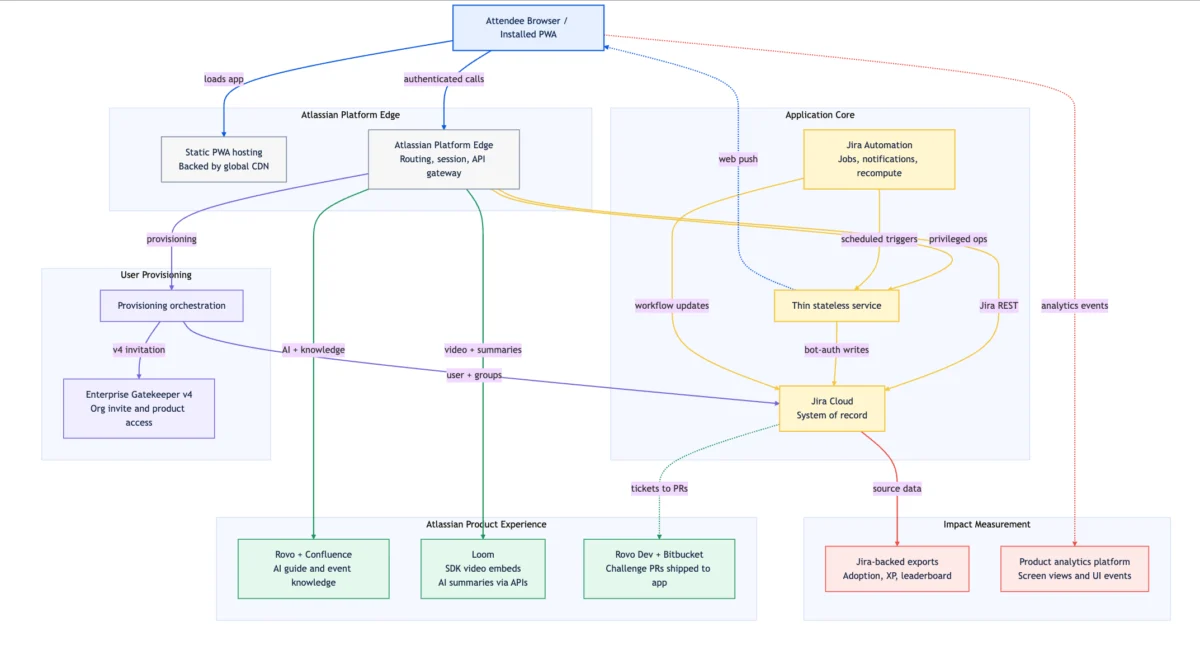
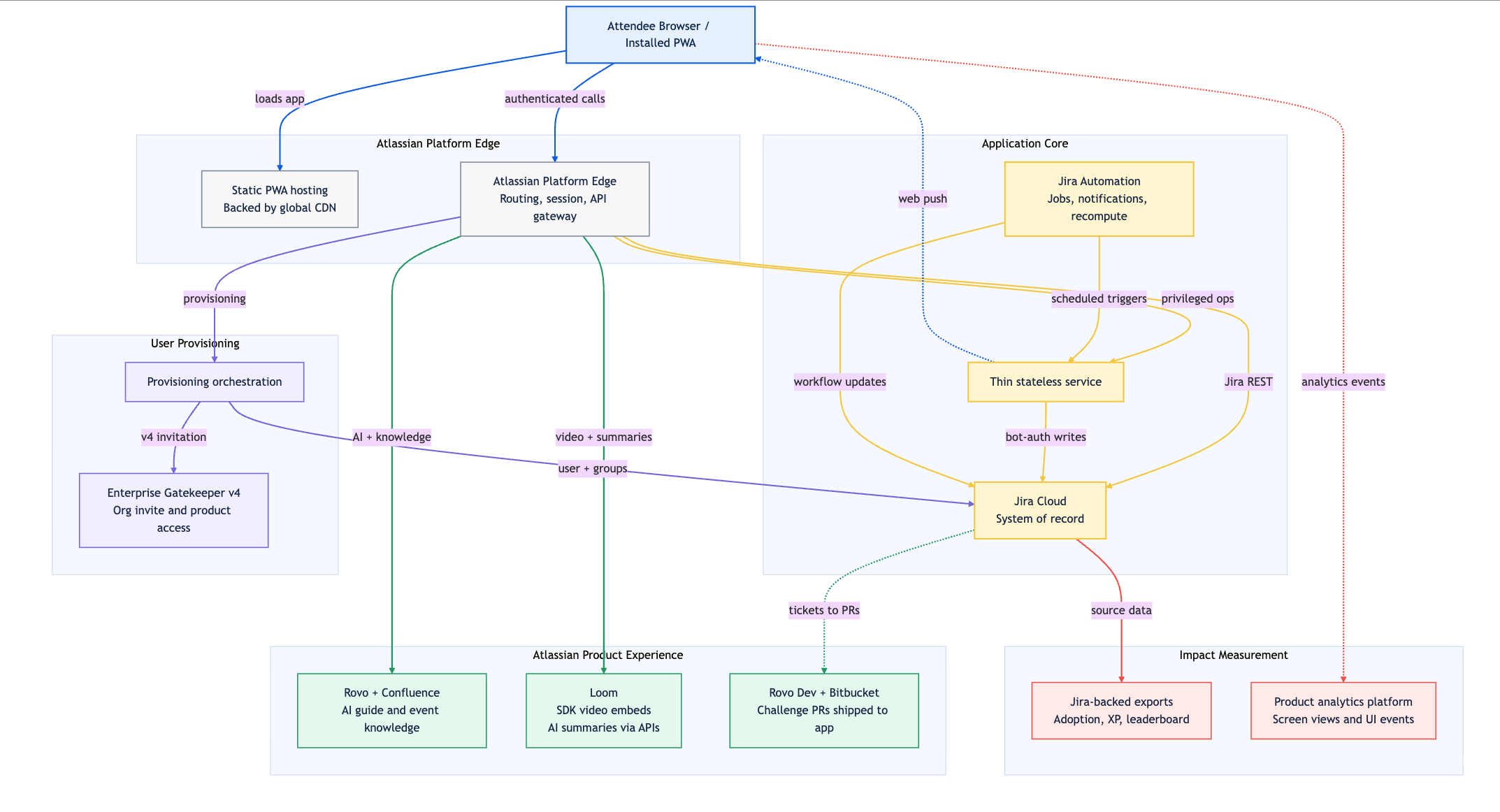
The engineering team designed a five-layer architecture to ensure the Atlassian stack handled the heavy lifting of collaboration, identity management, and deployment. The first layer consisted of the PWA, a static React application hosted on a global Content Delivery Network (CDN) without its own dedicated server. Authenticated calls were routed through Atlassian’s platform edge, which managed session security and API gateway functions.
The second layer established Jira Cloud as the system of record. In a departure from traditional relational databases, the team modeled sessions, speaker profiles, attendee registrations, and leaderboard data as Jira issues with structured fields. This allowed the app to leverage Jira’s REST APIs for both read and write operations. A third, thin stateless service layer was positioned between the PWA and Jira to handle operations requiring elevated privileges, such as bot-authenticated writes and notification signing. This layer held no business state, serving only to secure platform API usage from the browser context.
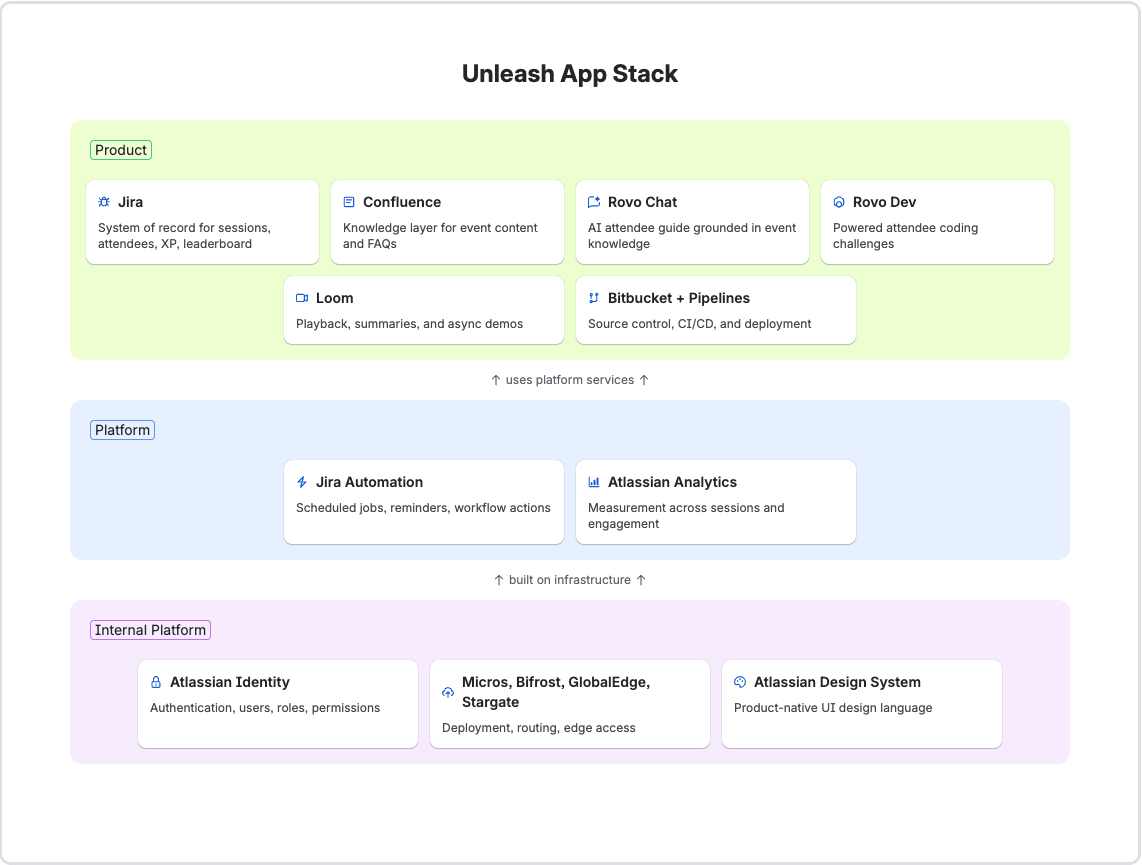
The fourth layer utilized Jira Automation to replace traditional cron services. It managed scheduled tasks including the recomputation of leaderboard totals and the triggering of push notification flows. Finally, a user provisioning layer handled programmatic invitations and product access at the moment of login, ensuring a seamless onboarding experience for the 500-plus attendees. The product experience was further enriched by connecting Rovo and Confluence for the AI event guide, Loom for session summaries, and the combination of Rovo Dev and Bitbucket for the live coding challenges.
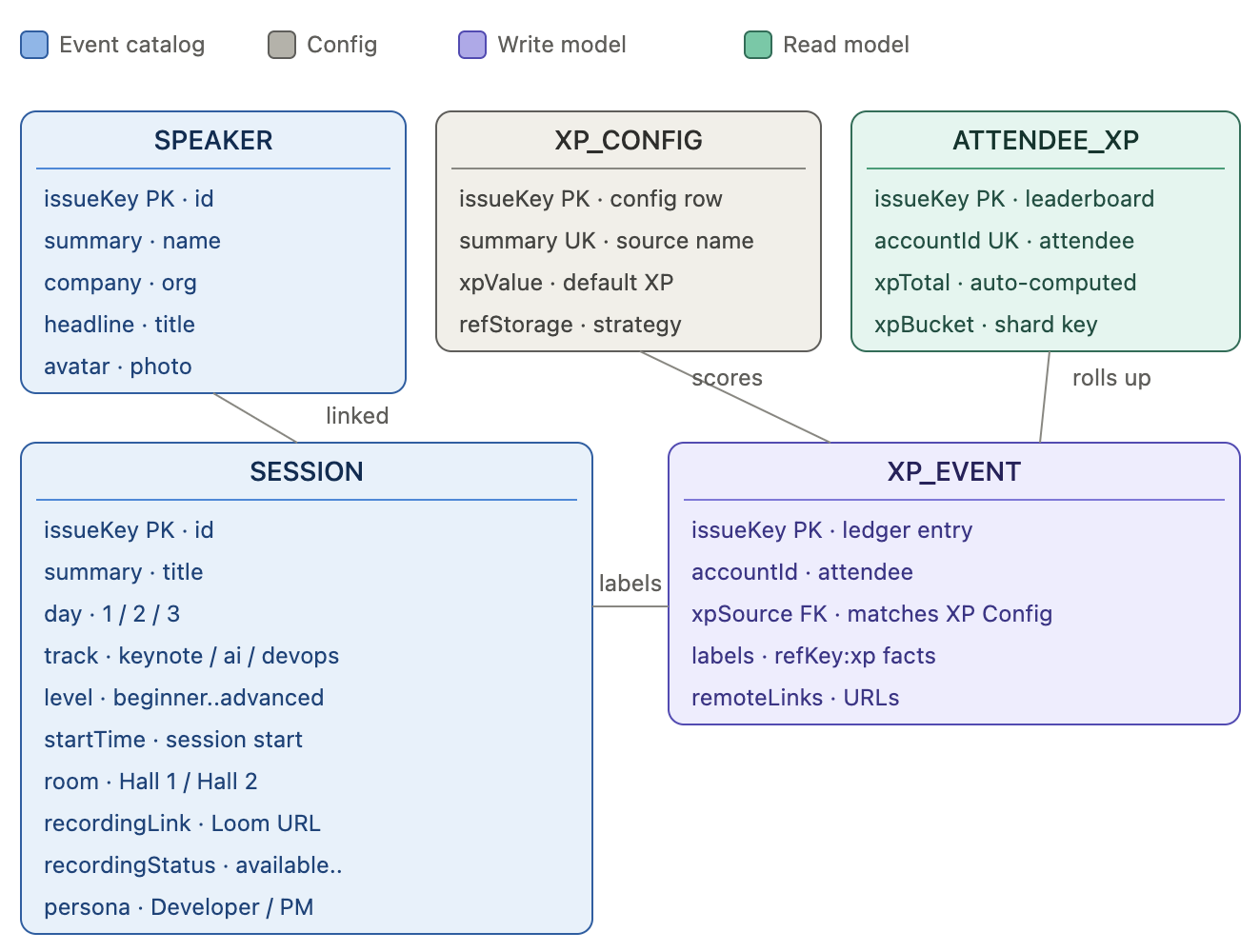
One of the primary engineering hurdles involved modeling the complex facets of a tech summit within Jira. The team identified that event data—such as the link between speakers and sessions—is naturally "workflow-shaped." By using Jira, the developers gained immediate access to permissions, audit histories, and an administrative UI without building custom tools. This meant that any last-minute changes to the agenda or room assignments were handled through simple Jira issue updates rather than code deployments or database migrations.
To manage the complexities of a live environment, the team designed for "eventual consistency." Recognizing that account provisioning and permission propagation could take time, they modeled readiness as a state machine rather than a binary "on/off" switch. The application was built to handle a "converging" state, where it could render cached event data and capture user intent locally while retrying backend delivery in the background. Once the system confirmed full synchronization, it transitioned to a "ready" state where live reads became authoritative.
To support this resilience, the developers implemented a durable local outbox for user actions. When an attendee performed a task, such as enrolling in a session, the app recorded the intent locally before attempting a backend write. An "settled overlay" was maintained in the UI, ensuring that the user’s action appeared successful immediately, even if the underlying read model had not yet reflected the change. This prevented the interface from "flickering" or appearing to undo actions during the latency period between a successful write and an updated read.
Performance optimization was a critical focus following the initial build phase. Early measurements indicated a 12-second load time, which was deemed unacceptable for an event environment. The team conducted a thorough audit using HAR files and Chrome Performance traces, discovering 24 page-load API calls, including eight duplicates, and a massive 7.7 MB unminified JavaScript bundle.
The team addressed these issues through several strategic fixes. First, they implemented a system to deduplicate in-flight requests, allowing multiple React components to share the same data-fetching promise. This reduced page-load calls from 24 to 16. Second, they refined revalidation logic so that the app only refreshed specific categories of data following a mutation, rather than reloading the entire data set. Third, the production build configuration was corrected, shrinking the JavaScript bundle by approximately 80% to 1.53 MB. Finally, the authentication waterfall was restructured to allow returning users to skip the provisioning check, shaving five seconds off the initial load time. By adopting a "stale-while-revalidate" pattern, the app began showing useful local data in less than one second.
The most ambitious aspect of the Unleash app was the live-shipping component. Attendees were encouraged to fix bugs and build features in the app they were currently using. This required a robust CI/CD loop where Rovo Dev, Bitbucket, and Pipelines worked in harmony. During the event, a scheduled infrastructure change upstream temporarily blocked the deployment path. Because the app was built on the standard Atlassian platform, the team was able to use internal incident channels to coordinate a fix with on-call engineers within minutes. This allowed attendee-built features to go live in production just a few hours later, proving the resilience of the operational model.
The impact of this technical approach was reflected in the event’s engagement metrics. Over 500 attendees actively used the app, resulting in more than 1,000 session enrollments. The gamified leaderboard drove significant interaction, and the live coding challenges resulted in over 130 pull requests being shipped to the production environment during the summit.
By utilizing their own stack to solve the practical challenges of hosting a large-scale tech summit, Atlassian demonstrated the capabilities of its AI and platform services in a high-stakes, real-world scenario. The project moved beyond a simple demonstration, providing a transparent look at how modern engineering teams can build, optimize, and maintain complex applications using integrated AI and workflow tools. The success of the Unleash 2026 app highlighted a shift toward applications that are not merely tools for consumption, but active environments for collaborative creation and live deployment.