11

In the modern workplace, the initial phase of a project often presents the most significant psychological hurdle. The "blank page" syndrome—the paralysis that occurs when staring at an empty document—has led many professionals to turn toward generative artificial intelligence as a primary spark for creativity. However, new research from Atlassian’s Teamwork Lab suggests that while AI provides an immediate boost in speed and volume, it may inadvertently erode a team’s sense of ownership and fail to reach the heights of originality achieved through human-to-human collaboration. The study, which included both large-scale controlled experiments and real-world organizational workshops, indicates that the timing of AI’s introduction into the creative process is the most critical factor in determining the quality and emotional resonance of the final output.
The investigation was driven by a fundamental question: Does AI amplify human judgment or replace it? To answer this, the Teamwork Lab designed a two-pronged research approach. The first experiment, conducted in April 2026, involved 797 knowledge workers participating in the Alternative Uses Task (AUT). The AUT is a cornerstone of psychological research used to measure divergent thinking; it requires participants to generate as many creative and unusual uses as possible for a common object—in this case, a paperclip. This experiment was structured into three distinct phases, allowing researchers to compare solo human effort, AI-assisted brainstorming, and collaborative human interaction. After each round, the creativity of the ideas was objectively measured, and participants were asked to self-evaluate their own performance.
The second experiment, conducted in May 2026, moved from the theoretical to the practical. It involved 15 Atlassian Human Resources Business Partners (HRBPs) engaged in high-stakes professional tasks: designing operating models and developing talent retention strategies. These participants were divided into two groups. One group used AI from the very beginning of their 20-minute brainstorming sessions. The second group—the "human-first" group—brainstormed without digital assistance for the first half of the session before introducing AI to polish and refine their ideas in the final ten minutes.
The first major finding of the research highlights the seductive nature of AI efficiency. In the paperclip study, participants who utilized AI tools generated up to 43% more ideas in their initial round compared to the control group working solo. These AI-assisted participants also received higher overall creativity scores in the early stages of the task. A similar trend emerged in the HRBP workshop, where those starting with AI moved significantly faster. Their initial output was 36% more complete and covered 45% more topics than the group that began with human-only brainstorming. This data suggests that AI is an unparalleled tool for overcoming "start-up friction" and rapidly populating a document with a broad range of concepts.
However, this early lead proved to be a temporary advantage. The research found that by the 20-minute mark, once both groups had access to AI for polishing their work, the creativity scores between the AI-first group and the human-first group leveled out. While AI helps teams reach a baseline of "good" ideas more quickly, it does not necessarily raise the ceiling of what a team can achieve by the end of a project. The "speed" of AI acts as a head start, but in the long run, the human-first groups caught up in quality, often with more nuanced results.

The second finding points to a significant hidden cost of AI-driven efficiency: a decline in psychological ownership. While 10 out of 12 participants in the HRBP workshop agreed that using AI first made it easier to get started, they reported feeling "less invested" in the ideas generated. When AI does the "heavy lifting" of the initial ideation, workers feel a sense of detachment from the outcome. The process of struggling with a problem, which is often viewed as a negative friction, appears to be essential for building a connection to the work. Without that initial mental labor, the output feels less like a personal or team achievement and more like a curated list of external suggestions. This lack of connection can have long-term implications for how motivated a team feels to execute those ideas.
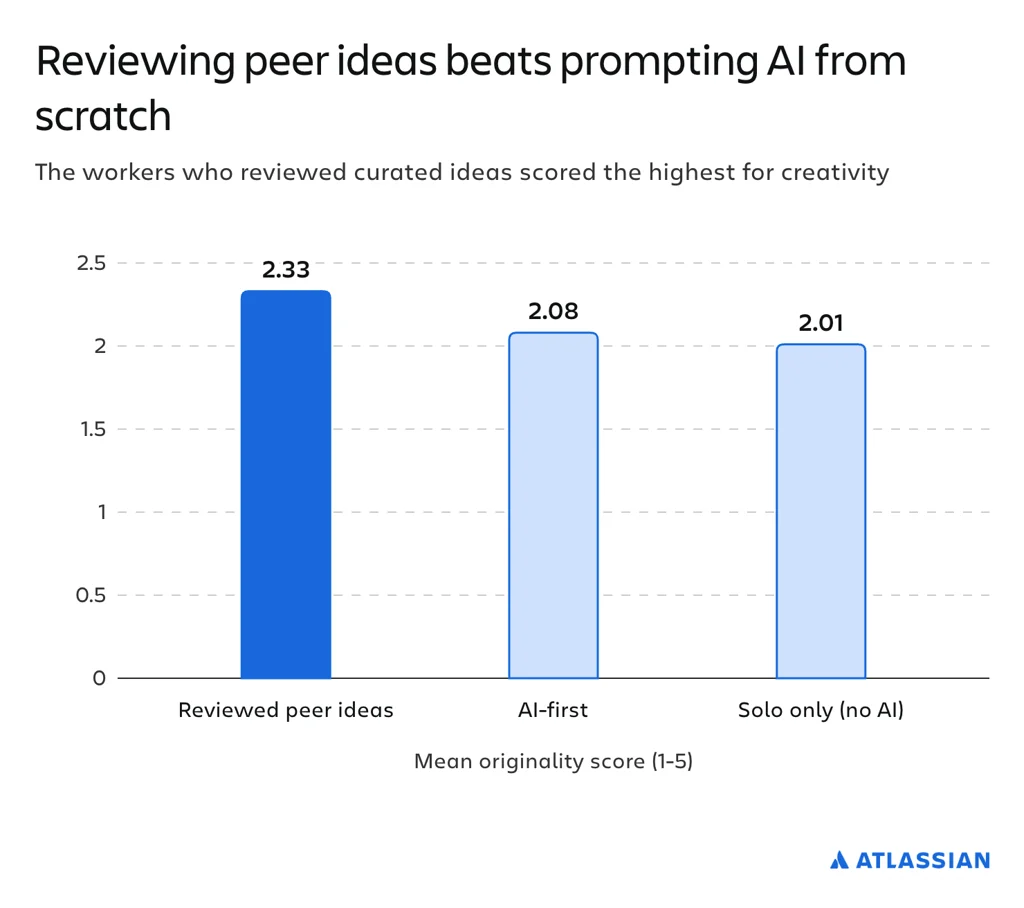
The third and perhaps most vital finding challenges the notion that AI is the ultimate tool for innovation. In the paperclip study, the highest levels of originality were not found in the AI-assisted rounds. Instead, peak creativity occurred through human cross-pollination. Workers who reviewed a colleague’s raw ideas before brainstorming on their own (without AI) outperformed every other group. These individuals scored 18% higher in originality than those working entirely solo and 11% higher than those who used AI directly.
Sara Gottlieb-Cohen, the Distributed Work Insights Lead at Atlassian’s Teamwork Lab, noted that the "secret ingredient" to breakthrough thinking is the human process of curating and expanding upon another person’s thoughts. While a Large Language Model (LLM) can provide volume, it lacks the lived experience and idiosyncratic connections that a human colleague provides. Prompting an AI from a blank slate provides breadth, but building on a teammate’s "seed" ideas provides the most significant boost to truly original thinking.
The research also uncovered a "misleading feeling of productivity" that often accompanies AI use. Generative AI significantly reduces the frustration associated with brainstorming, cutting self-reported frustration scores in half. This lack of friction creates a deceptive illusion of creative momentum. When participants were asked to identify which of their brainstorming rounds was the most creative, their guesses were rarely accurate. AI users were particularly poor at judging their own work, identifying their most creative round correctly only 32% of the time, compared to a 40% accuracy rate for those working solo. This suggests that because AI makes the process feel easy, users conflate "ease of use" with "quality of output."
Based on these findings, Atlassian’s Teamwork Lab suggests a strategic shift in how organizations integrate AI into their creative workflows. Rather than treating AI as a "starting gun," teams should view it as a "refiner" and "stress-tester." The recommended framework for high-stakes, original thinking involves three distinct stages. First, the team should be given space to struggle with the problem independently or in small groups to establish ownership and baseline ideas. Second, these ideas should be shared among teammates for cross-pollination, allowing human-to-human interaction to drive originality. Only in the final stage should AI be introduced to expand the scope, check for blind spots, and polish the final presentation.
The bottom line of the research is clear: AI is a powerful tool for routine tasks and high-volume output, but it is not a shortcut for deep, original thought. If the goal is to produce work that is truly unique and to maintain a team that is emotionally invested in the outcome, the human element must remain at the forefront of the initial creative process. By allowing teams to engage with the difficulty of the "blank page" first, organizations can ensure that AI serves to amplify human potential rather than flatten it. The creative value of AI is not found in the tool itself, but in the social and intellectual exchange that happens around its output. To assist teams in navigating this balance, Atlassian has developed an AI Collaboration framework tool designed to help leaders map out exactly when to work solo, when to collaborate, and when to bring in AI assistance.