 11
11
The definition of "shipping" a software feature has long been a point of contention within engineering teams. While code landing in a production environment signifies technical deployment, the broader industry consensus is shifting toward a more holistic view: a feature is not truly shipped until the accompanying documentation accurately reflects the change. For many development teams, however, the synchronization of code and documentation remains a significant manual bottleneck. Atlassian’s DevAI team recently addressed this challenge by implementing Agentic Pipelines within Bitbucket Cloud, a move designed to automate the repetitive tasks associated with maintaining technical documentation and to ensure that documentation evolves in lockstep with the codebase.
Prior to the implementation of this automated system, the DevAI team at Atlassian followed a traditional, manual workflow for every change made to the Rovo Dev Command Line Interface (CLI). This process involved a multi-step chain reaction: developers had to identify every affected documentation page, manually update Markdown files and configuration settings, deploy those updates to a staging or production environment, and verify the rendered output on the public developer portal. If discrepancies were found during the review of the generated pages, the developer had to return to the pull request to make further corrections. This cycle, while essential for maintaining high-quality developer resources, was characterized by the team as repetitive, tiring, and prone to human error.
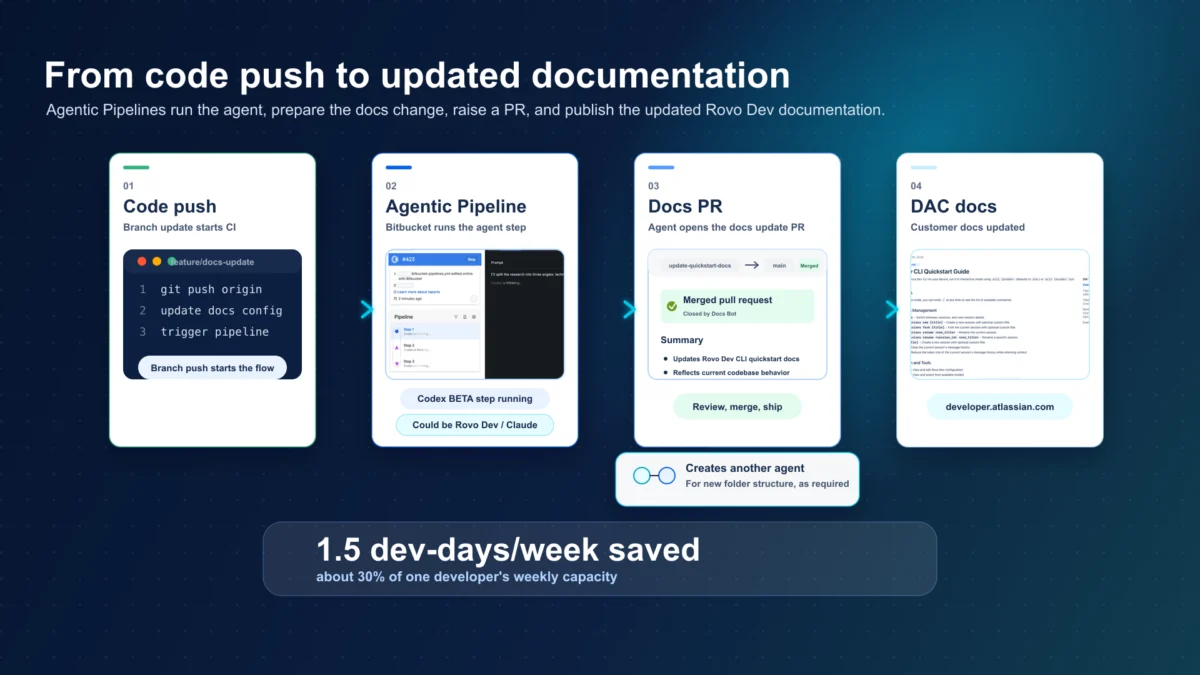
To resolve these inefficiencies, Atlassian explored the possibility of leveraging the same continuous integration and continuous deployment (CI/CD) pipelines that detect code changes to also trigger documentation updates. The result was the development of Agentic Pipelines, a system that utilizes specialized AI agents to handle various aspects of the documentation lifecycle. Rather than relying on a single, general-purpose model, the team created a suite of focused agents, each optimized for specific tasks such as updating release notes, refining quickstart guides, maintaining API documentation, updating configuration references, and logging changes in changelogs.
The technical architecture of these Agentic Pipelines relies on a series of prompts stored directly within the code repository. Each agent is governed by a specific prompt that outlines three core parameters: what parts of the repository it should inspect, what specific elements it is permitted to modify, and what the finalized documentation should look like in terms of tone and structure. These agents are integrated into Bitbucket Pipelines, which are configured to trigger only when changes are detected in relevant source paths. For example, a change within a specific directory—such as "src/commands" or "src/config"—acts as a condition that activates the "update-docs" agent.
Once triggered, the agent reads the context of the repository, analyzes the code changes, and generates proposed documentation updates. These updates are not automatically pushed to production; instead, the agent raises a pull request containing the suggested changes. This maintains a "human-in-the-loop" oversight model, where a developer reviews the AI-generated documentation alongside the code changes before they are merged. This integrated review process allows contributors to see both the functional change and its documented description in a single view, reducing the need for context switching and ensuring that the product’s behavior matches its public-facing instructions.
As the system matured, the Atlassian DevAI team identified a secondary layer of manual labor: the administrative task of setting up new agents for new documentation areas. Every time the documentation structure expanded, a developer was required to write a new prompt, define the agent’s scope, and configure the corresponding pipeline step. To solve this "automation tax," the team developed a "bootstrap agent." This meta-agent is designed to prepare the scaffolding for other agents. When a developer describes a new documentation requirement, the bootstrap agent creates the initial proposed document, writes the necessary task prompt, adds the agent definition to the repository, and updates the pipeline configuration. Like the documentation updates themselves, these structural changes are submitted via a pull request for human approval.
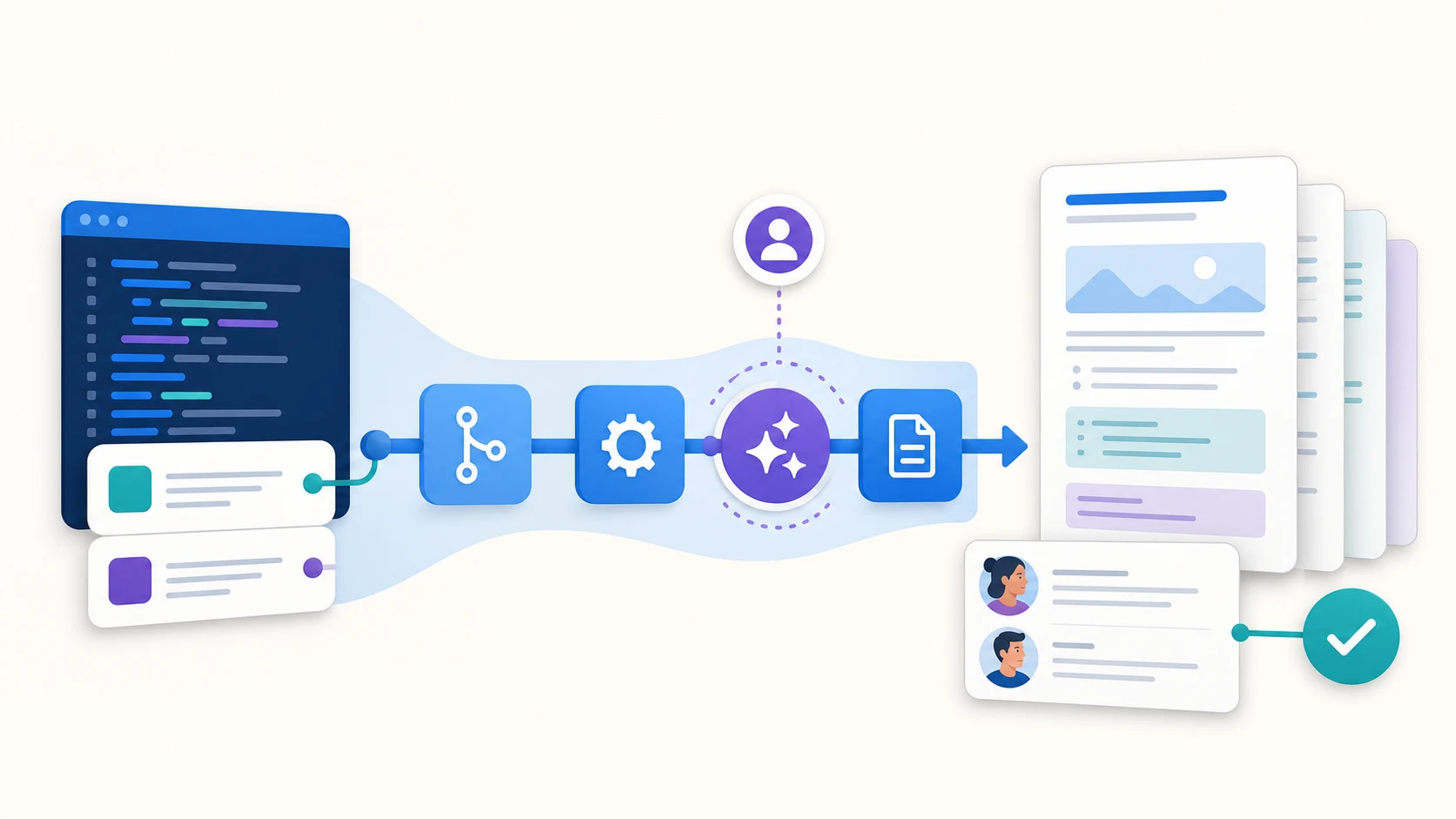
The implementation of the bootstrap agent represented a significant milestone in the experiment, demonstrating that automation can keep pace with a growing repository. As the documentation architecture becomes more complex, the bootstrap agent autonomously proposes the necessary support infrastructure, allowing the automation framework to scale without requiring constant manual intervention from the engineering team.
The impact of shifting to Agentic Pipelines has been quantifiable for Atlassian’s internal teams. The DevAI team estimates that the workflow saves approximately 1.5 developer-days every week. By eliminating the manual overhead of documentation maintenance, developers are able to redirect their time toward solving more complex technical challenges. Beyond the time savings, the team reported a significant improvement in documentation accuracy and a reduction in follow-up tasks. Because the documentation changes arrive simultaneously with the code, the risk of "documentation debt"—where features exist in production but remain undocumented for days or weeks—is virtually eliminated.
From a technical perspective, Atlassian has designed Agentic Pipelines to be provider-agnostic within its supported ecosystem. While the internal DevAI team uses Rovo Dev, the system also supports other AI models and tools, including Claude Code and Codex. Regardless of the underlying AI provider, the fundamental control points remain consistent: focused prompts, precise triggers based on file paths, scoped permissions (such as specific write access to Bitbucket repositories and pull requests), and reviewable outputs. This consistency ensures that the system remains familiar to DevOps engineers who are accustomed to standard CI/CD configurations.
Currently, Agentic Pipelines is available in a beta phase within Bitbucket Cloud. The service is accessible to teams using Rovo Dev, Claude Code, or Codex. To utilize Rovo Dev within this framework, teams require a paid Bitbucket Cloud account with Pipelines enabled and a Rovo Dev Standard subscription. Alternatively, teams can integrate their existing Claude Agent or Codex subscriptions into their Agentic Pipelines.
Atlassian’s findings suggest that the most effective way to implement this technology is to start with narrow, well-defined tasks. Repetitive follow-up actions that occur after a code change—such as updating API references or changelogs—are cited as the ideal starting points for automation. By keeping the agent’s job focused and the trigger conditions precise, teams can ensure that the AI provides high-utility contributions without introducing unnecessary noise into the development workflow.
The transition toward Agentic Pipelines reflects a broader trend in the software industry toward "agentic workflows," where AI does not just provide chat-based assistance but actively participates in the development lifecycle as a functional component of the CI/CD pipeline. By treating documentation as a first-class citizen of the deployment process, Atlassian aims to bridge the gap between engineering output and user comprehension. As the beta progresses, the integration of these agents is expected to become a standard feature for teams looking to optimize their DevOps maturity and maintain high standards of communication with their end users and developers.