11

The landscape of software engineering is currently undergoing a significant shift as routine operational tasks, long considered a necessary burden for developers, are being transitioned to autonomous AI agents. Atlassian has recently detailed its implementation of "Agentic Pipelines" within Bitbucket, a move designed to eliminate the "interruption tax" associated with security vulnerability patching. By leveraging a sophisticated workflow of AI agents and automated triggers, the company has successfully demonstrated a system where engineers can begin their workday with tested pull requests rather than a queue of manual maintenance tickets.
For most engineering teams, the difficulty of routine vulnerability fixes does not lie in the complexity of the code change itself, but in the procedural overhead required to execute them. The standard manual workflow involves picking up a Jira ticket, tracing dependencies, updating packages or container images, regenerating necessary files, running local checks, and opening a pull request. Once the change is deployed, the developer must return to the ticket to close the loop. This repeated handoff and context switching creates a steady drain on sprint capacity, competing with planned feature work even when the engineering decisions involved are straightforward.
To address this, Atlassian developed an agentic automation framework aimed at creating a reviewable path for vulnerability remediation. The goal of the project was to automate the repeatable aspects of security patching while maintaining human oversight where judgment is most critical. In a three-month internal trial, an Atlassian team reported resolving more than 120 vulnerabilities using this method. The system generated over 55 agent-created pull requests that were successfully merged into production. Notably, 95% of these pull requests were merged on the first run without requiring manual rework or failing automated tests. This high success rate suggests that AI agents, when properly constrained and instructed, can handle the deterministic aspects of software maintenance with high reliability.
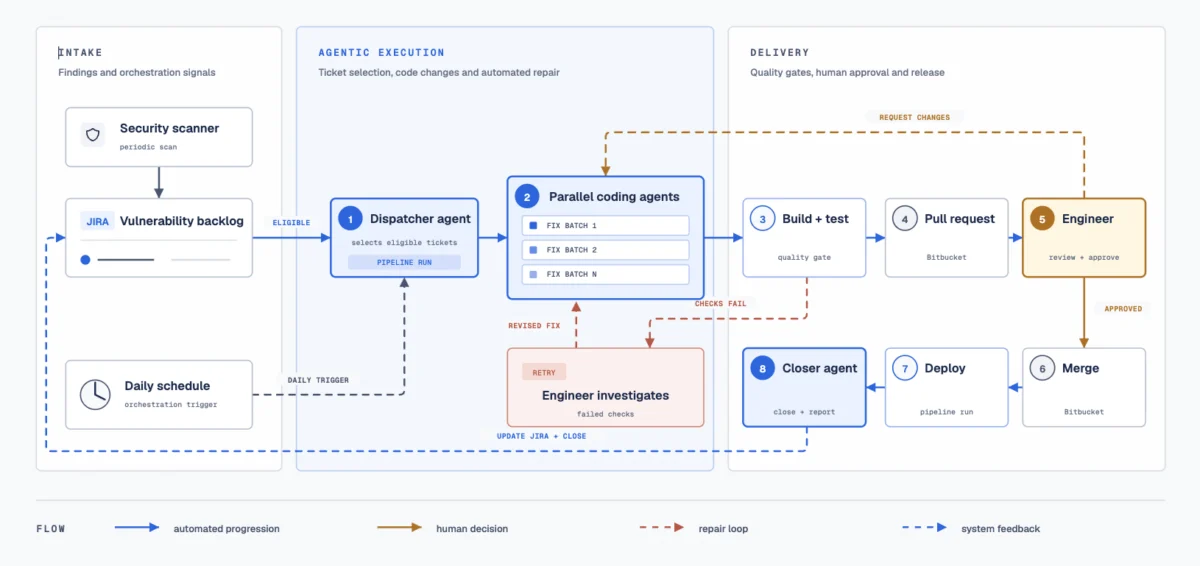
The architecture of this agentic system is built on several integrated components: Jira Automation, a custom dispatcher, Bitbucket Agentic Pipelines, Rovo Dev, and Atlassian Model Context Protocol (MCP) tools. The workflow is divided into three distinct functional roles—the dispatcher, the coding agent, and the closer—each operating with narrow permissions and specific objectives. This separation of concerns ensures that the automation remains manageable and that security protocols are strictly followed.
The process begins with Jira Automation, which schedules the workflow to run at specific intervals, typically before the start of the working day. The custom dispatcher, running as an agentic pipeline, then scans for vulnerability tickets within a configured patch window. The dispatcher is responsible for making four critical decisions: determining if a ticket is old enough to be handled by an agent, checking if the repository is currently in a valid maintenance window, grouping related vulnerabilities to minimize the number of pull requests, and deciding which tickets require manual intervention versus those eligible for automation. Every ticket processed by the dispatcher receives an explicit outcome, ensuring that no work disappears without a clear record of its status.
Once the dispatcher identifies eligible batches of work, it initiates the coding agent. This agent operates within the repository’s actual build environment, providing it with access to the same tools and context as a human engineer. The coding agent receives the ticket context, checks out the relevant repository, and follows codebase-specific instructions stored directly within the repository. These instructions act as a decision tree, guiding the agent through various scenarios. For instance, the agent must distinguish between a direct dependency that requires a simple version bump and a transitive dependency that may necessitate upgrading a parent package. It also handles platform-managed packages and base image updates according to the specific patterns of the codebase.
The coding agent’s responsibilities extend beyond mere text editing. After applying a change, it must regenerate any generated files and run the full suite of builds and tests. If the checks fail or if the required fix does not match the encoded patterns, the agent is programmed to stop the run and report the specific reason for the failure. If the tests pass, the agent creates a new branch and opens a pull request. This ensures that the agent’s work is always subject to the same CI/CD rigor and human review as any other contribution.
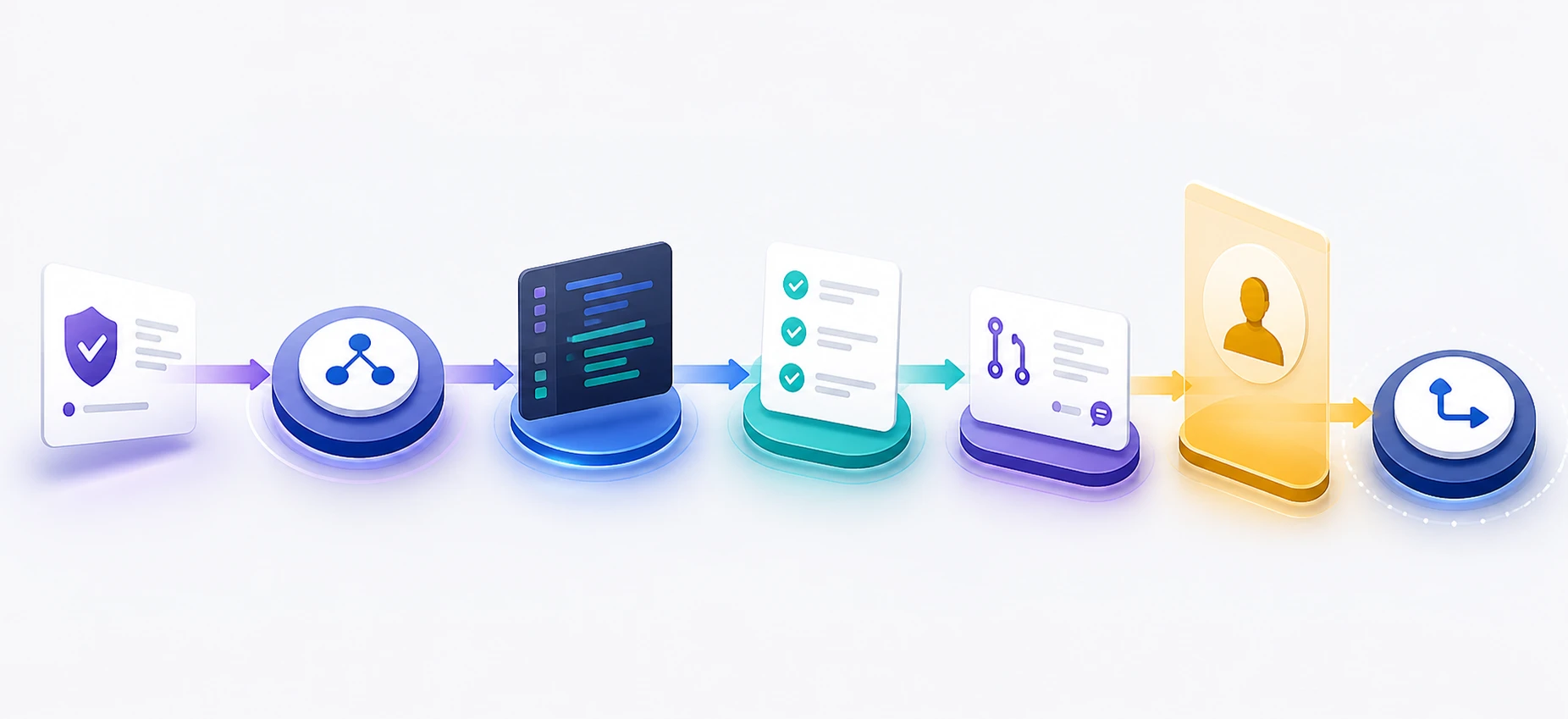
The final stage of the workflow is handled by the "closer." Atlassian engineers noted that opening a pull request is not the end of the remediation process; a vulnerability is only truly resolved once the fix is live in production. After deployment, the closer agent verifies that the pull request was merged and that the deployed environment contains the expected commit. Only after this verification does it transition the Jira ticket for final scanner verification. This idempotent process allows the closer to run repeatedly without duplicating actions, providing a robust audit trail for security compliance.
Atlassian’s findings suggest that the best candidates for agentic automation are not necessarily the largest or most complex tasks. Instead, they are jobs characterized by four specific traits: clear entry conditions, repeatable decisions, deterministic checks, and a clear definition of "done." Routine vulnerability remediation fits all these criteria perfectly. By focusing on these bounded tasks, the company has been able to shift the engineer’s role from performing the work to reviewing the work. The agent prepares the evidence and the code change, while the engineer retains the authority to decide whether the change should ship.
Several key learnings emerged from the implementation of this system. First, the importance of codebase-specific instructions cannot be overstated. Generic AI prompts often produce generic or incorrect fixes; reliability is achieved by storing specific dependency patterns, file locations, and build commands within the repository itself. Second, verification must remain deterministic and human-controlled. The AI model’s output should never act as a release gate on its own; rather, it should be validated by existing build systems, test suites, and mandatory peer reviews.
Third, the system must be designed to fail safely. When an agent encounters an unfamiliar dependency pattern or a failing test, it must provide a clear handoff to a human developer rather than attempting to force a fix. Finally, access must be kept narrow and attributable. By granting write scopes only to the specific pipeline steps that need them and using dedicated provider credentials, organizations can audit automated work without compromising their overall security posture.
The technology powering these agents includes Bitbucket Agentic Pipelines, which is currently in open beta for Bitbucket Cloud. Users can utilize Rovo Dev as an Atlassian-managed provider or integrate third-party models such as Claude Code or Codex. The integration is managed via YAML configurations within the Bitbucket environment, making the agent a versioned part of the delivery system. For example, a "vulnerability-fixer" agent can be defined in the repository’s configuration files, ensuring that its prompts and skills are treated as production assets and are subject to version control.
Beyond vulnerability patching, Atlassian suggests that this agentic pattern is applicable to a wide range of maintenance tasks, including dependency updates, the removal of stale feature flags, documentation maintenance, and the resolution of flaky tests. The transition to agentic workflows represents a move toward putting standard engineering maintenance on "autopilot," allowing development teams to reclaim time for innovation while maintaining a high standard of security and code quality.
As the industry moves forward, the focus is expected to remain on how these agents can be further integrated into existing DevOps toolchains. For now, the successful automation of over 120 vulnerabilities at Atlassian serves as a practical blueprint for organizations looking to reduce the operational burden on their engineering staff through the use of AI-driven agentic pipelines. The company encourages teams to start with small, bounded tasks and use first-run failures as data points to refine agent instructions, eventually scaling the automation across the entire development lifecycle.