11

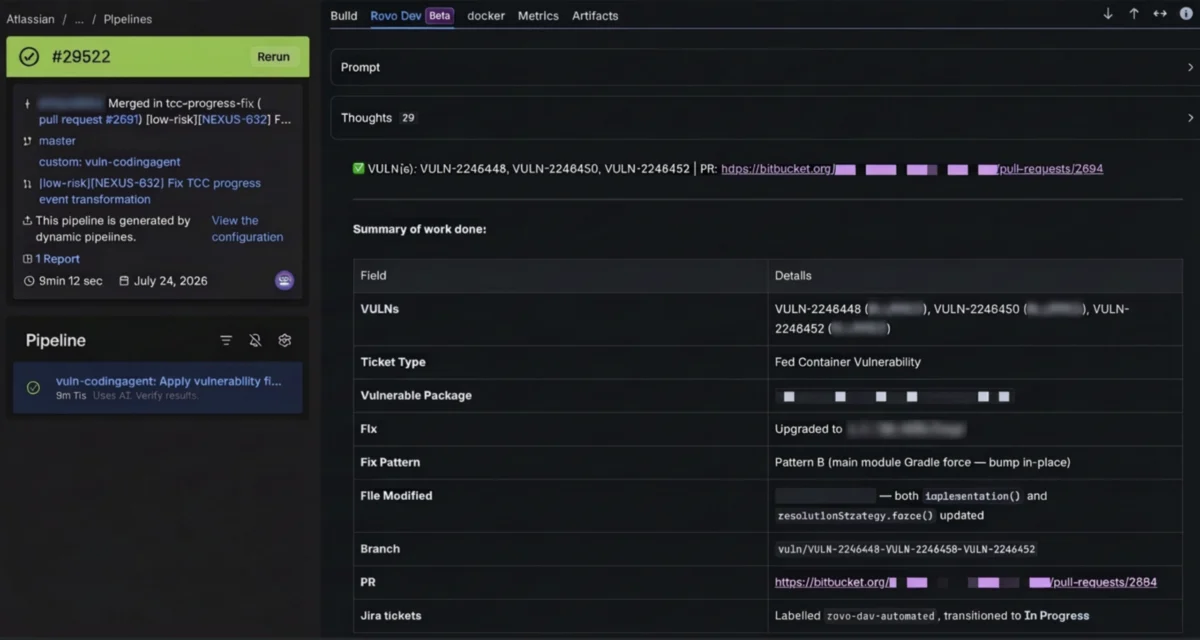
The landscape of modern software engineering is increasingly defined by a dichotomy between creative problem-solving and the repetitive maintenance required to keep complex systems secure and operational. Atlassian has addressed this challenge by unveiling a new framework for autonomous engineering workflows, specifically targeting the "interruption tax" associated with routine tasks. By integrating Bitbucket Agentic Pipelines, Rovo Dev, and the Atlassian Model Context Protocol (MCP), the company has demonstrated a system capable of identifying, fixing, and closing security vulnerabilities with minimal human intervention. This shift aims to transition engineering teams from the "execution layer" of predictable work to a "decision layer" focused on high-level oversight and architectural judgment.
Every engineering department carries a backlog of work that is functionally important but lacks intellectual stimulation. These tasks typically follow a predictable sequence: identifying a change, understanding the context, implementing a fix, verifying the solution, and updating documentation or ticketing systems. Security vulnerabilities represent the most prominent example of this category. They arrive at a constant rate, carry strict deadlines, and generally follow established playbooks for remediation. While no single ticket is overwhelming, the cumulative cost—encompassing context-switching, sprint planning, and post-deployment bookkeeping—creates a significant drag on productivity across quarters and teams.

To combat this, Atlassian’s autonomous system utilizes a three-part architecture: a dispatcher to identify and triage work, a coding agent to execute the remediation, and a closer to verify the deployment and finalize the administrative lifecycle of the task. The implementation relies on standard Atlassian platform capabilities, meaning teams using Bitbucket Cloud with Agentic Pipelines enabled can deploy these autonomous workflows immediately. The core philosophy of this approach is that the agents and their instructions live within the application repository, allowing them to be versioned, reviewed, and managed with the same rigor as source code.
The technical foundation of this system rests on Bitbucket Agentic Pipelines, which allows developers to define AI agents as versioned pipeline steps. These steps invoke Rovo Dev in a non-interactive mode. All prompts, configurations, and "skills"—reusable units of codebase-specific knowledge—are stored in a dedicated .rovodev directory within the repository. This structure ensures that the AI’s operating boundaries are explicit. For instance, a pipeline-config.yml file defines the Large Language Model (LLM) to be used, such as Claude 3.5 Sonnet, and specifies which tools the agent is permitted to access. These permissions might include searching Jira issues using JQL, transitioning issue statuses, and creating or managing pull requests.
The first stage of the workflow is managed by the Dispatcher. Unlike a simple automation rule that blindly forwards tickets, the Dispatcher is an intelligent agent triggered by scheduled Jira automation. Its primary role is to make four critical decisions before any code is modified. First, it fetches eligible work items from the backlog. Second, it classifies which items are suitable for automation based on the complexity of the required fix. Third, it deduplicates and batches items that share an underlying root cause or require the same dependency update. Finally, it dispatches a specific coding agent run for each batch and reports the outcome for every item. This ensures transparency, as every vulnerability is either addressed, grouped, or flagged for manual intervention.

Once work is dispatched, the Coding Agent takes over. Its primary objective is to apply the necessary fix and open a pull request. The Coding Agent’s prompt is designed to be "thin," acting as a harness rather than a repository of domain knowledge. The actual logic for fixing vulnerabilities is stored in a "Skill"—a structured instruction set that encodes institutional knowledge specific to the codebase. This skill defines how the agent should navigate a decision tree similar to one an engineer would follow.
The decision tree within the "fix-vulnerability" skill covers various scenarios. If a vulnerability exists in an application dependency, the agent determines if it was directly declared, in which case it bumps the version. If the vulnerability is in a transitive dependency, the agent checks if upgrading the parent package will resolve the issue or if a strict constraint must be overridden. For vulnerabilities in base container images or sidecar containers, the agent identifies whether it should update a pinned version or if the version is platform-managed and thus outside its scope. This codified institutional knowledge ensures that the agent does not guess but follows the specific frameworks, conventions, and dependency patterns of the organization.
The final step in the autonomous loop is the Closer. Triggered after a deployment, the Closer verifies that the fix is actually live in the production or staging environment. Its instructions guide it to find the relevant work items, confirm that the corresponding pull requests were merged, and ensure that the deployed build includes the specific changes. Only after establishing this evidence does the agent transition the Jira ticket to its final state. This workflow is designed to be idempotent, meaning it can be re-run safely without creating duplicate actions or closing items prematurely.

The impact of this system on the daily life of a software engineer is significant. In a traditional environment, an engineer is notified of a ticket, finds space in a sprint, reads the ticket, identifies the culprit package, makes the change, runs tests, opens a PR, and eventually returns to close the ticket after deployment. In the autonomous model, the engineer’s role is reduced to reviewing and merging a pre-prepared pull request. Because the Dispatcher can run daily before working hours, engineers often start their day with fixes already waiting for their approval. If the agent encounters a scenario requiring human judgment or if the automated build fails, it stops and reports the issue rather than attempting to force a broken change through the pipeline.
The results of this implementation are described as fully autonomous, requiring zero engineer effort beyond the final code review. This allows the backlog of security vulnerabilities to drain continuously rather than accumulating until a dedicated "sprint cleaning" is required. Engineers are freed from the execution layer of predictable maintenance, allowing them to focus on innovation and complex problem-solving.
Atlassian emphasizes several key principles for getting these autonomous systems right. First, the prompts must be viewed as the system itself. Because they encode institutional knowledge in a versioned and reviewable form, they are the most critical investment. Second, generic prompts are insufficient; they must be specialized for the specific codebase and architectural patterns they serve. Third, the system must be refined through iteration on real-world runs, using failure logs to continuously tighten the logic and improve the merge rate of automated pull requests.

Furthermore, verification is a non-negotiable component of the framework. The agent must run the full build and test suite before opening a pull request. If the tests do not pass, no pull request is created, ensuring that the system remains trustworthy. The use of dedicated service accounts is also recommended, as it ensures that automated work is clearly distinguishable from human contributions in the pull request feed and removes ownership ambiguity.
While security vulnerability remediation is the primary use case presented, Atlassian notes that this framework is applicable to any repetitive, scheduled task with a clear definition of success. The release of Rovo Dev and Agentic Pipelines suggests a broader move toward "autopilot" workflows in software development, where AI agents handle the logistical and predictable aspects of the software lifecycle, leaving the creative and strategic decisions to human developers. The question for engineering teams is no longer whether such automation is possible, but which of their repetitive workflows they will choose to put on autopilot first.