 11

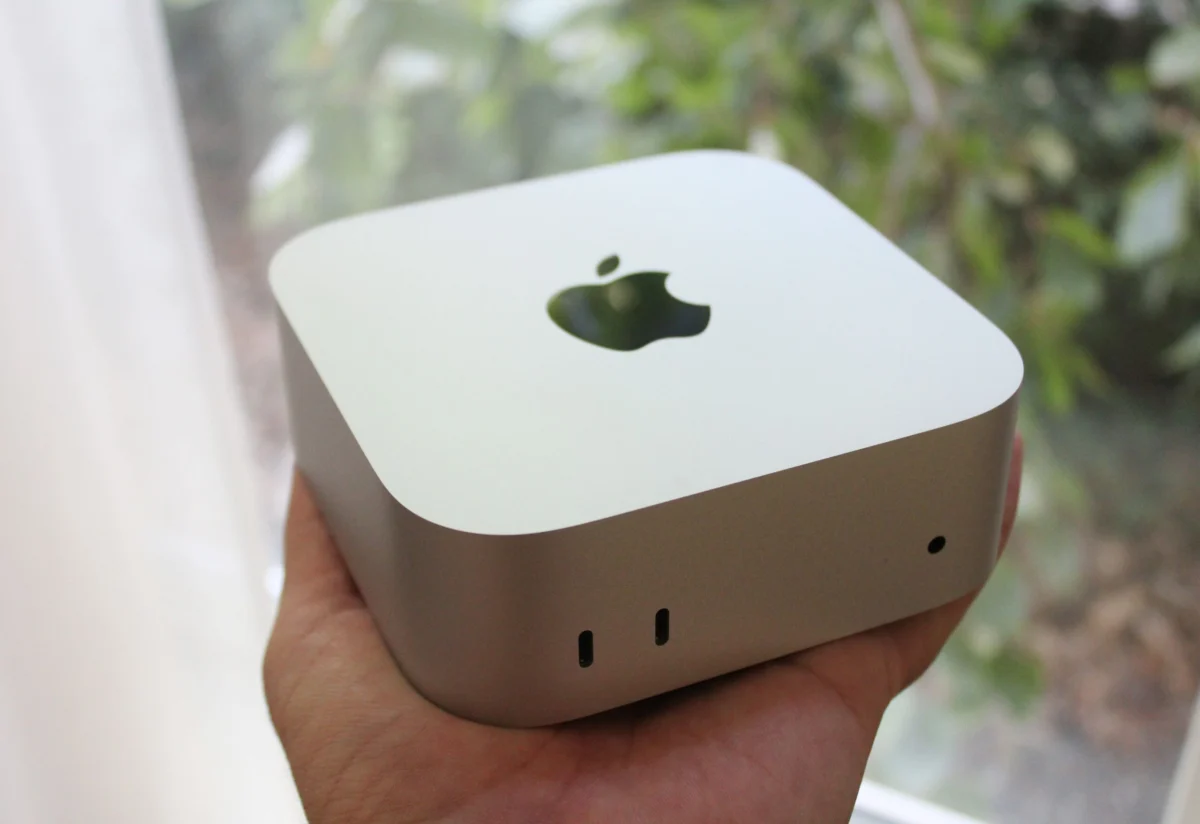
Apple has introduced its latest iteration of the Mac Mini, featuring the formidable M6 chip, marking a significant advancement in performance while largely maintaining its familiar external design and port configuration. This release positions the compact desktop computer as a powerful contender for users seeking a blend of high-end processing capabilities and a space-saving form factor, though some long-standing design quirks and feature omissions persist.
Connectivity: A Robust Array for Modern Workflows
The new Mac Mini retains a comprehensive suite of connectivity options, strategically placed for both convenience and high-speed data transfer. On the front, users will find two forward-facing USB-C 3 ports. These ports offer data transfer speeds of up to 10 gigabytes per second, making them ideal for connecting frequently accessed peripherals such as external SSDs, webcams, or charging mobile devices. Alongside these, a standard headphone jack provides audio output, and a subtle power indicator light keeps users informed of the device’s operational status. The front-facing placement of these ports is a practical choice, enhancing accessibility for everyday connections.
The rear panel of the Mac Mini is where the true power user connectivity resides. Here, Apple has equipped the device with three Thunderbolt 4 ports. Thunderbolt 4 represents a significant leap in connectivity, offering a staggering 40 gigabytes per second of bidirectional bandwidth. This enables a single port to handle multiple high-resolution displays, external GPUs, vast arrays of external storage, and network adapters simultaneously, all while delivering power. This level of versatility makes the Mac Mini a suitable hub for professional creative workstations.
Complementing the Thunderbolt ports is an HDMI 2.1 port, providing native support for high-resolution and high-refresh-rate displays. HDMI 2.1 is crucial for connecting to modern 4K and 8K televisions and monitors, offering features like variable refresh rate (VRR) and enhanced audio return channel (eARC). An Ethernet jack ensures reliable wired network connectivity, which is often preferred in professional environments for its stability and speed over Wi-Fi. Finally, the power adapter port rounds out the rear connectivity, maintaining the Mac Mini’s clean aesthetic by keeping power cables out of sight.
Advanced Display Support for Professionals
One of the standout features of the M6 Mac Mini is its robust support for external displays. Leveraging the available USB-C ports (which can also carry DisplayPort signals via Thunderbolt) and the dedicated HDMI 2.1 port, the device can drive an impressive array of high-resolution monitors. Users have the flexibility to connect up to two 5K external displays running at a smooth 120 Hz refresh rate. This capability is particularly beneficial for professionals in fields such as graphic design, video editing, and software development, where screen real estate and visual fidelity are paramount. Compatible displays include high-end options like the Apple Studio Display XDR or the BenQ 5K MA270S, offering pixel-perfect clarity and color accuracy. Alternatively, the Mac Mini can support up to three 4K displays, providing an expansive workspace for complex multitasking and immersive computing experiences. This level of display flexibility underscores the Mac Mini’s potential as a powerful workstation despite its compact size.
Design Philosophy: A Mix of Convenience and Controversy
While the internal components see a significant upgrade, the external design of the Mac Mini remains largely unchanged. This includes a design choice that has consistently drawn criticism from some users: the placement of the power button. It remains discreetly hidden underneath the back-left corner of the computer. For those familiar with its location, a simple tilt of the device allows for easy access. However, for new users or those who frequently forget its exact spot, powering the device on or off can necessitate flipping the entire unit over, a cumbersome task especially when multiple cables are attached. This design decision prioritizes a minimalist aesthetic, keeping the front and sides of the device clean, but at the cost of practical accessibility for a fundamental function. While some might deem it a minor inconvenience, it reflects Apple’s enduring commitment to certain design principles. It is, however, generally considered less problematic than the infamously bottom-mounted charging port of the Apple Magic Mouse, which prevents simultaneous charging and use—a design choice that has become a recurring point of user frustration.
Feature Wishlist: SD Card Slot and Color Options
Despite its comprehensive port selection, the Mac Mini still lacks an integrated SD card slot, a feature that many creative professionals continue to desire. Unlike the Mac Studio, which offers a convenient, forward-facing SD card slot, Mac Mini users, particularly photographers and videographers, will need to invest in an additional external dock or adapter to transfer media from their cameras. This adds an extra peripheral to their setup and slightly detracts from the Mac Mini’s otherwise self-contained nature for professional workflows.
Furthermore, while the Mac Mini maintains its signature silver aluminum finish, some users express a wish for more color options, similar to the vibrant array available with the iMac line. Personalization through color could enhance its appeal in various home and office environments. Nevertheless, the Mac Mini continues to be recognized for its well-built, compact mini PC form factor, a testament to Apple’s engineering and industrial design. The real transformation and "extra value" in this latest generation, however, lies beneath its familiar exterior, within its advanced performance capabilities.
AI Gains: The Dawn of the M6 Chip
The introduction of the M6 Mac Mini represents a pivotal moment for Apple Silicon, offering the first glimpse into the next generation of Apple’s custom-designed chips. The M6 chip is built on a cutting-edge 2-nanometer (2nm) process node, a significant technological leap in semiconductor manufacturing. This smaller process node allows for an unprecedented increase in transistor density, with the M6 boasting a remarkable 46 billion transistors on its die. This represents approximately a 35 percent increase in transistor density compared to previous generations, directly translating into higher efficiency and enhanced performance. The move to a 2nm process node signifies a major step forward in chip design, enabling more complex circuitry to be packed into the same physical space, leading to faster computations and lower power consumption. This foundational improvement is critical for driving the "AI Gains" that Apple is increasingly integrating into its ecosystem.
The M6 chip also brings substantial improvements to its central processing unit (CPU). It features a total of 12 CPU cores, an increase of two cores compared to the M4 model. This architectural enhancement yields tangible performance benefits: a 21 percent increase in single-thread performance and a notable 36 percent improvement in multi-threaded workloads when compared to its M4 predecessor. Single-thread performance is crucial for the responsiveness of individual applications and general system fluidity, while multi-threaded performance dictates the speed at which complex tasks like video rendering, code compilation, and professional content creation can be executed.
While these numbers are impressive in isolation, a comparative analysis reveals the M6’s positioning within Apple’s broader chip lineup. When stacked against the M5 chip found in the MacBook Air, the M6’s performance gains, though present, are not as substantial as the generational leap might suggest. However, the two additional CPU cores in the M6 Mac Mini provide a noticeable boost in multi-threaded performance, even surpassing the base M5 chip in this specific metric. Comparing desktop-class chips like the M6 in the Mac Mini to chips designed for laptops, such as the M5 in the MacBook Air or the M5 Pro in the MacBook Pro, inherently presents challenges due to differences in power envelopes and thermal designs. The M6 Mac Mini, for instance, shows approximately a 10 percent faster single-threaded performance than the M5 Pro chip in the MacBook Pro, though it understandably falls further behind in multi-threaded performance against the more powerful Pro variant designed for heavier workloads.
The "AI Gains" highlighted by the M6 chip are primarily driven by advancements in Apple’s Neural Engine. While specific details on the M6’s Neural Engine cores or throughput were not provided, the general trajectory of Apple Silicon indicates continuous improvements in on-device machine learning capabilities. An enhanced Neural Engine accelerates tasks such as image recognition, natural language processing, video analysis, and intelligent recommendations directly on the device, without relying heavily on cloud services. This not only improves privacy but also offers faster, more responsive AI-driven features in applications for photo and video editing (e.g., object detection, background blur), accessibility (e.g., live captions, voice control), and creative workflows. The M6’s robust core count and advanced architecture are foundational for supporting these increasingly sophisticated AI features across macOS.
Thermal Management: Sustained Performance Through Active Cooling
Unlike some of Apple’s more compact or ultra-portable devices, the Mac Mini has always incorporated an internal fan for active cooling. This design choice is critical for maintaining sustained peak performance, especially under heavy workloads that fully leverage the M6 chip’s capabilities. When engaged in demanding tasks, such as rendering high-resolution video, compiling large software projects, or running intensive scientific simulations, users will likely notice the fan beginning to make some noise. While not described as excessive or disruptive, this audible presence differentiates it from fanless devices like certain MacBook Air models, which rely on passive cooling and may experience thermal throttling—a reduction in performance to prevent overheating—during prolonged strenuous activity.
The active cooling system in the Mac Mini ensures that the M6 chip can operate at its higher performance thresholds for extended periods without significant degradation. This is a key advantage for a desktop computer intended for professional use, where consistent performance is paramount. This active thermal management system allows the M6 Mac Mini to extract stronger, more consistent performance from the M6 chip than would be possible in a passively cooled device like an M6 MacBook Air, which is anticipated to launch in 2027. This proactive approach to heat dissipation underscores the Mac Mini’s design as a workstation-grade machine capable of handling demanding computational tasks with reliability.






