11

Anthropic has begun embedding an invisible, machine-readable watermark into all content generated by its AI model, Claude. This invisible mark is integrated directly into the text, designed to withstand copy-pasting and modifications, and will be implemented across all global versions of Claude. The move comes as a direct response to new European Union legislation mandating the labeling of AI-generated content.
For most marketers, this development is unlikely to cause significant concern. The integration of AI into everyday marketing tools has become ubiquitous. Platforms such as Gmail, Google Docs, Canva, Figma, Photoshop, Word, Notion, Slack, Grammarly, and LinkedIn now routinely feature AI-powered functionalities. In this landscape, identifying a marketing tool without AI assistance is becoming increasingly difficult. The primary issue arises only when AI-generated work is misrepresented as entirely human-created, especially when contractual agreements or promises dictate otherwise. For those who are transparent about their content creation processes, the presence of a watermark should not be a cause for alarm.
Anthropic’s announcement details the implementation and functionality of this watermarking system, highlighting its scope and limitations. According to Anthropic’s support documentation, the detected mark signifies that content "may have been processed by Claude." This wording is crucial, as it implies Claude’s involvement in the creation or modification process, rather than definitive authorship. For instance, if a user pastes their own draft into Claude for grammar correction, translation, or summarization, the resulting output may carry the watermark. This indicates that Claude was part of the workflow, but it does not attribute the original writing to the AI.
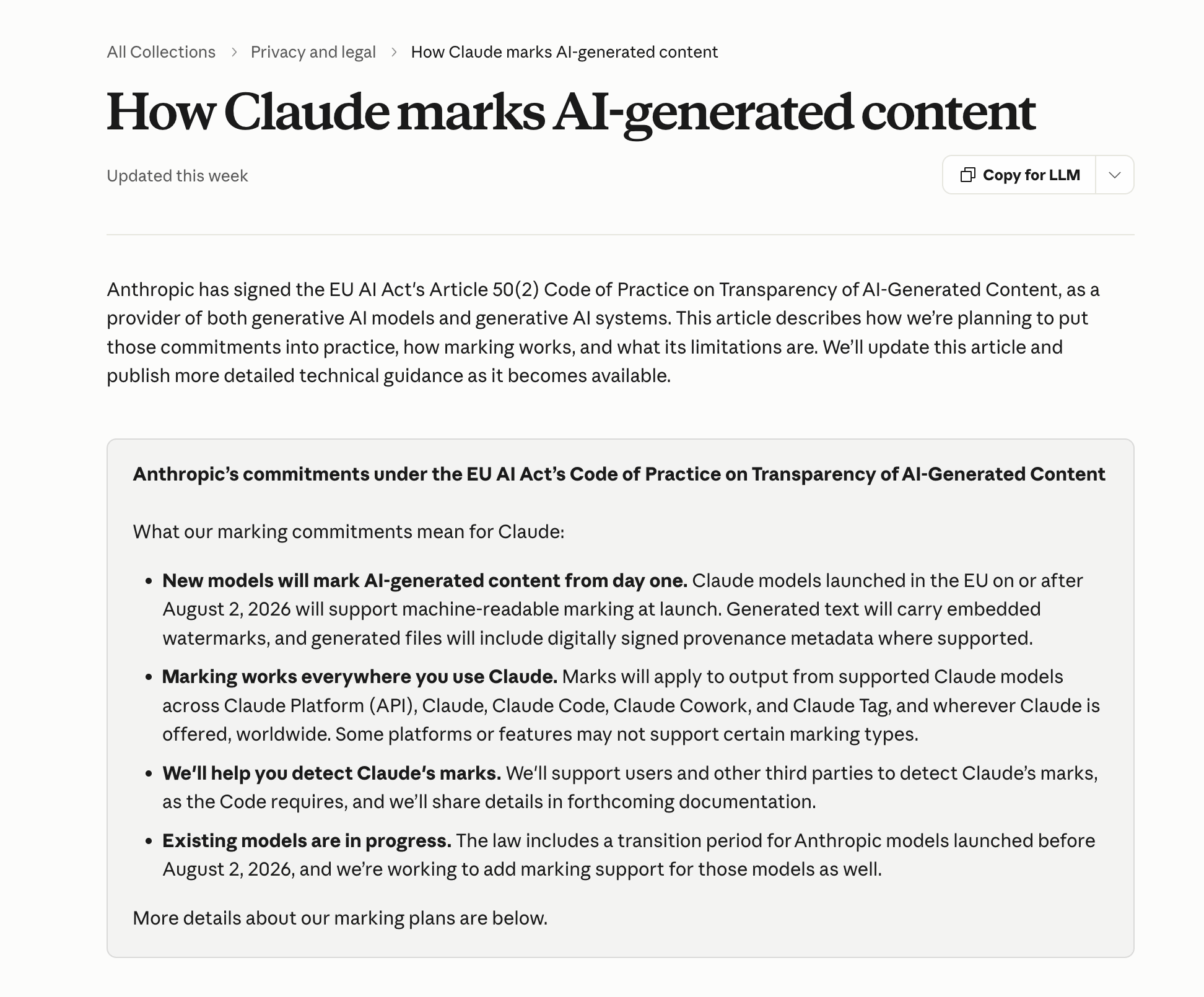
Anthropic also emphasizes that the absence of a watermark does not definitively prove content is human-generated. Watermarks can be undetectable in short passages of text, following extensive rewriting, or after format conversions that strip file metadata.
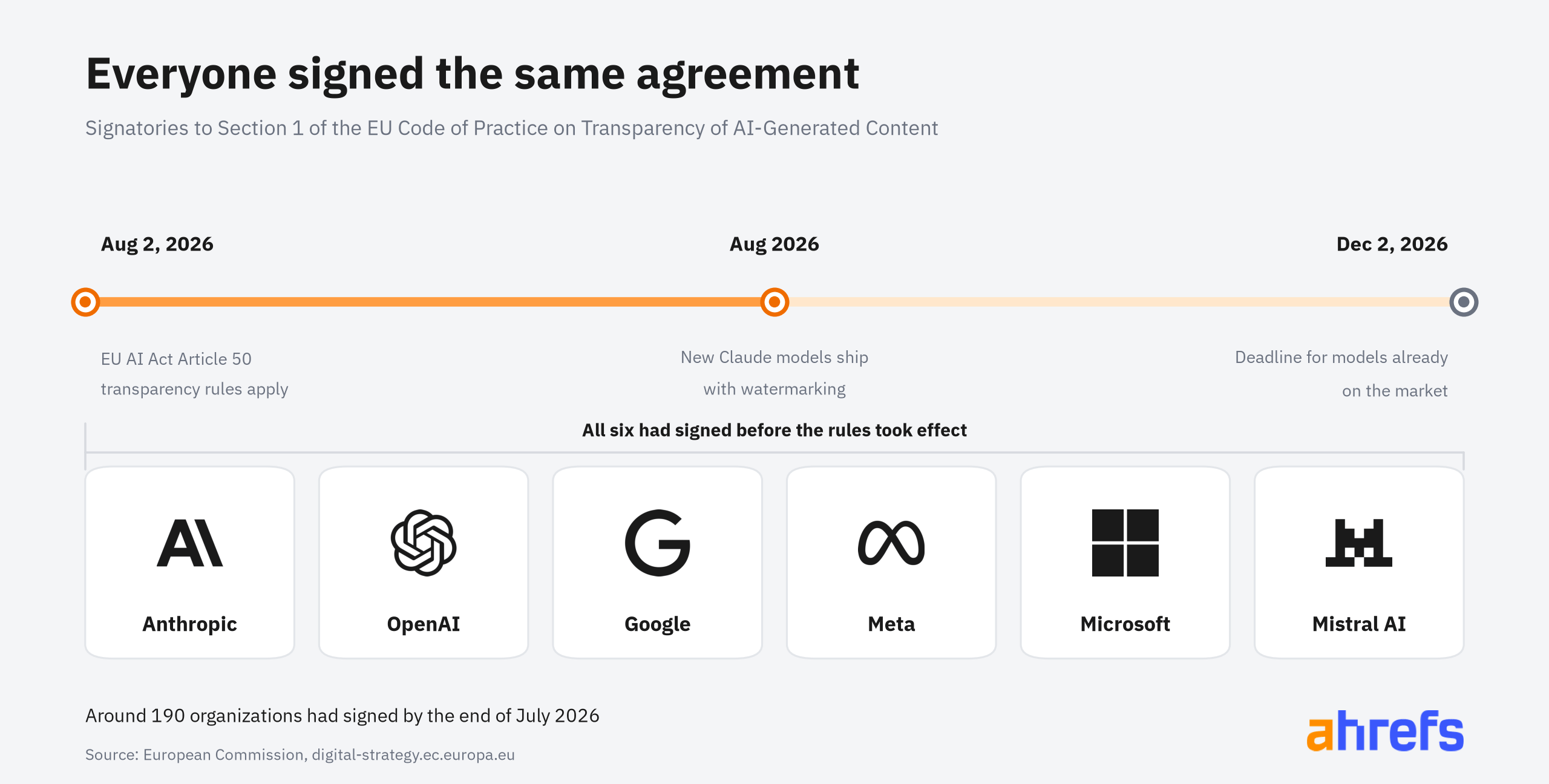
The implementation of AI content watermarking is expected to become a standard across all major AI providers. Anthropic’s decision to implement watermarking is driven by its compliance with Article 50 of the EU AI Act, which became applicable on August 2, 2026. This article mandates that providers of generative AI systems must mark their output in a machine-readable format. While Anthropic is the first to implement this and gain public attention, all major AI providers have committed to the same obligation. Therefore, switching to a different AI model will not exempt users from eventual watermarking requirements.
Beyond the obligation for AI providers, Article 50(4) of the EU AI Act also impacts publishers. It requires disclosure when AI-generated text is published to inform the public on matters of public interest. However, guidance from the European Commission clarifies that this requirement does not apply if the text has undergone human review or editorial control, and a natural or legal person holds editorial responsibility for the publication.
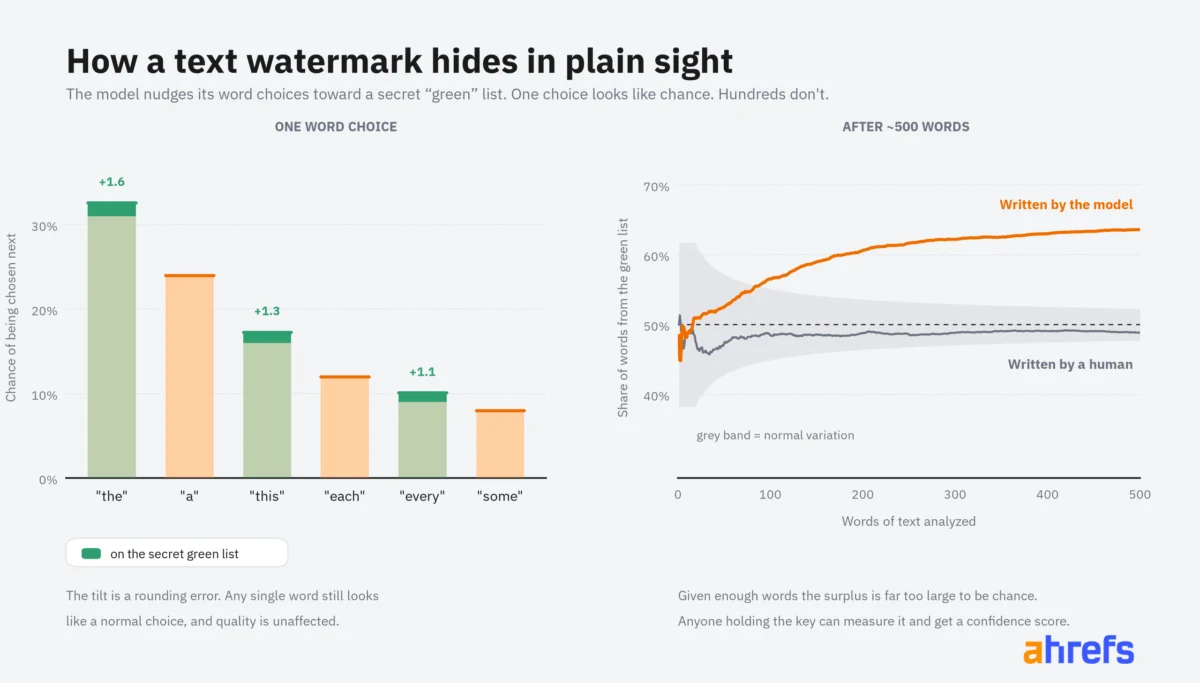
The technical mechanism behind watermarking involves subtle nudges in the AI model’s word choices. When a Large Language Model (LLM) generates text, it predicts the next token (a word or part of a word) by scoring potential options based on their likelihood. Watermarking subtly alters these scores. The foundational approach, as described by researchers, involves pre-selecting a randomized set of "green" tokens before generation and then gently favoring their use during the sampling process. While any single word choice appears normal, a consistent pattern across hundreds of words can become statistically significant and difficult to attribute to chance. A detection key, held by the AI provider, can then be used to identify this pattern and generate a confidence score.
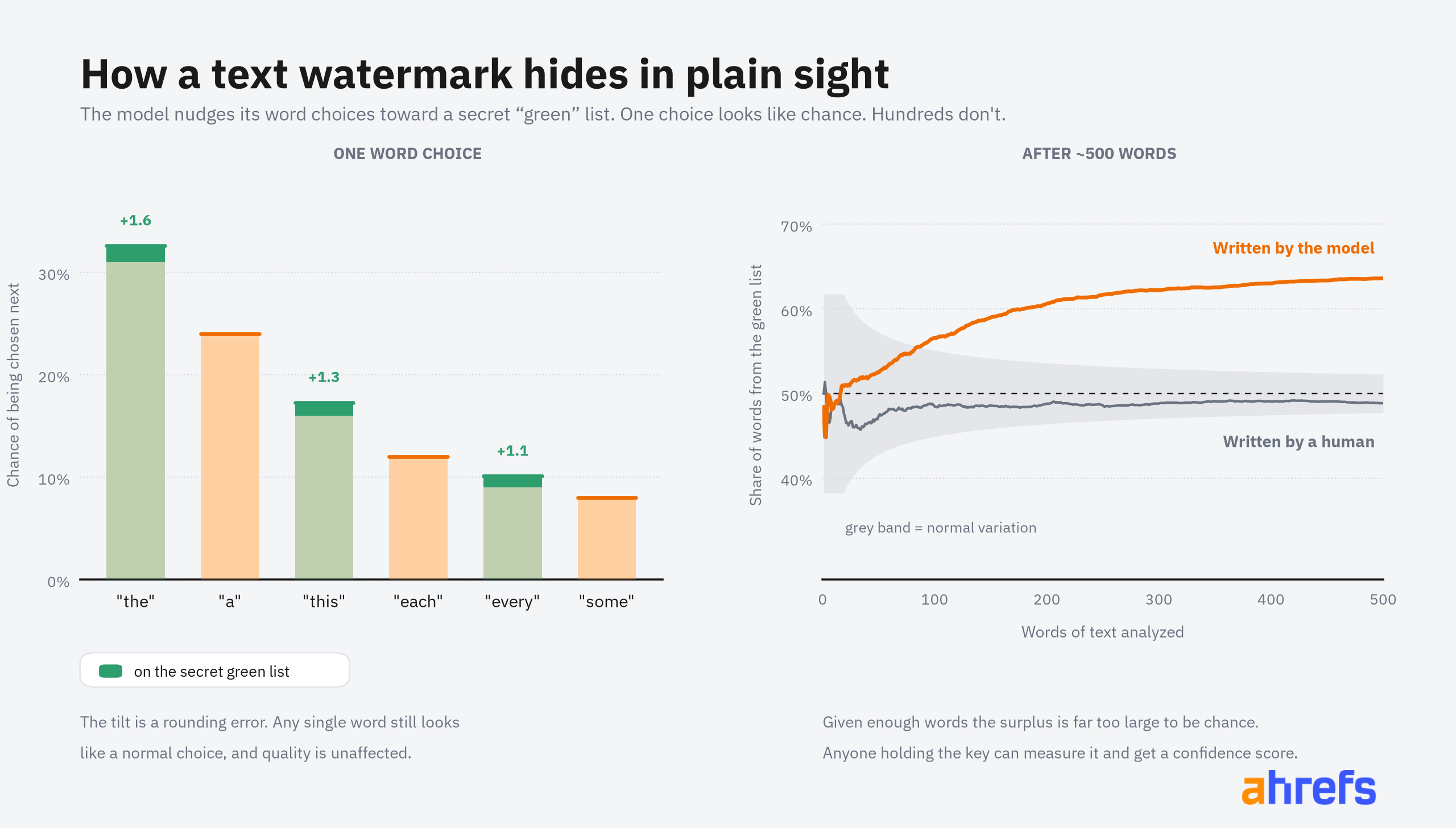
However, watermarking has inherent limitations. Short texts may not contain enough data for reliable detection. Significant rewriting can degrade the watermark, and as noted by Google DeepMind, confidence scores decrease sharply with thorough rewriting or translation. File metadata can be lost through re-saving. Crucially, detection requires the specific key, which, in Anthropic’s case, is currently proprietary and not publicly disclosed.
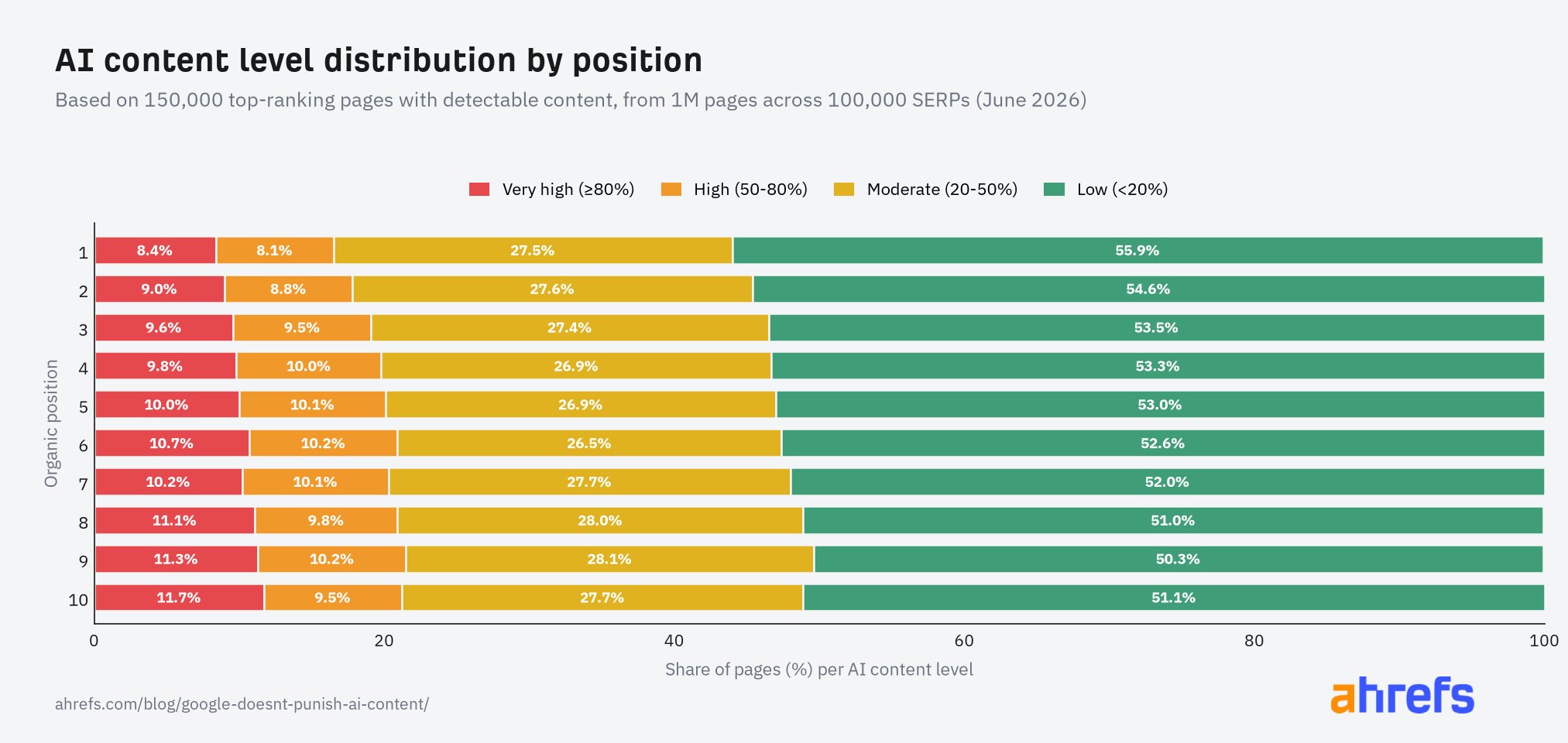
The impact of this watermarking on Google rankings is considered unlikely to be significant. Google has historically maintained an agnostic stance on AI-generated content, focusing instead on content quality. Research indicates that AI-generated content can and does achieve top rankings in Google search results. While there is a slight trend of AI content becoming less prevalent at the very highest search positions, the decline is gradual, with no abrupt drop-off observed. Similarly, AI content is not being systematically excluded from Google’s index. The difference in indexing rates between low-AI and very-high-AI content pages is approximately nine percentage points, not a cliff edge.
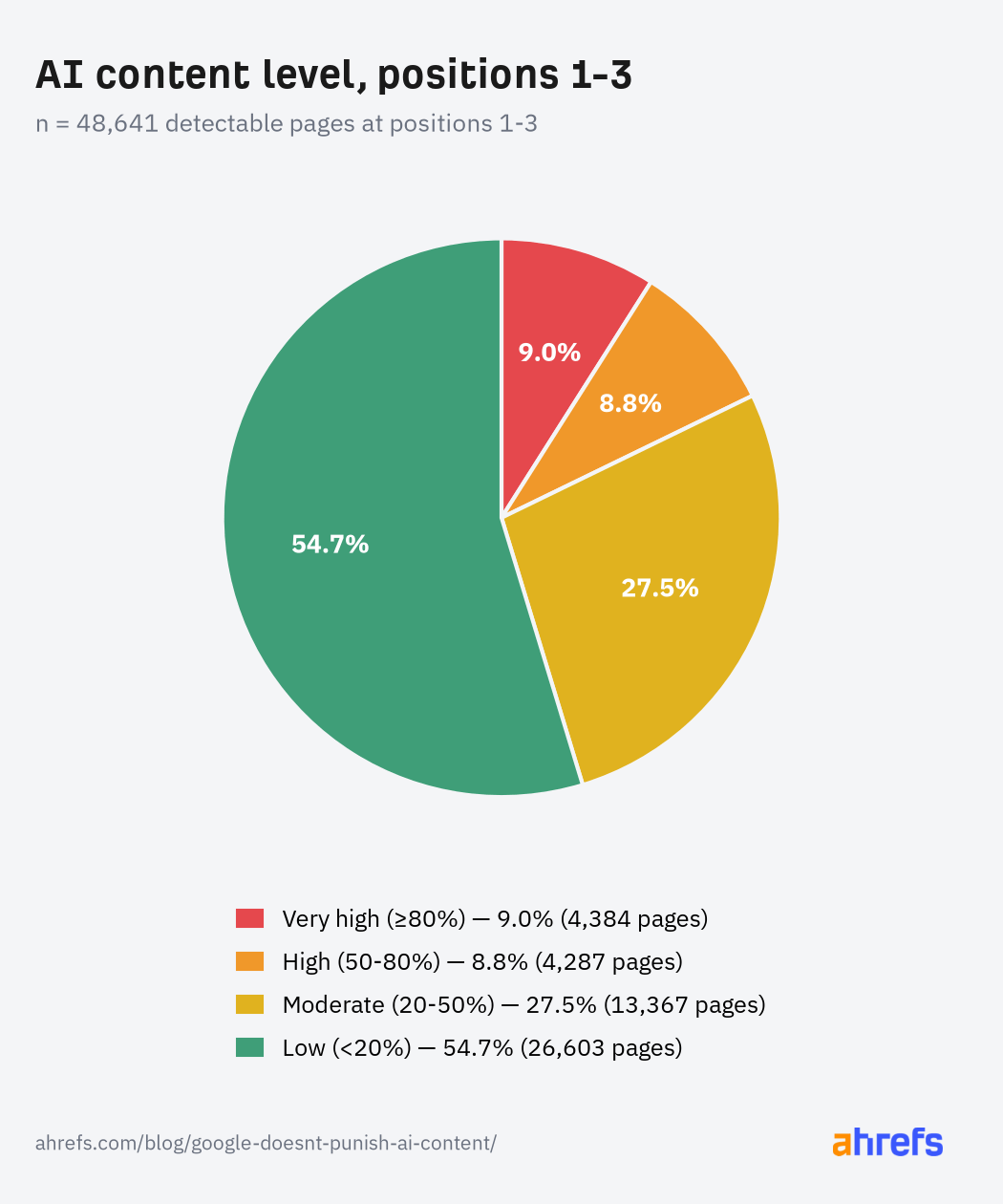
AI content detection has been possible even without watermarking. If Google intended to penalize AI content solely for its origin, this would be evident in the data, which it is not. The prevailing view is that Google prioritizes punishing low-quality or spammy content, regardless of its origin. AI content generation can sometimes coincide with the creation of poor-quality content, but this is not an inherent characteristic. Therefore, it is improbable that watermarking will become a direct ranking signal.
The practical application of watermarking is more likely to be in contractual disputes. For example, if an agency has signed a contract prohibiting AI use or a client has paid for human-written content and wishes to verify its origin, the watermark could serve as evidence of AI involvement. Even then, a detected mark only indicates Claude’s participation in the process, and the absence of a mark provides very little conclusive information.
Tools exist to assess the AI content level of web pages without relying on provider cooperation or secret keys. Services like Ahrefs’ Site Explorer offer an AI content level rating for individual pages, allowing for site-wide analysis. This detection capability fills the gap left open by proprietary watermarking systems and forms the basis of research in this area.
The introduction of watermarking by Anthropic is a direct result of legal mandates, and other major AI providers are expected to follow suit within months, having already committed to similar obligations. The impact on search engine rankings is anticipated to be minimal, as search engines like Google continue to prioritize content quality over the method of its creation. The core principle remains that using AI to produce content is not inherently problematic; the issue lies in using AI to produce content that is inferior to human-created alternatives. The focus for marketers and content creators should remain on delivering valuable and high-quality content, irrespective of the tools used in its production.