 11

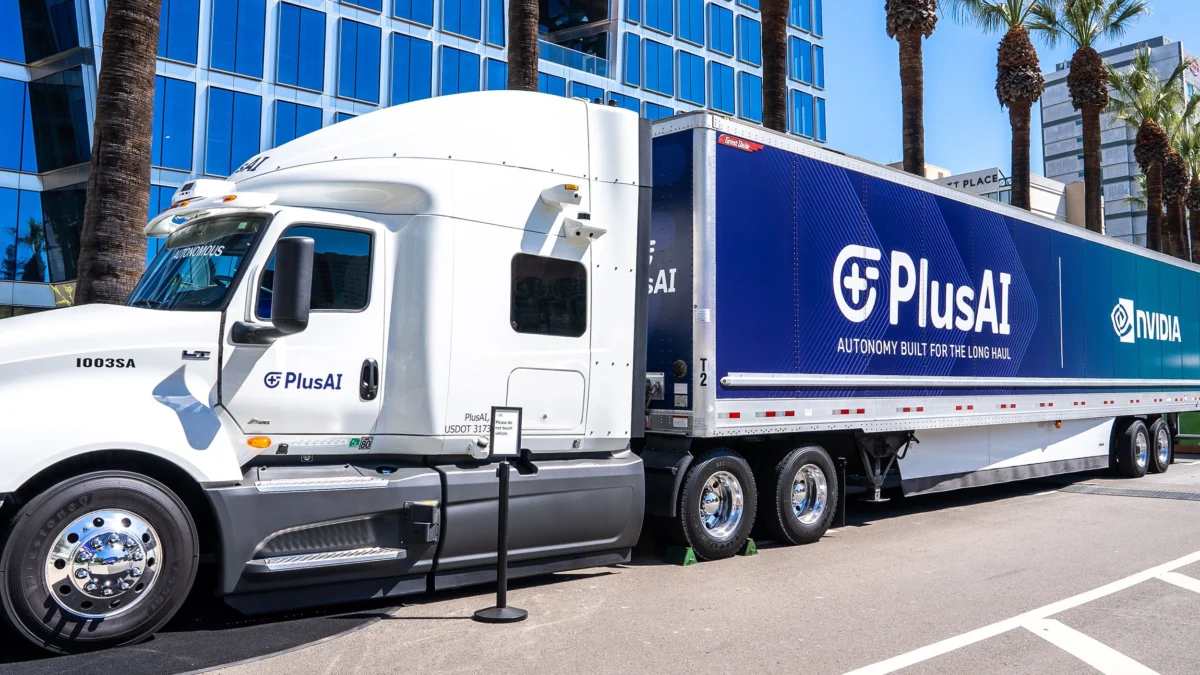
On a recent Thursday morning, a seemingly innocuous text message brought an unexpected twist to the operations of PlusAI, a prominent developer in the burgeoning field of self-driving truck technology. A top executive at the company received a congratulatory message from an acquaintance, expressing pride in the executive’s "adventure and success at Plus." The message continued, "Just saw two of your trucks near my work place! :)" This seemingly benign observation, however, quickly unraveled into a perplexing case of theft and recovery.
The acquaintance’s workplace was located in Newark, California, a detail that immediately raised alarms for the PlusAI executive. According to the company’s records and operational knowledge, their distinctive trailers were absolutely not supposed to be in that vicinity. The last known location for the two heavy-duty trailers was securely docked outside PlusAI’s warehouse, situated approximately half a mile away from where the acquaintance had spotted them. The discrepancy prompted immediate action from PlusAI personnel, who quickly realized they were dealing with a situation far more serious than a simple logistical error.
Within a short time, the situation escalated, leading to the involvement of local law enforcement. Police officers were dispatched to the scene in Newark to assist in the recovery of the two missing trailers. These trailers were not just ordinary commercial vehicles; they were prominently emblazoned with the logos of PlusAI, signifying their connection to cutting-edge autonomous vehicle development, and crucially, the emblem of Nvidia. Nvidia, currently recognized as the most valuable company in the world, is a critical partner in PlusAI’s endeavors, collaborating on advanced AI software and the sophisticated autonomous truck technology that defines PlusAI’s mission. The presence of both logos underscored the high-tech nature of the stolen assets, even if they were only trailers.
Upon arrival and initial assessment, PlusAI employees provided police with a crucial piece of information that shed light on why the perpetrators, whoever they might have been, chose to abandon their heist after seemingly breaking into the trailers. The revelation was both surprising and somewhat humorous: each of the large trailers was not carrying valuable computer chips, data center equipment, or advanced sensors, but rather a colossal weight of approximately 20,000 pounds of sand. This meant a combined total of 40,000 pounds of sand across the two trailers.
Lauren Kwan, a spokesperson for PlusAI, later clarified the unusual cargo. "PlusAI uses simulated loads in its trailers to assist with research and development testing," Kwan explained. This practice is standard in the autonomous vehicle industry, where vehicles must be rigorously tested under conditions that accurately mimic real-world scenarios, including varying weights and cargo distributions. The sand provided the necessary ballast to simulate a fully loaded truck, allowing PlusAI’s autonomous driving systems to be trained and refined under realistic operational stresses without the risk or cost associated with transporting actual commercial goods during experimental phases. Fortunately, the trailers were recovered with "40,000 pounds of sand intact," indicating that the thieves had not managed to offload the unexpected cargo.
Further details provided by Kwan highlighted the specific nature of the theft. The advanced, tech-enabled truck cabs—the primary components where the driver sits and the sophisticated autonomous systems are housed—were securely parked inside PlusAI’s warehouse. These highly valuable and proprietary assets were not targeted or taken, suggesting the thieves might have been interested only in the trailers or their perceived contents. The trailers themselves, while not containing the most valuable technology, were secured with hand locks, which were forcibly broken to facilitate the theft. This detail points to a deliberate act of breaking and entering rather than a simple oversight or unauthorized borrowing.
As of the latest updates, the case remains an active investigation. Amy Gee, a spokesperson for the Fremont Police Department, confirmed that no arrests have been made in connection with the incident. Nvidia, despite its prominent logo on the stolen trailers and its partnership with PlusAI, did not immediately respond to requests for comment regarding the theft, likely deferring to PlusAI and law enforcement as the primary parties involved.
This peculiar incident, while ending happily for PlusAI with the recovery of its property, occurs amidst a disturbing and escalating trend of cargo theft targeting high-value computer equipment across the United States, particularly in California. The tech industry, with its continuous innovation and production of costly components, has become a prime target for organized criminal networks. Thieves are increasingly focusing on specialized chips, processors, and other electronic components that are vital for modern data centers, artificial intelligence applications, and high-performance computing.
In August, a comprehensive investigation by WIRED magazine brought to light the severity of this problem, revealing two distinct incidents in California where thieves employed aggressive tactics. In these cases, the criminals deliberately struck the vehicles of security escorts, which are typically employed to follow high-value tech loads and ensure their safe transit to designated destinations. After incapacitating the escorts, the trucks carrying the precious cargo were then diverted and driven to alternative, clandestine locations. At the time of WIRED’s report, millions of dollars worth of data center equipment onboard these stolen trucks had not been recovered, underscoring the significant financial impact and the challenge faced by law enforcement.
The scope of cargo theft extends beyond just data center hardware. This year alone, criminal elements have also specifically targeted large quantities of Tesla batteries, components crucial for electric vehicles and energy storage solutions, often before they even leave the factory premises. Similarly, various types of bitcoin mining machines, highly specialized and expensive hardware designed for cryptocurrency computation, have been stolen. While authorities have managed to apprehend suspects and make arrests in some of these high-profile cases, a substantial number of these sophisticated crimes regrettably remain unsolved, perpetuating a cycle of loss for tech companies and a lucrative illicit market for criminals.
According to Verisk CargoNet, a leading analytics and risk assessment firm specializing in supply chain security, some of the most common targets for cargo theft in recent months across the United States have included metals, which command high prices on the black market, and, perhaps most pertinently, enterprise-grade computer and networking equipment. This category encompasses a wide array of products, from servers and switches to motherboards and processors, all of which are in high demand and can be quickly resold through illicit channels, making them attractive targets for organized theft rings. The strategic nature of these thefts, often involving detailed planning and execution, highlights the sophistication of the criminals involved.
In contrast to the grim statistics and ongoing challenges faced by many in the tech supply chain, the story of PlusAI’s stolen trailers had a more fortunate resolution. By Thursday afternoon, just hours after the initial discovery, the two sand-filled trailers were successfully recovered and returned to PlusAI. The Fremont Police Department confirmed their safe return, bringing a swift and positive end to what could have been a much more costly and complicated incident for the self-driving truck developer. While the motive behind targeting trailers with simulated loads remains unclear, the incident serves as a peculiar footnote in the larger narrative of tech cargo theft, reminding companies of the constant need for vigilance and robust security measures in an increasingly vulnerable supply chain environment.






