 11


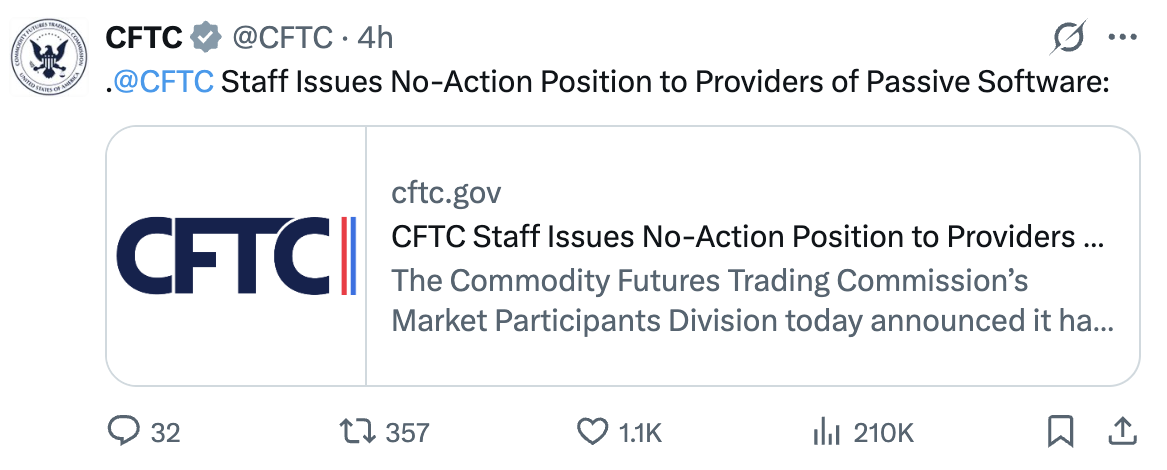
The Commodity Futures Trading Commission (CFTC) has significantly expanded regulatory relief for providers of "passive software," a move that promises to streamline access to regulated derivatives markets for users of various applications, including cryptocurrency wallets and other platforms. In a no-action position issued on Thursday, the agency’s Market Participants Division announced it would not recommend enforcement against qualifying providers and their personnel for failing to register as introducing brokers or associated persons when facilitating trading with CFTC-registered firms and exchanges. This development could substantially lower the barriers for crypto wallets and similar applications to offer access to regulated derivatives, such as perpetual contracts and prediction markets, without the burden of becoming registered introducing brokers themselves.
This regulatory update builds upon a similar position previously granted to Phantom Technologies in March. That earlier no-action letter, also subject to specific conditions, allowed Phantom’s self-custodial crypto wallet software to provide and market services connecting users with registered futures brokers and exchanges without requiring the software provider to register as an introducing broker. The current expansion of this relief indicates a broader regulatory intent to accommodate the evolving landscape of digital asset trading and financial technology.

To qualify for this regulatory relief, software providers must adhere to strict conditions that limit their involvement in transactions. A key requirement is the restriction on exercising discretion over users’ orders, ensuring that the software acts primarily as a conduit rather than an active trading participant. This limitation is crucial for maintaining the distinction between a passive technology provider and a regulated intermediary that actively influences trading decisions.
The broader implications of this regulatory stance were further highlighted in July when Phantom and the Hyperliquid Policy Center actively lobbied the CFTC. They urged the agency to modernize its rules and provide more comprehensive protections for non-custodial wallet providers. Their advocacy focused on shielding these providers from introducing broker requirements and seeking clarity on how existing regulations apply to blockchain developers and regulated derivatives firms that leverage on-chain infrastructure. The current no-action position appears to be a direct response to these ongoing discussions and a step towards addressing the concerns raised by the digital asset industry.
This regulatory move by the CFTC comes swiftly on the heels of the CLARITY Act’s failure to advance in the Senate. The CLARITY Act, which aimed to provide a comprehensive framework for digital asset regulation, fell short of the necessary 60 votes for debate, ending its immediate legislative prospects. Following this setback, key regulators signaled their commitment to proceeding with crypto regulation under their existing statutory authority.
CFTC Chair Michael Selig articulated this determination in a post on X, stating, "The CFTC is locked in and ready to ship its rules for the new frontier of finance." Similarly, Securities and Exchange Commission (SEC) Chair Paul Atkins indicated that the SEC would act "with or without legislation" to establish regulatory certainty for digital assets. This coordinated approach between the CFTC and SEC suggests a proactive regulatory agenda, even in the absence of new legislative mandates.
On the same day as the CFTC’s announcement, the SEC also took action, approving a temporary exemption that permits qualifying platforms to facilitate limited on-chain trading of tokenized U.S. stocks. This exemption applies to platforms utilizing permissioned automated market makers and liquidity pools, further demonstrating the agencies’ willingness to adapt existing regulatory frameworks to accommodate emerging financial technologies.
The CFTC’s expanded no-action relief for passive software providers represents a significant development for the digital asset ecosystem. By easing the regulatory burden for technology platforms that connect users to regulated derivatives markets, the agency is fostering innovation and potentially increasing accessibility to these markets. The emphasis on specific conditions, particularly regarding the limitation of discretion over user orders, underscores the CFTC’s commitment to maintaining market integrity and investor protection while embracing technological advancements. This action, coupled with the SEC’s recent temporary exemption, signals a renewed regulatory push to provide clarity and facilitate responsible growth within the digital asset space, even as legislative efforts face hurdles. The industry will be closely watching how these regulatory adjustments translate into practical applications and further market development.






