 11


A groundbreaking study by researchers at the Bank for International Settlements (BIS) has uncovered a significant challenge in accurately measuring the value of on-chain Bitcoin transfers. The findings indicate that estimates can vary by as much as sixfold, depending entirely on the methodology employed to track transactions. This discrepancy does not pertain to trading volumes on cryptocurrency exchanges, but rather to the actual movement of Bitcoin on its native blockchain.
The core of this measurement problem lies within Bitcoin’s inherent transaction structure. When a user initiates a Bitcoin transaction, any unspent portion of the funds is typically returned to the sender as "change." This change output, while technically a separate part of the transaction record, does not represent value being transferred to a new, distinct party. However, different measurement approaches can include or exclude these change outputs, leading to vastly different valuations of the total on-chain transfer value. This fundamental difference in how these outputs are interpreted is the primary driver behind the substantial sixfold gap observed in the BIS study.
The researchers highlight that commonly cited metrics such as transaction volumes, market capitalization, and total value locked often present an illusion of precision that is not truly supported by the underlying data. "Metrics such as transaction volumes, market capitalisation and total value locked often suggest a degree of accuracy that is not supported by the nature of the underlying data," the report states.
Beyond transfer values, the study also sheds light on similar measurement complexities affecting Bitcoin’s market capitalization. The conventional method of calculating market cap, which multiplies the total circulating supply by the current price, can, at times, be as much as four times higher than a more refined metric called "realized capitalization." Realized capitalization values each Bitcoin at the price it was last moved on the blockchain, offering a potentially more grounded view of the capital that has actively participated in transactions.
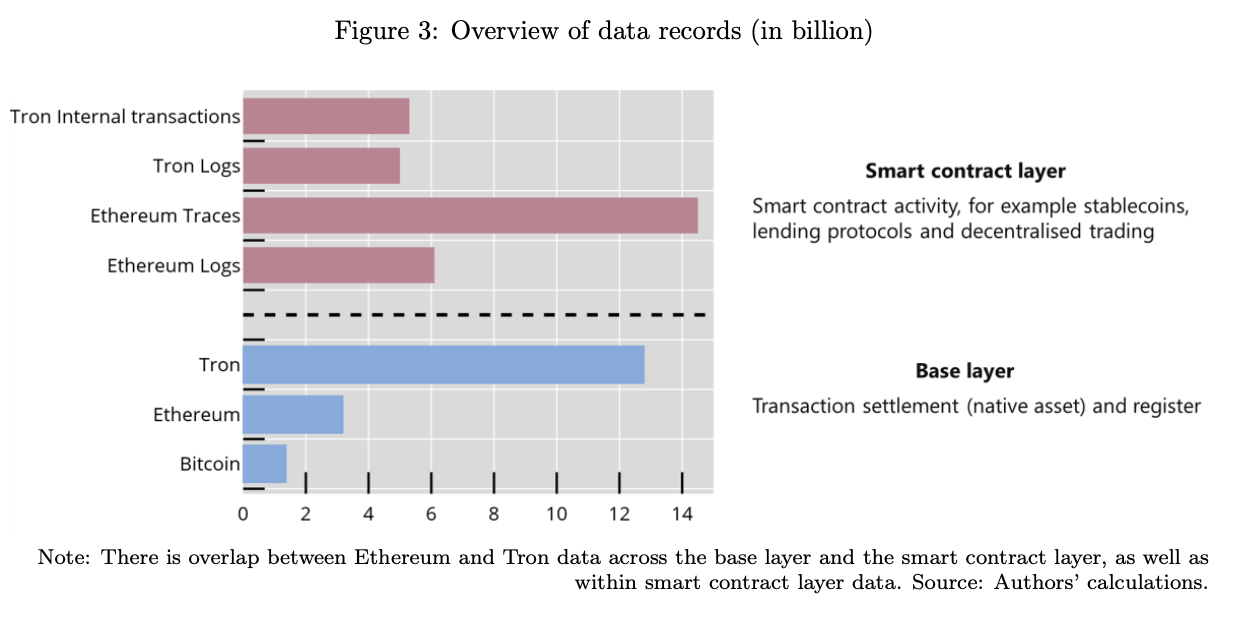
The BIS study’s comprehensive analysis encompassed an immense dataset of 100 billion blockchain records, spanning Bitcoin, Ethereum, and Tron. This broad scope allowed the researchers to identify that these measurement challenges are not isolated to Bitcoin but are, in fact, pervasive across the broader cryptocurrency ecosystem.

Ethereum and Stablecoins Present Unique Measurement Hurdles
The complexity of measuring on-chain activity extends beyond Bitcoin, with Ethereum and stablecoins introducing their own distinct challenges. Ethereum’s vast and dynamic ecosystem, characterized by a proliferation of smart contracts, creates significant interpretive difficulties. Out of approximately 67.5 million active smart contracts examined in the study, a staggering 54 million could not be neatly categorized using the established classification frameworks employed by the researchers. This indicates a significant portion of Ethereum’s on-chain activity operates outside of easily definable categories, complicating attempts to quantify its economic impact.
Interpreting the activity of stablecoins, such as USDT, presents another layer of complexity. The same stablecoin asset can serve fundamentally different purposes depending on the blockchain it resides on. For instance, USDT on the Ethereum network showed a stronger correlation with Decentralized Finance (DeFi) activities, indicating its use in more sophisticated financial applications. In contrast, USDT on the Tron network was more frequently associated with payment-like transactions and acting as a store of value.
These differences were particularly pronounced when examining the holdings of stablecoins within smart contracts. In 2022, the share of USDT held by smart contracts on Ethereum surpassed 20%, a stark contrast to the approximately 1% observed on Tron. The BIS researchers emphasized that aggregating USDT activity across different blockchains without accounting for these divergent use cases can lead to a conflation of distinct economic activities, ultimately obscuring the true nature of how stablecoins are being utilized within the digital asset landscape.
Based on these extensive findings, the BIS researchers concluded that on-chain indicators should be approached with a degree of caution. They recommend treating these metrics as "noisy approximations rather than direct measures of economic activity," underscoring the need for more nuanced and context-aware analytical approaches.
Visa Adopts Adjusted Metrics to Reflect True Economic Activity
Recognizing the limitations of raw blockchain data, some analytics providers are actively developing and implementing methodologies to better reflect genuine economic activity. Visa, through its Onchain Analytics dashboard powered by data from Allium Labs, is one such entity. This platform offers users the ability to view both total stablecoin transaction volumes and "adjusted" volumes.
Visa’s adjusted methodology is specifically designed to filter out potential distortions caused by activities that may not represent genuine economic transfers. These include high-frequency trading, automated bot activity, operations involving cross-chain bridges, and internal transactions within centralized exchanges. By removing these elements, Visa aims to provide a more accurate representation of stablecoin usage for actual economic purposes.
The impact of this adjustment is substantial. The Visa Onchain Analytics dashboard currently reports a staggering $6.4 trillion in total stablecoin transaction volume across the networks it tracks over the past 30 days. However, the adjusted volume, intended to reflect more economically significant activity, stands at a significantly lower $313.1 billion. This considerable difference highlights the scale of non-economic or duplicative transactions that can inflate raw blockchain metrics.
The BIS study’s findings are a critical reminder for the cryptocurrency industry and its observers. As the digital asset space continues to evolve, the development of more robust and accurate measurement frameworks is paramount for understanding its true economic significance and potential. The work by institutions like the BIS and the efforts by companies like Visa to refine data analysis are crucial steps towards achieving greater clarity and reliability in the reporting of on-chain activity.






