 11

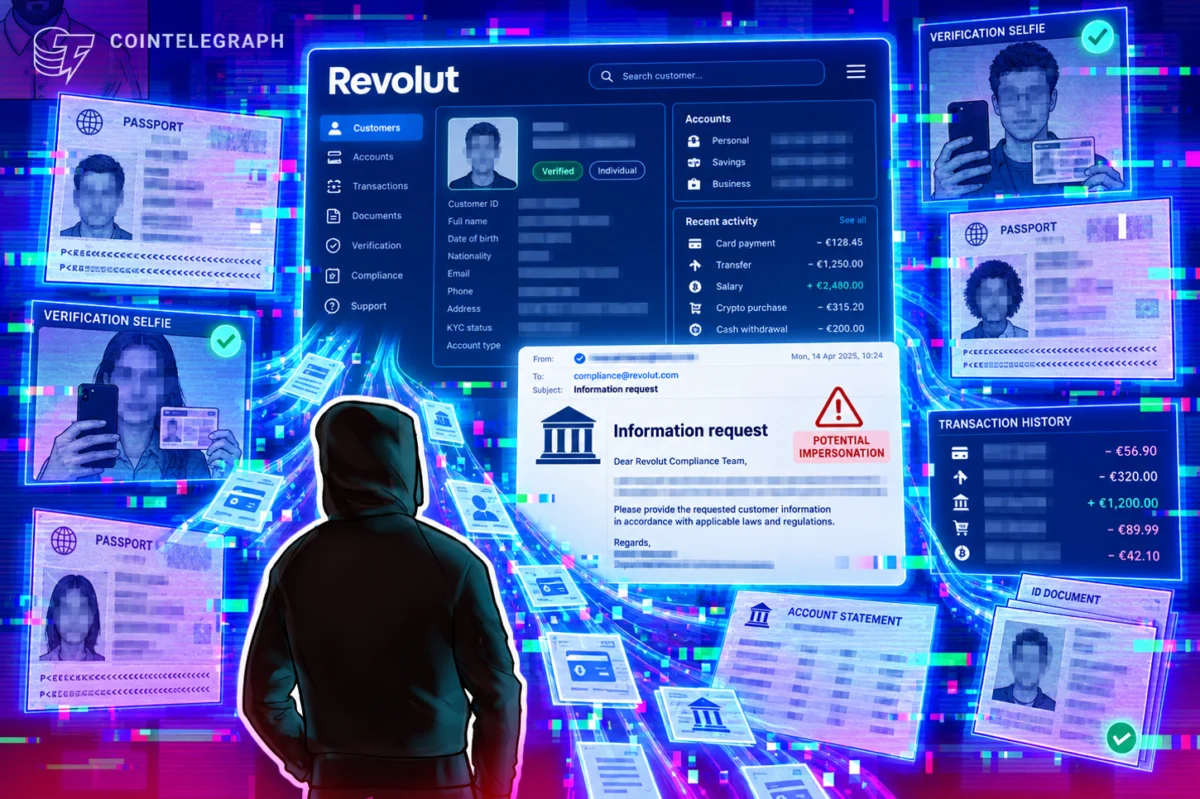
Financial technology giant Revolut has confirmed a significant data breach, resulting in the exposure of sensitive customer information, including copies of passports, verification selfies, and detailed transaction histories. The breach occurred after the company fell victim to a sophisticated external impersonation scam, where an unauthorized third party utilized a legitimate government agency’s email domain to submit fraudulent requests for customer data.
The incident, first reported by International Cyber Digest on X (formerly Twitter), revealed that the fraudulent requests successfully bypassed Revolut’s authentication checks because they originated from what appeared to be a legitimate government email address. Revolut later determined that these requests were not authentic. The company began notifying affected customers on Friday about the compromise of their personal data.
A spokesperson for Revolut confirmed the details of the sophisticated scam to Cointelegraph on Saturday. "Revolut recently identified a sophisticated external impersonation scam where an unauthorised third party utilised a legitimate government agency domain email to submit fraudulent requests for information," the spokesperson stated.
Upon detecting the fraudulent activity, Revolut took immediate action. The company reportedly blocked the unauthorized email address and alerted the relevant government agency from which the domain was impersonated. Furthermore, Revolut proactively notified enforcement agencies and financial regulators about the incident.
Despite the breach, Revolut has assured its customers that its core systems and customer funds remain unaffected. "Revolut systems and customer funds are unaffected. We have contacted the limited number of impacted individuals directly to inform them and provide support," the spokesperson added. This suggests that while personal identification and financial activity data were compromised, the company’s operational infrastructure and the security of its customers’ money were not directly impacted.
While the full scope of the breach is still being assessed, crypto sleuth ZachXBT reportedly indicated that the incident appeared to be limited in scale and potentially targeted high-net-worth users. This suggests that the perpetrators may have been selective in their requests, aiming for individuals with substantial financial activity or significant personal data that could be exploited.
The data breach has ignited a debate on social media, particularly on X, concerning the efficacy and inherent risks of mandatory Know Your Customer (KYC) regulations in the financial sector. Marc Zeller, a prominent figure in the crypto space, shared his experience on X, stating that he woke up to discover all his data had been leaked by Revolut. He expressed his dismay, tweeting, "Sharp reminder that KYC hasn’t produced meaningful upside and has put many in harm’s way." This sentiment reflects a growing concern among some users that the extensive personal information collected through KYC processes, while intended for security, can become a significant liability if compromised, potentially leading to identity theft and other malicious activities.
The incident underscores the evolving nature of cyber threats, where attackers are becoming increasingly adept at mimicking legitimate entities and exploiting established trust protocols. The use of a genuine government email domain highlights the advanced tactics employed by cybercriminals, making it challenging for even sophisticated financial institutions to distinguish between authentic and fraudulent requests.
Revolut’s response, which includes immediate blocking of the malicious source, notification of the impersonated agency, and engagement with law enforcement, aligns with standard cybersecurity incident response protocols. The proactive communication with affected customers is also a crucial step in mitigating the potential harm and rebuilding trust.
The financial technology sector, which often handles vast amounts of sensitive personal and financial data, remains a prime target for cyberattacks. This breach serves as a stark reminder of the continuous need for robust security measures, ongoing vigilance, and adaptive strategies to counter sophisticated threats. The debate around data privacy and the necessity of extensive data collection for regulatory compliance is likely to intensify in the wake of such incidents.
Cointelegraph, in its reporting of this news, reiterates its commitment to independent, transparent journalism, adhering to its Editorial Policy to provide accurate and timely information. Readers are encouraged to conduct their own independent verification of the facts presented. The implications of this breach for Revolut’s customer base and the broader fintech industry will continue to unfold as more details emerge and regulatory bodies assess the situation. The incident also prompts a wider discussion on the balance between security, privacy, and the convenience offered by digital financial services.






