11

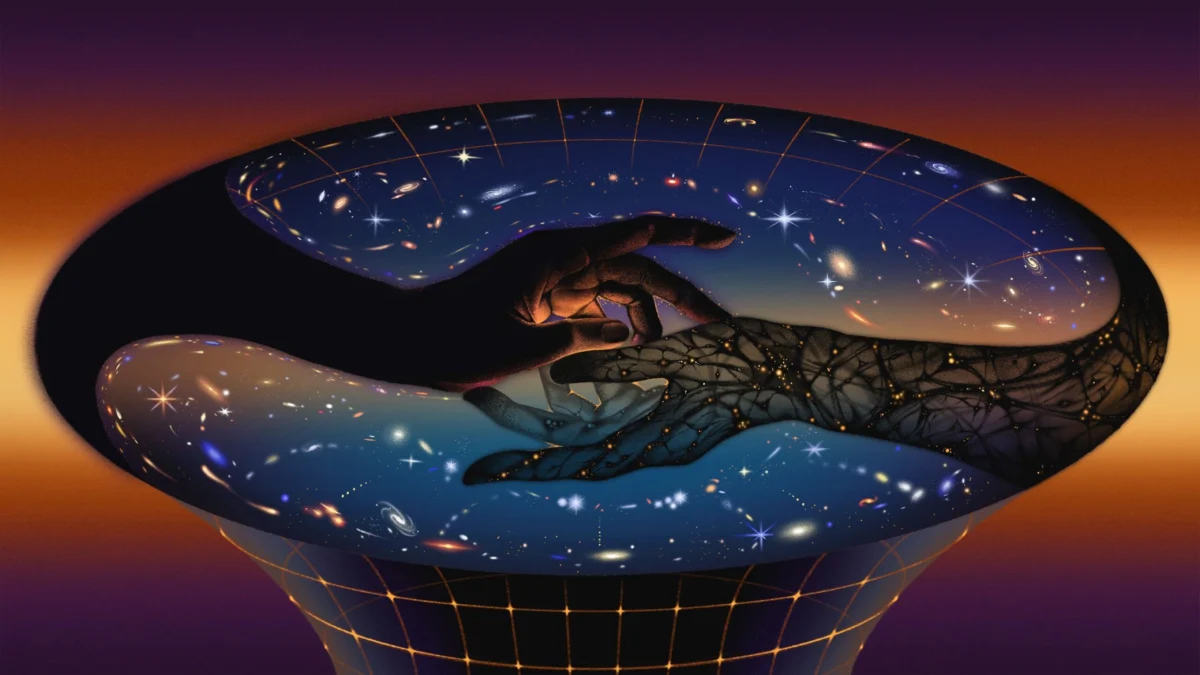
The cosmos, as we currently understand it, presents a largely enigmatic picture, dominated by components that defy direct observation. An estimated 70 percent of the universe’s total mass-energy content is attributed to dark energy, a mysterious force responsible for accelerating the expansion of space. Another 25 percent consists of dark matter, an equally elusive substance whose gravitational pull is essential for holding galaxies together, preventing them from flying apart. These two "dark" entities are not dark in the conventional sense of lacking luminosity; rather, they are invisible, neither emitting, reflecting, nor absorbing light, making them profoundly challenging to detect and study directly. For decades, cosmologists have largely treated dark energy and dark matter as distinct phenomena, their primary connection being their shared elusiveness. However, recent astronomical observations are compelling scientists to reconsider this assumption, leading to a burgeoning idea that these two cosmic unknowns might be physically intertwined.
A pivotal shift in this perspective emerged from the Dark Energy Spectroscopic Instrument (DESI) research team. In 2024, DESI presented compelling evidence suggesting that the strength of dark energy, often conceptualized as the "cosmological constant," might not be constant after all. This groundbreaking finding was further corroborated by a 2025 study, which utilized more than double the data and similarly concluded that dark energy is indeed changing over time. These results indicate a complex evolution: dark energy appears to have attained a maximum value approximately 2 billion years ago, subsequently beginning a phase of weakening. Intriguingly, the data also hinted at an earlier epoch where dark energy might have grown stronger, a scenario that seemingly contradicts the fundamental law of energy conservation.
Researchers describe this perplexing behavior as dark energy entering the "phantom regime." To illustrate the counterintuitive nature of this phenomenon, scientists offer an analogy: it’s akin to a ball rolling uphill. While such a feat is certainly possible, it necessitates the influence of an external force beyond standard gravity. In the context of the cosmos, this "something other than gravity" could very well be an interaction with dark matter, opening up new avenues for theoretical exploration.

Indeed, a growing number of theorists are now actively investigating the hypothesis that dark energy’s peculiar behavior is influenced by its connections to dark matter. Tim Tait, a particle physicist at the University of California, Irvine, noted that while scientists have generally assumed "dark energy and dark matter don’t have anything to do with each other," it’s entirely conceivable "you can imagine a case where one influences the other." He added that it "would not be surprising if they were manifestations of a kind of unified theory of the dark universe."
The concept of dark energy and dark matter interacting is not entirely novel. As early as 2005, Justin Khoury, a physicist at the University of Pennsylvania, explored this very prospect. Khoury recounted that he and his coauthors at the time posed a hypothetical question: Could a form of dark energy exist whose energy density increased over time? Their research found that if dark energy and dark matter were capable of influencing each other, such interactions could produce what appeared to be phantom behavior, even if it wasn’t truly phantom in the conventional sense. Khoury described this as "the most natural, simplest way of achieving this."
Two decades later, the DESI findings provided empirical impetus for these theoretical ideas. Spurred by the observational hints of changing dark energy, Khoury, along with his Pennsylvania colleagues Meng-Xiang Lin and Mark Trodden, developed a sophisticated model of dark interactions. This model draws parallels from quantum chromodynamics, a cornerstone theory of particle physics, and posits that both the energy density of dark energy and the mass of dark matter could change in concert, exhibiting a synchronized evolution.
A separate, yet similarly intriguing, study published in January 2025 in Physical Review D also explored this interconnectedness. According to this model, dark matter could have transferred a small fraction of its energy to dark energy during an earlier period of cosmic history. Elsa Teixeira, a cosmologist at the University of Montpellier in France and one of the study’s authors, explained that "dark matter is the main brake on [the universe’s] expansion." Consequently, an easing of this "brake" through energy transfer would naturally lead to an acceleration in the universe’s expansion.

David Andriot, a physicist at CNRS (the French National Center for Scientific Research), who presented his own coupled dark energy-dark matter model in May 2025, offered a pragmatic perspective on the "phantom regime." He suggested that its appearance might largely be a result of "bookkeeping," where "any change or evolution of the mass of dark matter has been put into the box of dark energy." Harvard physicist Cumrun Vafa echoed this sentiment, stating emphatically that "the notion that you can compute dark energy independently of dark matter is wrong." He contended that this long-held assumption by cosmologists, including the DESI team, ultimately "led to the physically unacceptable phantom behavior."
Beyond reconciling the "phantom regime," the idea of interacting dark sectors offers a potential solution to one of cosmology’s most persistent and vexing puzzles: the Hubble tension. This tension refers to a significant discrepancy in the measured rate of the universe’s current expansion, known as the Hubble constant. Scientists can determine this value using two primary methods. One involves analyzing light from the early universe, specifically the cosmic microwave background, which provides a snapshot of the cosmos’s expansion in its infancy. The other method relies on more recent cosmic phenomena, such as observations of exploding stars (supernovas), which reveal how the universe is expanding today.
According to the standard model of cosmology, these two independent measurements of the Hubble constant should yield consistent results. However, in recent years, scientists have repeatedly found that the expansion rate derived from the early universe differs from that measured in the more recent universe by approximately 9 percent. This persistent discrepancy has, as Teixeira and her co-authors noted, "provoked heated debates in the cosmology community about whether this difference could be due to systematic errors or whether it is a signal of new physics." Their model, which incorporates interacting dark energy and dark matter, suggests that this seemingly contradictory variation in expansion rates might not be a crisis at all, but rather an expected outcome within a more comprehensive cosmological framework.
If dark energy and dark matter indeed interact, it strongly suggests they might share a common origin, as Khoury proposed. This idea finds intriguing support within the realm of string theory, which posits that our universe, at its most fundamental level, is composed of vibrating strings. In 2019, building on the string theory concept that dark energy is naturally variable, Vafa and two collaborators concluded that the mass of dark matter particles might also fluctuate over time. This led them, in 2022, to propose a radical idea: dark matter and dark energy could be intrinsically linked through a so-called "dark dimension."

String theory typically hypothesizes the existence of six or seven extra spatial dimensions, in addition to our familiar three spatial dimensions and one time dimension. These extra dimensions are usually thought to be incredibly small, curled up at the Planck scale (10-35 meters). However, Vafa and his colleagues proposed that the dark dimension could be significantly larger than these other hypothesized dimensions, on the order of a micron (10-6 meters). In this scenario, gravitons—the theoretical particles that mediate the force of gravity—could "leak" into this enlarged dark dimension. Upon doing so, they would acquire mass, transforming into "dark gravitons." While these massive dark gravitons would primarily reside within the dark dimension, their gravitational effects could still be felt in our observable dimensions, allowing them to fulfill the role traditionally ascribed to dark matter.
Georges Obied, a physicist at the University of Chicago, highlighted that in this theoretical framework, "there is a very natural coupling between dark energy and dark matter." Crucially, changes in the size of this proposed dark dimension would simultaneously affect both dark energy and dark matter, providing a unified mechanism for their observed behaviors. In a July 2025 paper, Obied, Vafa, along with Alek Bedroya of Princeton and David Wu of Harvard, demonstrated that this "dark dimension" scenario is remarkably consistent with the recent DESI data. Their model specifically predicts that both the strength of dark energy and the mass of dark matter will gradually decrease over cosmic time. Furthermore, it posits that the rate at which dark energy changes will be directly proportional to its energy density. Given that the energy density of dark energy is extraordinarily small, Vafa explained, "it won’t change fast." He added, "It’s not surprising that we didn’t see it until now," emphasizing that "we had to wait the entire age of the universe to detect something that small."
The "dark dimension" model also offers testable predictions. If dark matter is indeed coupled to dark energy, it implies that dark matter particles could interact with each other through a new, long-range force, distinct from gravity. Obied enthusiastically stated that "there could be astrophysical ways of testing this." Coincidentally, two physicists, Marc Kamionkowski (now at Johns Hopkins University) and Michael Kesden (now at the University of Texas at Dallas), had already explored one such test in a 2006 paper. They envisioned a scenario where two galaxies closely approach each other, and the gravitational pull of one galaxy tugs at the other. If dark matter possessed a stronger gravitational attraction to other dark matter than it does to ordinary matter, a unique "tidal tail"—an elongated stream of stars, gas, and dust—would form behind one of the interacting galaxies.
Kamionkowski and Kesden searched for this specific effect but did not find it, which allowed them to establish an upper bound on the possible strength of such an extra attractive force. Intriguingly, the value predicted by Vafa’s team within the dark dimension framework falls well within this established observational bound. Kamionkowski noted the profound significance, stating, "It is interesting that we are now finding connections between that fairly abstract work and observational and experimental work."

While this correspondence between a prediction derived from string theory and astrophysical evidence does not definitively confirm the validity of these "stringy" models, it offers a deeply gratifying moment for Vafa, who has dedicated four decades to bringing string theory from a purely conceptual realm to one capable of generating testable predictions. Obied, a former Ph.D. student of Vafa, shares this ambitious goal. He acknowledges that unraveling the mysteries of dark energy, dark matter, and their potential relationship is a formidable challenge. However, he believes it is "very beneficial to come at this in different ways"—whether through observational cosmology, particle physics, or theoretical string theory. Ultimately, Obied concludes, "This is how people should do science… it’s the job of theoretical physicists to explore everything that’s possible, to get all the possibilities on the table. And eventually, the data will help us decide."