11

In the challenging and often perilous aftermath of natural disasters, structural collapses, or other catastrophic events, the deployment of small robots and drones has become an increasingly vital strategy for emergency response teams worldwide. These advanced machines are instrumental in navigating environments too hazardous or confined for human rescuers, such as the precarious interiors of collapsed buildings, subterranean tunnels, or vast, debris-strewn landscapes. While many of these technological advancements have primarily focused on critical search and rescue operations – meticulously locating survivors amidst the rubble or identifying danger zones – a groundbreaking new development introduces a novel and somewhat unexpected approach to emergency care. Researchers are now exploring how insects, with their inherent ability to infiltrate even the most minuscule crevices and navigate highly complex, uneven terrains, could be transformed into the next generation of first responders, offering immediate medical intervention. These ‘cyborg bugs,’ enhanced with micro-electrodes, are envisioned to not only locate victims but also provide crucial initial medical assistance, potentially bridging the critical time gap until human teams can arrive.
This ambitious vision is being brought to life by a collaborative research team from the University of Queensland (UQ) and the University of New South Wales (UNSW) in Australia. Their innovative creation, aptly named the ‘Paraborg,’ represents a significant leap forward in the field of bio-robotics. The Paraborg is designed to extend beyond mere victim location, aiming to administer essential first aid directly to those trapped in disaster zones. While the concept of receiving medical care from a cockroach might initially evoke a sense of unease or be described as ‘skin-crawling,’ as the researchers acknowledge, the potential impact of these cyborg insects is profound. By delivering timely medical intervention, such as pain relief or life-sustaining drugs, the Paraborgs could provide invaluable minutes or even hours, significantly improving the chances of survival for victims while human rescue teams work tirelessly to reach them through challenging obstacles. Tan Vo Doan, a bio-robotics researcher at UQ, highlighted the evolutionary step represented by their work, stating in a press release, "Cyborg insects have been designed for ‘search and explore’ missions for the past couple of decades. We wanted to take the next step."
The foundation of the Paraborg technology lies in the remarkable biological capabilities of the giant burrowing cockroach, an indigenous species found exclusively in northern Queensland, Australia. This particular cockroach was selected for its impressive physical attributes, which make it uniquely suited for the demanding role of a miniature disaster responder. Measuring up to 87 millimeters (approximately 3.5 inches) in length and weighing as much as 40 grams (around 1.4 ounces), it is one of the largest and most robust cockroach species in the world. Its substantial size and inherent strength are critical, as the research team needed an insect capable of carrying specialized equipment without significant impairment to its natural movements or ability to traverse difficult environments. The team meticulously documented their detailed methodology and findings in a recent paper published in the esteemed journal Advanced Science, outlining the engineering and biological integration involved in creating these novel cyborgs.
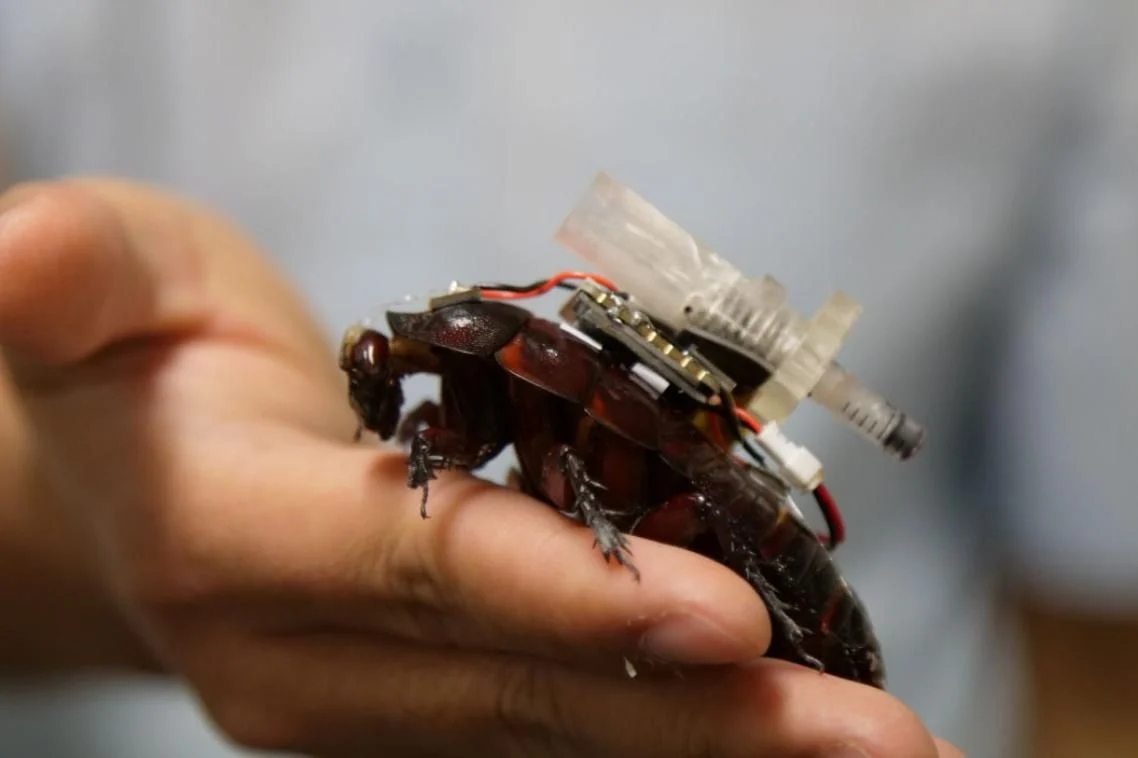
Leveraging the giant burrowing cockroach’s impressive carrying capacity, which can comfortably transport up to 1.5 times its own body weight, the researchers successfully developed two distinct types of Paraborgs, each engineered for specific functions within a disaster scenario. One variant is equipped with a miniature camera, designed to transmit real-time video footage of victims’ conditions from deep within collapsed structures. This visual data is crucial for assessing injuries, understanding the immediate environment, and informing subsequent human rescue strategies, providing eyes where human responders cannot easily go. The second, and perhaps most revolutionary, Paraborg type incorporates an automatic injection mechanism, enabling it to administer medication directly to victims. For the injection-equipped cockroach, the additional apparatus resulted in an increase of approximately 15 millimeters in total height and about 17 grams in weight. Crucially, the study rigorously assessed these modifications and found that they did not significantly impede the cockroach’s normal locomotion or ability to navigate tight spaces, confirming its operational viability. The creation of these cyborg insects involved a carefully managed process: the cockroaches were briefly anesthetized while the minute electrodes and microchips were delicately attached to their bodies. Upon removal of the equipment after the experiments, the insects were observed to resume their normal lives, highlighting a considered approach to animal welfare within the research parameters.

The ability to precisely control the Paraborgs’ movements is central to their utility in complex and unpredictable disaster environments. Researchers achieved this remote control by applying targeted electrical stimuli to specific sensory organs of the cockroach. Electrodes were embedded into the insect’s antennae, which are primary organs for navigation and sensing the environment through touch and smell, and also into the cerci, a pair of prominent, sensory appendages located at the rear of the abdomen that detect air currents and vibrations. By stimulating each antenna independently, scientists could effectively steer the cockroach, guiding its direction of travel with remarkable accuracy, much like reins on a horse. Similarly, stimulating both cerci simultaneously allowed researchers to control the insect’s walking speed, dictating whether it moved cautiously or with more urgency, enabling dynamic response to varying terrain. The scientists meticulously experimented with various electrical frequencies, determining that administering stimuli between 10 and 40 hertz proved most effective for sustained and reliable control. Frequencies exceeding 50 hertz, they discovered, became ineffective over time, indicating a threshold for optimal neural response and control without causing fatigue or desensitization.
The sophisticated injection mechanism integrated into one of the Paraborg variants is a testament to ingenious micro-engineering, designed for maximum efficiency and autonomy in a life-saving situation. This compact device utilizes a spring-loaded system to deploy a syringe. The activation of this syringe is triggered by a chemical reaction contained within the device itself. Specifically, a sealed barrier separates a chamber containing citric acid from another chamber holding baking soda. When the mechanism is activated, this seal breaks, allowing the two compounds to mix. The resulting chemical reaction, fundamentally the same effervescent process observed when baking soda and vinegar (another acidic compound) are combined to create a "volcano" in a children’s science experiment, generates a sufficient volume of carbon dioxide gas. This gas rapidly builds pressure within the sealed chamber, which is then harnessed to push the plunger of the syringe, thereby administering the pre-loaded medication into the target. This self-contained, chemically-driven injection system ensures autonomy and minimizes the need for complex external power sources or intricate mechanical parts during deployment, making it robust and reliable in challenging conditions.
To validate the Paraborg’s capabilities, the research team conducted a series of rigorous experiments within a controlled laboratory setting, meticulously simulating aspects of a disaster scenario. In one key demonstration, a remotely controlled cockroach successfully navigated from a designated starting point, traversed through three distinct checkpoints designed to mimic debris fields, and ultimately administered an injection to a simulated target, representing an injured victim. The results of these trials were highly encouraging and indicative of the technology’s potential. The success rate for injections performed at close range – specifically within 150 millimeters (approximately 6 inches) of the target – reached an impressive approximately 95 percent, demonstrating the precision of the delivery system. Furthermore, the overall success rate for the entire sequence of tasks, encompassing departure from the starting point, navigation through the checkpoints, and successful completion of the injection, stood at a commendable 72 percent, underscoring the system’s operational reliability. Beyond individual performance, the researchers also successfully demonstrated the potential for coordinated teamwork among the cyborg insects. In this scenario, one Paraborg, equipped with a camera, was deployed to locate and identify a simulated victim, relaying crucial visual information to operators. Simultaneously, another Paraborg, carrying the injection mechanism, was then directed to the precise location to administer the necessary medication, showcasing a multi-functional, collaborative approach to disaster response. The researchers also noted that while they had previously developed cyborg beetles capable of climbing vertical walls, the larger size and superior carrying capacity of the giant burrowing cockroaches made them better suited for the specific task of transporting and deploying specialized rescue and medical equipment.
Despite the promising outcomes of these initial experiments, the research team acknowledges that the carefully controlled laboratory environment does not fully replicate the inherently complex and unpredictable conditions found at actual disaster sites. Real-world scenarios present formidable challenges such as extensive and unpredictable debris, highly uneven and unstable terrain, and dynamic, shifting landscapes, all of which could impact the Paraborgs’ navigation, stability, and operational efficiency. However, the foundational research provides a robust framework for future development and refinement. Vo Doan expressed optimism regarding the future deployment of these innovative bio-robots. He articulated a hopeful timeline, suggesting that if adequate resources can be secured to accelerate both research and extensive field testing, a fully operational rescue team composed of cyborg insects could potentially be deployed at real disaster sites within the next five to 10 years. This long-term vision aligns with a strategic philosophy articulated by Vo Doan: "Rather than building one robot to do everything, we can harness the natural strengths of different insects and equip them for different missions." This approach underscores the potential for a diversified fleet of insect-based cyborgs, each specialized for particular tasks, to revolutionize disaster response by complementing existing technologies and human efforts, ultimately saving more lives in the most challenging circumstances.