 11

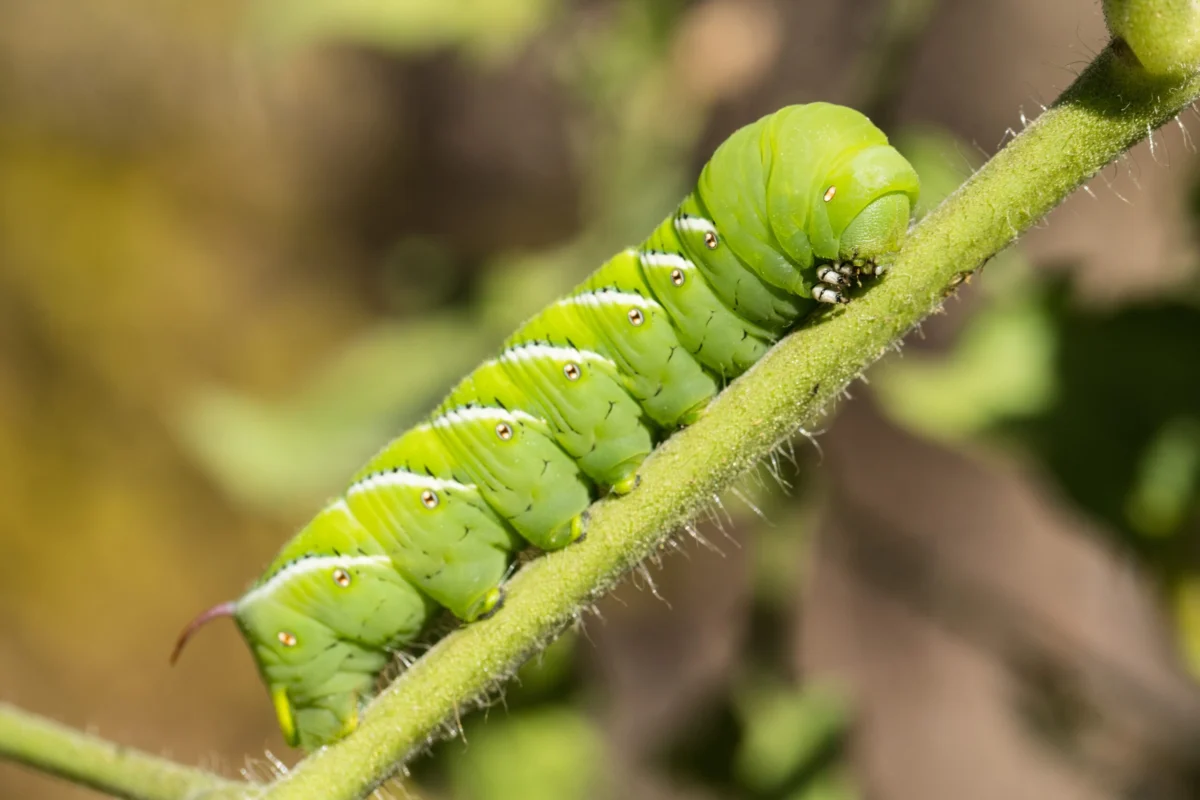
In the serene quietude of a summer garden, a tobacco hornworm caterpillar (scientifically known as Manduca sexta) rests on a leafy branch, consuming its meal with typical insect diligence. Suddenly, its feeding ceases, and its body freezes in an instant. This abrupt halt is not arbitrary; it signifies a critical moment of sensory perception – the caterpillar has detected imminent danger. From the shadows, a wasp, a common predator, approaches stealthily, meticulously assessing its potential prey. This seemingly simple encounter raises a profound biological question: How does this creature, which possesses no visible ears, discern the approach of its airborne adversary?
For many years, the precise mechanisms by which tobacco hornworm caterpillars perceive their environment, particularly auditory cues, have remained largely unknown to the scientific community. However, a dedicated team of biologists and engineers has embarked on an ambitious research journey to unravel this natural enigma. Their ongoing investigations are yielding compelling evidence, suggesting that these fascinating insects possess a unique and highly specialized auditory system: they can hear using a multitude of tiny, supersensitive hairs distributed across their bodies. This groundbreaking research not only promises to solve a longstanding mystery of the natural world but also holds significant potential for revolutionary advancements in human technology, particularly in the design of novel, more affordable, and highly efficient microphone systems.
The delicate nature of this research necessitates an environment of absolute acoustic purity. To accurately study such minute biological responses to sound, scientists must eliminate all extraneous noise and vibrations. For this reason, the research is primarily conducted within the unparalleled silence of an anechoic chamber, a facility specifically engineered to absorb all sound reflections and block external noise. Binghamton University’s anechoic chamber, a marvel of acoustic engineering, provides the ideal setting for such precise scientific inquiry.
Inside the Anechoic Chamber: A Haven of Silence
The construction of an anechoic chamber is a testament to meticulous engineering designed to achieve extreme quietude. It is one of the quietest places on Earth, a sanctuary where unwanted sounds are systematically prevented from entering or reverberating. The chamber itself is not directly connected to the ground; instead, it "floats" on heavy-duty steel springs. This ingenious design isolates the inner space from any external vibrations or structural noise that might otherwise interfere with sensitive measurements. Every aspect of its construction is geared towards creating an environment where the most subtle acoustic phenomena can be observed without interference, ensuring that what happens outside the anechoic chamber truly stays outside.
Within this acoustically isolated environment, the researchers initiated their experiments by first studying the caterpillars’ responses to controlled vibrations. Over the course of an entire year, a daily routine involved carefully placing a tobacco hornworm caterpillar on a specialized platform. This platform was then subjected to a variety of vibrations, each delivered at precisely controlled intensities. To ensure accurate measurement of the physical stimuli, a highly sensitive device known as an accelerometer was attached to the platform. This instrument precisely quantified the movement and minute vibrations transmitted through the surface upon which the caterpillar rested.
The observations during these experiments were consistent and revealing. In response to the induced vibrations, the caterpillars exhibited distinct behavioral reactions. Sometimes they would perform a sudden, rapid jump; at other times, they would merely twitch their bodies; and at higher intensities, they would even shudder from the sheer physical force of the vibrations. Through painstaking observation and data collection, the research team was able to precisely determine a specific threshold: a magnitude of vibration below which the caterpillars would no longer display any visible reaction. This established a baseline for their sensitivity to direct physical vibrations.
Distinguishing Airborne Sound from Vibrations
Following the establishment of this vibratory response threshold, the researchers advanced their investigation to explore the caterpillars’ sensitivity to airborne sound. The hypothesis was that if the caterpillars possessed a distinct auditory capability for sound waves propagating through the air, they would demonstrate a responsiveness to sound at levels that did not trigger their direct vibratory reactions. This phase of the study was crucial for differentiating between sensing physical vibrations and truly "hearing" sound.
Sound, in its broadest definition, is a form of vibration or energy that becomes audible when perceived by an ear. However, a critical aspect of sound is that it also invariably causes the objects it encounters to vibrate. To definitively ascertain that the caterpillars were not merely sensing the vibrations induced by the airborne sound through the platform, the accelerometer was once again employed. This time, it measured the vibrations that the platform experienced as a result of the airborne sound stimulus. The goal was to establish a clear comparison between the platform vibrations generated by direct mechanical stimulation versus those indirectly caused by sound waves traveling through the air.
The findings from this comparative study were highly significant. The caterpillars continued to react to the airborne sound even when the induced platform vibrations were below the previously established threshold for their response to direct physical vibrations. This observation provided compelling evidence that the tobacco hornworm caterpillars were indeed perceiving airborne sounds, independent of any direct physical contact or significant vibrational transfer through their substrate. This suggested the presence of a dedicated, non-tympanal auditory system.

Locating the Caterpillars’ "Ears": The Role of Supersensitive Hairs
The discovery that caterpillars could hear airborne sounds without obvious ears prompted the next logical question: Where, or what, are their "ears"? Hearing, in general, can occur through two primary mechanisms: the perception of sound waves’ pressure or the detection of the velocity of the particles that constitute the sound waves. For a long time, the scientific understanding of hearing, especially in mammals, has been predominantly associated with tympanal organs—structures like the eardrum, a membrane that vibrates in response to sound pressure, subsequently transmitting these vibrations to adjacent bone structures. In most insects that respond to sound pressure, the analogous structure is typically an air-filled sac, with vibrations to this sac being interpreted as sound.
However, caterpillars presented a unique challenge to this conventional understanding of insect hearing, as they clearly demonstrated auditory capabilities without possessing any discernible tympanal membranes. Drawing upon existing literature and previous research into insect mechanoreception, and through meticulous examination of the caterpillars under powerful microscopes, the researchers made a crucial observation: the presence of distinctive, fine hairs covering their bodies. These hairs, initially appearing to be simple sensory bristles, emerged as prime candidates for their "auditory" structures.
This led to the inception of a new phase of experimentation. The research team embarked on a series of delicate surgical procedures to remove these hairs and then compare the caterpillars’ responses to sound before and after the removal. This process involved painstaking precision; sometimes all the hairs were surgically plucked using micro-tweezers under a microscope, while at other times, specific, strategically targeted hairs were removed. The results of these experiments were nothing short of striking. A dramatic decrease in the caterpillars’ defensive reactions to various sound frequencies was observed, and crucially, this reduction was directly dependent on which specific hairs had been removed. This direct correlation provided strong evidence that these specialized hairs function as the caterpillars’ auditory receptors.
While this research is still ongoing and the detailed findings have not yet been published in a peer-reviewed scientific journal, this groundbreaking work is systematically piecing together the intricate puzzle of caterpillar hearing. The team is actively investigating which specific hairs are tuned to register different sound frequencies, delving into the nuanced mechanics of how these microscopic structures translate acoustic energy into neural signals.
Biomimicry: Inspiring the Next Generation of Microphones
Beyond solving a captivating biological mystery, this line of research into how insects perceive sound using specialized, microscopic hairs holds immense promise for technological innovation. It could inspire the development of a new generation of advanced acoustic tools. Standard microphones commonly used today are fundamentally pressure-detecting devices; they contain internal membranes that vibrate in response to sound pressure levels, converting these mechanical vibrations into electrical signals.
By drawing inspiration from these remarkable biological systems, future microphone designs could move beyond solely detecting sound pressure. Mimicking the structure and function of these supersensitive biological hairs, engineers could develop new sensors that measure the acoustic particle velocity—the actual movement of air molecules caused by sound waves—in conjunction with sound pressure levels.
Microphones capable of detecting air particle velocity would offer a significant advantage: they would be inherently capable of determining the precise direction of origin of a sound wave. This directional sensitivity is a critical feature with profound implications for various applications. For instance, in the realm of hearing aid technology, current designs often struggle to help users distinguish individual voices or specific sounds in noisy, complex environments. A microphone that can track both sound pressure (volume) and air particle velocity (direction) would provide hearing aid users with invaluable spatial information, enabling them to better localize sounds and focus on desired auditory inputs, thereby dramatically improving their listening experience.
In essence, by meticulously studying the elegant and efficient hearing systems of organisms like the tobacco hornworm caterpillar and imitating how their "hearing hairs" function, scientists and engineers are poised to unlock innovative solutions for some of humanity’s most pressing technological challenges, bridging the gap between fundamental biological discovery and applied engineering.
This article is republished from The Conversation under a Creative Commons license.






