 11

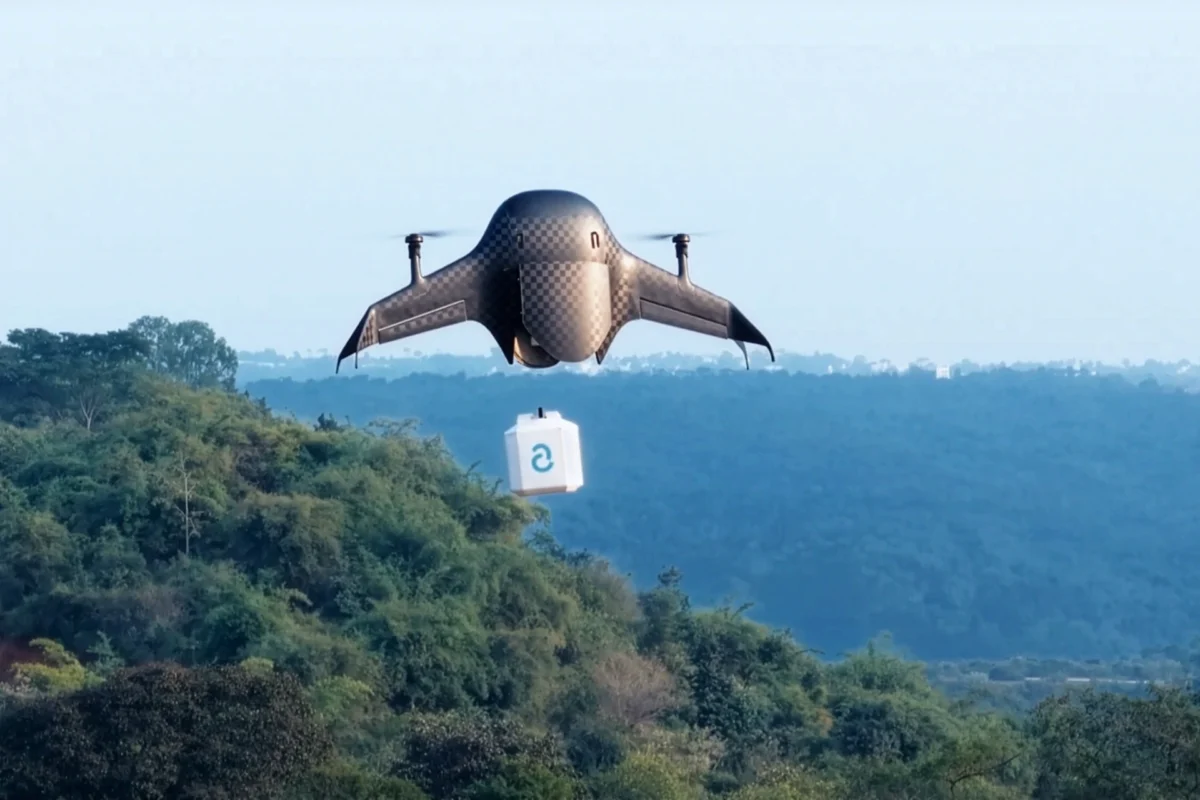
Airbound, an innovative Indian startup dedicated to pioneering autonomous drone technology, has successfully closed a Series A funding round, securing $37 million in fresh capital. This significant investment propels the company forward in its ambitious mission: to establish aerial goods movement that is as economically viable as traditional road-based trucking. The round, spearheaded by Greenoaks, saw robust participation from prominent investors including DoorDash, Lachy Groom, Lightspeed, and Humba Ventures. This recent influx of capital comes less than a year after Airbound’s initial seed round, which raised $8.65 million, bringing the three-year-old startup’s total funding to nearly $50 million. The substantial backing underscores growing investor confidence in the nascent but rapidly evolving drone logistics sector, particularly in the Indian market.
The core premise driving Airbound and other players in this emerging field is the potential for drones to transport specific categories of goods with unparalleled speed and, crucially, at a lower cost than conventional road vehicles. While successful pilot programs and limited deployments have demonstrated this potential, drone delivery remains a considerable distance from matching the sheer scale, versatility, and established infrastructure of the trucking industry. Airbound is strategically positioned to bridge this gap, focusing its efforts on a fundamental redesign of aircraft to enhance their competitiveness against ground transportation methods.
Naman Pushp, founder and CEO of Airbound, elaborates on the company’s innovative approach to tackling the inherent inefficiencies of conventional aircraft. Traditional aviation designs often dedicate a substantial portion of their energy to lifting their own weight rather than the payload itself, rendering flight an expensive proposition, especially for smaller cargo loads. Airbound’s solution centers on developing vertical-flight drones meticulously engineered to weigh less than the cargo they are designed to carry. This ingenious design philosophy aims to drastically improve the payload-to-weight ratio, thereby reducing energy consumption and operational costs per delivery.
The startup’s current operational drone, christened TRT, exemplifies this design philosophy, weighing approximately 3.3 pounds while capable of transporting a payload of around 2.2 pounds. Looking ahead, Airbound is actively developing its next-generation drone, projected to weigh approximately 6.6 pounds and boast an impressive payload capacity of up to 11 pounds. This planned increase in payload capability is critical for expanding the range of goods that can be efficiently transported, moving beyond lightweight diagnostic samples to potentially include larger e-commerce parcels or essential medical supplies.
Airbound’s drones feature a distinctive rocket-like, tail-sitter design. This configuration allows the aircraft to take off and land vertically in an upright position, a critical capability for operating in diverse environments without requiring extensive ground infrastructure. Following takeoff, the drone seamlessly transitions to horizontal flight for efficient long-distance travel. Pushp emphasizes that the commitment to vertical takeoff and landing (VTOL) will remain a cornerstone of Airbound’s design philosophy, even as the company develops larger aircraft. This strategic decision eliminates dependence on traditional runways, granting unprecedented flexibility in deployment and enabling point-to-point delivery directly to customer locations or facilities. The overarching vision, as articulated by Pushp, is to "build towards a world where everything has cost parity with trucking," signifying a profound transformation in logistics economics.
Since its inception in 2023, Airbound has already achieved significant operational milestones, having completed over 13,000 autonomous flights across the southern Indian cities of Bengaluru and Guntur. A cornerstone of its early success is a transformative partnership with Narayana Health, a prominent Indian hospital network. Airbound’s drones are actively deployed to transport critical diagnostic samples between various healthcare facilities within the network, demonstrating the tangible benefits of drone logistics in a time-sensitive environment. Over 1,000 flights have been dedicated to this vital service.
In practice, a single active Airbound drone efficiently covers a Narayana route of approximately 2.5 miles, completing the transport of diagnostic samples in roughly seven minutes. This dramatically contrasts with traditional road transport methods, where two-wheelers often take between three to five hours to cover the same distance. This extended duration for road transport is largely due to the necessity of bundling enough samples to make a trip economically viable, leading to significant delays in diagnosis and treatment. The drone solution not only offers superior speed but also ensures the integrity and timely delivery of critical medical cargo, which can have life-saving implications.
The success of this partnership is further underscored by its planned expansion to Narayana’s new Banashankari hospital in Bengaluru. This modern facility has been intentionally designed without an on-site diagnostic laboratory or blood bank, relying entirely on Airbound’s drone network to seamlessly connect with centralized diagnostic facilities. This integration of drone logistics directly into the hospital’s operational model highlights a paradigm shift, moving beyond mere supplementary delivery to a foundational component of healthcare infrastructure, enhancing efficiency and patient care capabilities from the ground up.
Ambitious Three-City Drone Network for Andhra Pradesh
Airbound’s vision extends far beyond individual partnerships, encompassing a far grander ambition: the establishment of a comprehensive drone delivery network connecting three key cities within the Indian state of Andhra Pradesh. The startup has already forged an agreement with the state government to realize this ambitious project, with an eventual target of facilitating 10,000 flights per day. This expansive network is envisioned to serve a diverse range of sectors, including retail, e-commerce, and, of course, healthcare deliveries. Achieving such a daily flight volume would necessitate a substantial fleet, estimated to range between 250 and 1,000 aircraft, depending on the specific lengths of the routes, though Pushp anticipates the actual number will likely hover closer to 250.
Notably, this agreement with the Andhra Pradesh government does not involve any direct government contract or subsidy. Instead, the state government is actively collaborating with Airbound on the development of the necessary regulatory framework to enable the large-scale operation of such a network. This partnership is crucial, as it addresses one of the most significant hurdles for drone operations: regulation. Airbound expects to generate its revenue from companies that will utilize its network for their various delivery needs, positioning itself as a vital logistics infrastructure provider.
The Indian drone sector is vibrant, with several startups already building aerial logistics businesses. Companies like Skye Air Mobility and TSAW Drones are actively establishing their presence, while other Indian drone manufacturers such as Garuda Aerospace are exploring various delivery use cases. However, Naman Pushp articulates a distinct strategic differentiation for Airbound. Rather than aspiring to become the largest drone delivery operator itself, Airbound aims to build the advanced aircraft that other logistics networks could ultimately deploy. "That’s the Boeing role — the aircraft airlines everywhere rely on, not the airline itself," Pushp clarifies, drawing a powerful analogy. This strategic focus positions Airbound as a technology enabler and manufacturer, providing the foundational hardware for a multitude of drone logistics providers, thereby potentially achieving a broader market impact and fostering a wider ecosystem of aerial delivery services.
Airbound maintains a high degree of control over its core technology and manufacturing processes. The company designs and manufactures its aircraft within a state-of-the-art 43,000-square-foot facility located in Bengaluru. This facility is where the critical work on the airframe and other core systems is meticulously handled in-house. While Pushp refrained from disclosing specific production capacity figures or the exact number of aircraft built to date, he confidently asserts that manufacturing will not pose a bottleneck as Airbound scales its operations. The emphasis on in-house production ensures stringent quality control, protects proprietary intellectual property, and allows for rapid iteration and customization of designs.
However, Pushp candidly identifies the primary bottleneck to Airbound’s rapid expansion: regulation. Specifically, securing approvals for Beyond Visual Line of Sight (BVLOS) operations remains the most significant hurdle. BVLOS certification is absolutely critical for enabling drones to fly beyond the direct sight of an operator, a fundamental requirement for operating scalable, efficient delivery networks over long distances and across urban landscapes. The complexities surrounding BVLOS approvals often involve stringent safety protocols, integration with existing air traffic control systems, and addressing public concerns regarding drone operations.
These regulatory constraints have, in turn, limited Airbound’s ability to translate its extensive flight operations into substantial commercial revenue. Despite having a robust team of over 150 employees, the startup largely remains in a pre-revenue phase. This situation is not uncommon for deep-tech companies operating in highly regulated and nascent industries, where significant upfront investment in research, development, and regulatory pioneering is required before commercialization. Pushp’s long-term perspective is clear: "The goal is to be a giant in a few decades, not to make revenue as soon as we can." This statement encapsulates Airbound’s commitment to a long-term strategy focused on fundamental technological innovation and market disruption, rather than immediate short-term financial returns, aiming to fundamentally redefine how goods are moved across India and potentially, the world.






