 11


A groundbreaking working paper from the Federal Reserve Bank of Cleveland proposes a compelling and provocative explanation for the distinct behavior of cryptocurrencies compared to traditional financial assets. The research suggests that the divergence is not merely a matter of differing demographics or risk appetites among American investors, but rather a consequence of profoundly divergent beliefs about the future returns of digital assets. This finding could illuminate the persistent volatility characteristic of the cryptocurrency market and the mechanisms by which rallies attract new buyers, potentially creating a self-reinforcing feedback loop. In this cycle, rising prices bolster bullish expectations, subsequently drawing more investors into the market.
The study, conducted by researchers Michael Weber, Bernardo Candia, Olivier Coibion, and Yuriy Gorodnichenko, utilized data from repeated surveys involving as many as 25,000 U.S. households per wave. Their analysis revealed that expectations regarding future cryptocurrency returns were a more significant determinant of who owned these digital assets than a wide array of demographic characteristics. The paper, titled "Do You Even Crypto, Bro? Cryptocurrencies in Household Finance," further employed a randomized information experiment. This experiment demonstrated that providing individuals with information about Bitcoin’s (BTC) recent performance could directly increase their desired allocation to cryptocurrency and, consequently, their subsequent purchasing behavior.
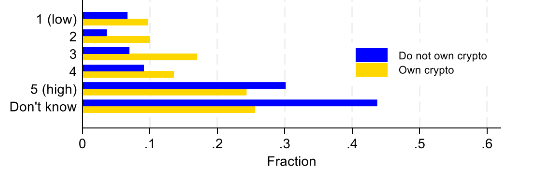
The researchers posit that these findings point to a potential mechanism underlying speculative bubbles. Past gains, they suggest, can attract new investors. The subsequent purchases by these new entrants drive prices higher, which in turn can attract even more buyers. "Positive returns attract new participants, which raises the price further," the authors state in their paper. This dynamic is particularly noteworthy given that cryptocurrency remains poorly understood by a substantial portion of the population. In a 2021 survey conducted by the researchers, 87% of individuals who did not own crypto reported being unsure about the expected returns from these assets over the following year. Even among existing crypto owners, this uncertainty persisted, with 54% admitting they did not know what returns to expect.

For those individuals willing to venture a forecast, however, the disparity in expectations was significant. Crypto owners anticipated an average return of 22% over the subsequent year, a stark contrast to the mere 7% expected by non-owners. Furthermore, owners tended to perceive cryptocurrency as a less risky investment compared to non-owners. The study identified expected returns as an unusually powerful predictor of ownership. Specifically, a one-percentage-point increase in an individual’s expected cryptocurrency return was correlated with a 0.8-percentage-point increase in the probability of owning cryptocurrency. When considered together, expectations about returns and perceived risk explained considerably more of the variation in crypto ownership than observable characteristics such as age, income, and gender.
This contrasts sharply with traditional assets like stocks, bonds, and gold, where demographic and financial characteristics typically hold greater explanatory power than differences in expected returns. Cryptocurrency, in essence, reverses this established relationship. Despite this, the demographic profile of crypto investors remains distinctive. Individuals under 40 were 13 percentage points more likely to own cryptocurrency than those over 60, even after accounting for other influencing factors. Men exhibited a higher propensity to own crypto, being approximately 4 percentage points more likely than women. Additionally, households with higher incomes and greater wealth were also more inclined to participate in the cryptocurrency market.
The randomized information experiment yielded perhaps the most consequential finding in the paper for cryptocurrency markets. In 2025, researchers randomly assigned households to receive information about Bitcoin, stocks, GameStop, or inflation. Participants exposed to information regarding Bitcoin’s 12-month prior returns increased their desired allocation to cryptocurrency by approximately 2 percentage points. This represented a substantial 47% increase relative to the 4.3% desired allocation among the control group. Actual subsequent cryptocurrency purchases also rose by about 2.5 percentage points. The authors described this result as demonstrating that "providing information about recent Bitcoin returns induces some households to start buying cryptocurrency." This effect was particularly pronounced among individuals who had previously cited a lack of sufficient information as their reason for not owning crypto. Conversely, those who already held a negative view of cryptocurrency as an investment generally did not react to the informational treatment.
The paper also uncovered evidence that cryptocurrency wealth can positively influence household consumption. A doubling in Bitcoin’s price led to a 1.4 percentage point increase in the likelihood of a household, whose entire financial portfolio was in crypto, purchasing a durable good. This increase is equivalent to roughly a 7% rise compared to the unconditional probability of such a purchase. However, this effect did not extend to ordinary spending patterns. This observation led the researchers to draw a stark comparison: crypto gains appear to be treated more akin to "gambling income" or lottery winnings rather than a permanent enhancement of wealth.
The broader implication of these findings is that the inherent volatility of cryptocurrency may be partly rooted in investor disagreement and ongoing learning processes, rather than solely in fundamental market dynamics. The authors conclude that cryptocurrency distinguishes itself due to its lack of widespread understanding, the formation of sharply divergent investor views about its future prospects, and the capacity of new information about past returns to alter both expectations and investment behavior. "The absence of common information and beliefs about crypto across investors," they write, "suggests that price volatility will continue to be one of the most defining characteristics of this new asset for the foreseeable future."
For cryptocurrency markets, this suggests a potentially challenging conclusion: the next surge in retail demand may hinge not only on the prevailing price of Bitcoin but also on what investors are informed about its preceding price movements.






