 11
11
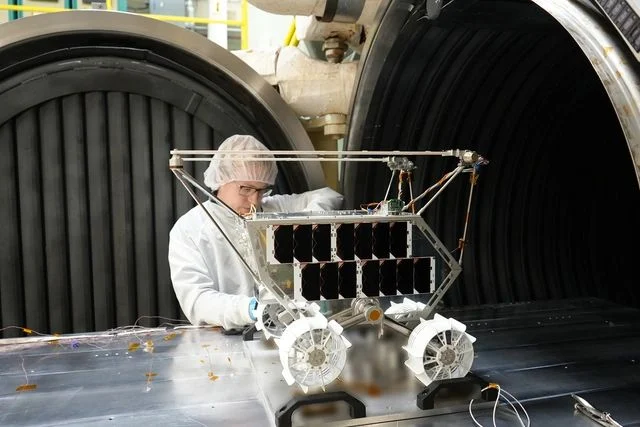
Nvidia, a global leader in graphics processing units (GPUs) and artificial intelligence (AI) technology, is extending its reach beyond Earth, setting its sights on the Moon. This ambitious new endeavor involves deploying its compact and powerful Jetson chips in lunar exploration, marking a significant step towards advanced robotics in extreme extraterrestrial environments.
On Thursday, Lunar Outpost, a pioneering startup dedicated to developing robotics for space infrastructure, made a landmark announcement: its forthcoming Moon rover will integrate Nvidia Jetson chips to command its LiDAR system. This integration is poised to make Lunar Outpost’s rover home to the first-ever GPU to operate on the lunar surface, heralding a new era for autonomous operations beyond Earth. The move underscores Nvidia’s expanding influence, as its technology, traditionally associated with gaming and data centers, finds crucial applications in the rigorous demands of space exploration.
Justin Cyrus, CEO of Lunar Outpost, articulated the strategic rationale behind this decision. "We’re taking the NVIDIA Jetson and comparing it to our flight compute platform that has a little bit more spaceflight heritage," Cyrus stated. He added, "We’re seeing what the pros are, seeing what the cons are. And we’re really pushing towards trying to adopt these more capable GPU-powered systems in these extreme environments." This comparative approach highlights a deliberate effort to evaluate and ultimately embrace cutting-edge commercial off-the-shelf (COTS) technology, even in the highly specialized and demanding domain of spaceflight, where established, radiation-hardened components have traditionally been preferred. The potential benefits of advanced processing capabilities offered by GPUs in enhancing mission autonomy and data analysis are driving this shift.
This private sector push into lunar exploration aligns seamlessly with NASA’s broader strategic objectives. The U.S. space agency has initiated a comprehensive campaign to incentivize private companies to conduct exploration missions on the lunar surface. This initiative serves as a critical precursor to NASA’s ambitious plans to return human astronauts to the Moon, potentially as early as 2028, under the Artemis program. Modeled after its highly successful partnerships with companies like SpaceX for cargo and crew transport to the International Space Station, NASA’s Commercial Lunar Payload Services (CLPS) program tasks technology companies with developing innovative vehicles capable of transporting scientific sensors to the Moon. The primary goals are to gain a deeper understanding of the lunar terrain, identify potential landing sites, and, crucially, hunt for vital substances such as water ice. Water is considered a key resource for future lunar outposts, potentially useful for life support, rocket propellant, or even as a lucrative commodity to exploit.
Nvidia’s engagement with lunar initiatives isn’t limited to Lunar Outpost. The company recently announced another significant partnership with Firefly Aerospace, an aerospace firm that achieved a historic milestone as the first private company to safely land a robotic spacecraft on the Moon. In this collaboration, the Jetson platform will operate on a satellite orbiting the Moon. Its primary function will be to process imagery data collected from lunar orbit. This orbital mission aims to gather extensive data for scientists worldwide, contributing to more precise mapping of the Moon’s surface. Furthermore, the satellite will play a crucial role in tracking the increasing number of robotic missions and assets deployed on the lunar surface, providing essential situational awareness for future operations.
Lunar Outpost’s upcoming rover mission is a testament to the collaborative spirit driving modern space exploration. The rover itself will be carried aboard a lander constructed by Intuitive Machines, another prominent Moon-focused technology company. This integrated mission design exemplifies how specialized private entities are combining their expertise to achieve complex space exploration goals. The rover is specifically engineered to transport a suite of scientific sensors into challenging lunar environments, such as deep craters and other topographical features that are difficult or impossible to explore effectively from orbital vantage points. The subsequent mission planned by Lunar Outpost will target a particularly intriguing region on the lunar surface known as Reiner Gamma. This area is characterized by a distinctive magnetic anomaly that has long puzzled scientists, making it a high-priority target for in-situ investigation. Both of these groundbreaking missions are slated to launch on a SpaceX Falcon 9 rocket before the end of the current year, highlighting the rapid pace of development in the commercial space sector.
While Nvidia’s high-performance AI accelerators like Blackwell and Vera Rubin dominate headlines for their role in data centers and advanced AI research, the Jetson platform holds a unique and vital position in the ecosystem of physical AI systems. Designed with a focus on compactness and power efficiency, Jetson modules enable robotic systems to perform sophisticated processing of sensor inputs directly at the edge, meaning on the device itself. This capability is crucial for autonomous operations, allowing robots to interpret their surroundings and react to environmental cues with significantly reduced latency, a critical factor for navigating unpredictable terrains and performing complex tasks in remote environments.
Elaborating on the evolution of their robotic intelligence, Justin Cyrus noted the shift in Lunar Outpost’s autonomy stack. "Our autonomy stack was a bit more deterministic five years ago, and now it’s a combination of deterministic and physical AI, which is pretty fun," Cyrus explained. He further added, "We still run both in parallel, and then it’s our job to figure out where physical AI can actually plug into our stack and help us do things that no one’s done before." This blend of traditional, rule-based deterministic programming with advanced physical AI, powered by GPUs, allows for greater adaptability, learning, and sophisticated decision-making in dynamic and unstructured environments like the Moon.
Operating GPUs in space, particularly on the lunar surface, presents formidable engineering challenges. Most space-faring GPUs currently in operation are typically found in Earth orbit, where they benefit from a degree of protection against the harsh space environment. They are relatively shielded from the full brunt of cosmic radiation and dramatic temperature fluctuations by Earth’s magnetosphere and atmosphere. The Moon, however, lacks these protective layers, leaving it directly exposed to intense cosmic radiation, which can disrupt electronic components and lead to data corruption or outright failure. Moreover, the lunar surface experiences extreme temperature swings, plummeting to hundreds of degrees below zero during the two-week-long lunar night and soaring during the lunar day. Sustaining operations through these periods demands highly robust and power-efficient systems. "Your system has to survive lunar night and has to do so on very low power," Cyrus emphasized, underscoring the critical need for advanced power management and thermal control solutions.
If Lunar Outpost’s engineers successfully overcome these environmental hurdles and enable the Jetson chips to operate reliably, the implications for future lunar missions are profound. Their vehicles would become significantly more capable, endowed with the ability to process environmental data more quickly and make autonomous decisions with greater precision and speed. NASA harbors extensive and long-term ambitions for establishing a sustained human presence on the Moon. However, realizing this vision will almost certainly necessitate a robust and highly capable fleet of autonomous systems to precede human explorers, pave the way, and undertake the arduous, repetitive, or hazardous tasks, thereby laying the groundwork for human habitation and scientific endeavors.
"What we at Lunar Outpost are currently working on is how do we go from exploration to permanence, how do we actually build that outpost on the moon?" Cyrus articulated, highlighting the company’s long-term vision. He firmly believes in the synergistic potential of combining different AI approaches: "We do think combining our deterministic models plus the physical AI layer—that’s what allows us to make a human presence in space sustainable, actually having that robotic workforce." This perspective underscores the indispensable role of advanced robotics and AI in transitioning from fleeting exploration missions to the establishment of permanent lunar infrastructure and habitats.
Looking ahead, Lunar Outpost has a busy schedule of missions planned. In the coming years, several smaller autonomous rovers are slated for launch to the Moon. In addition to these, a much larger rover, named Pegasus, is in development with the specific intent of carrying human astronauts on the lunar surface. However, the deployment of Pegasus is contingent upon the availability of a suitable heavy-lift rocket. It is currently awaiting a launch vehicle built by Jeff Bezos’s space company, Blue Origin. Blue Origin’s rocket, which Pegasus is slated to use, unfortunately suffered an anomaly earlier this summer. The incident has cast uncertainty on its return-to-flight timeline, making it unclear precisely when the Pegasus mission can proceed. Despite this setback, Cyrus remains optimistic about Blue Origin’s progress. "It does seem like they’re making pretty darn good progress on the pad," Cyrus remarked. While acknowledging the uncertainties, he added, "I can’t really answer Blue Origin’s timelines or NASA’s timelines on the pad reconstruction, but everything we’ve been told, we’re on the same timeline [for 2028]."
Ultimately, the realization of futuristic visions, such as the deployment of space data centers or the establishment of vast fleets of robots tirelessly working on the Moon, hinges on a fundamental prerequisite: the availability of larger, more powerful rockets capable of efficiently transporting substantial payloads to deep space destinations. As technology advances and demand for lunar resources and infrastructure grows, the development of these advanced launch capabilities will be paramount to unlocking humanity’s full potential in space.