 11
11
One of the most transformative global endeavors currently underway is the rapid expansion of solar energy infrastructure. Across continents, nations and corporations are vigorously pursuing the deployment of solar panels and battery storage solutions. This monumental effort is driven by a dual imperative: to achieve energy independence, reducing reliance on volatile fossil fuel markets, and to mitigate the escalating impacts of climate change by transitioning to cleaner, renewable power sources. The scale and speed required for this energy transition are unprecedented, making it a cornerstone of contemporary economic and environmental policy.
However, this ambitious build-out is encountering a significant bottleneck: a formidable labor market challenge. The burgeoning demand for solar panel installation and related construction tasks is rapidly outstripping the available supply of skilled workers. This shortage is exacerbated by several factors, including the physically demanding nature of the work, often in challenging outdoor environments, and the sheer volume of projects needing completion. The scarcity of labor threatens to slow down the pace of renewable energy adoption, undermining critical climate goals and delaying the realization of energy independence.
In this context, robotic automation has long been considered a potential solution. Yet, traditional industrial robots have historically struggled to adapt to the unstructured, dynamic, and often unpredictable environments typical of construction sites. Unlike controlled factory settings, outdoor construction presents variable terrain, changing weather conditions, and unforeseen obstacles, rendering conventional robotic systems largely ineffective. This limitation has historically hindered the widespread application of robotics in construction, despite the clear need for automation. Nevertheless, a paradigm shift is now occurring with the latest generation of artificial intelligence (AI) models, which possess enhanced capabilities for perception, learning, and adaptation. This technological leap has fundamentally altered the equation, opening new avenues for intelligent automation in previously intractable settings.
This profound realization is the driving force behind Gritt, an innovative startup that recently emerged from stealth mode. Founded by two highly accomplished roboticists trained at Carnegie Mellon University, CEO Puneet Puri and CTO Vishal Dugar, Gritt is poised to revolutionize construction through AI. The company made its public debut on Tuesday morning, announcing a significant $26 million Series A funding round. This round was led by prominent venture capital firm Obvious Ventures, with additional participation from Union Square Ventures and Active Impact Investment. This latest injection of capital brings Gritt’s total funding to an impressive $34 million, building upon an earlier seed round that saw investments from First Round Capital, Climactic, Congruent Ventures, and VSC Ventures. At its core, Gritt is dedicated to developing an intelligent system designed to "help civilization build infrastructure faster," as articulated by CEO Puri. This mission speaks to the urgency of accelerating critical infrastructure projects, particularly those vital for the energy transition.
Puneet Puri elaborated on the company’s foundational thesis in an interview with TechCrunch, stating, "Our thesis is that if we truly want to speed up construction, you need an intelligence which can work in the outdoor, chaotic environments of these construction sites, and it has to be generalizable enough that it can work in these varied environments." This emphasis on "generalizable intelligence" highlights Gritt’s ambition to create adaptable robotic solutions rather than highly specialized machines limited to single tasks or specific conditions. Such versatility is crucial for the diverse and unpredictable nature of large-scale construction.
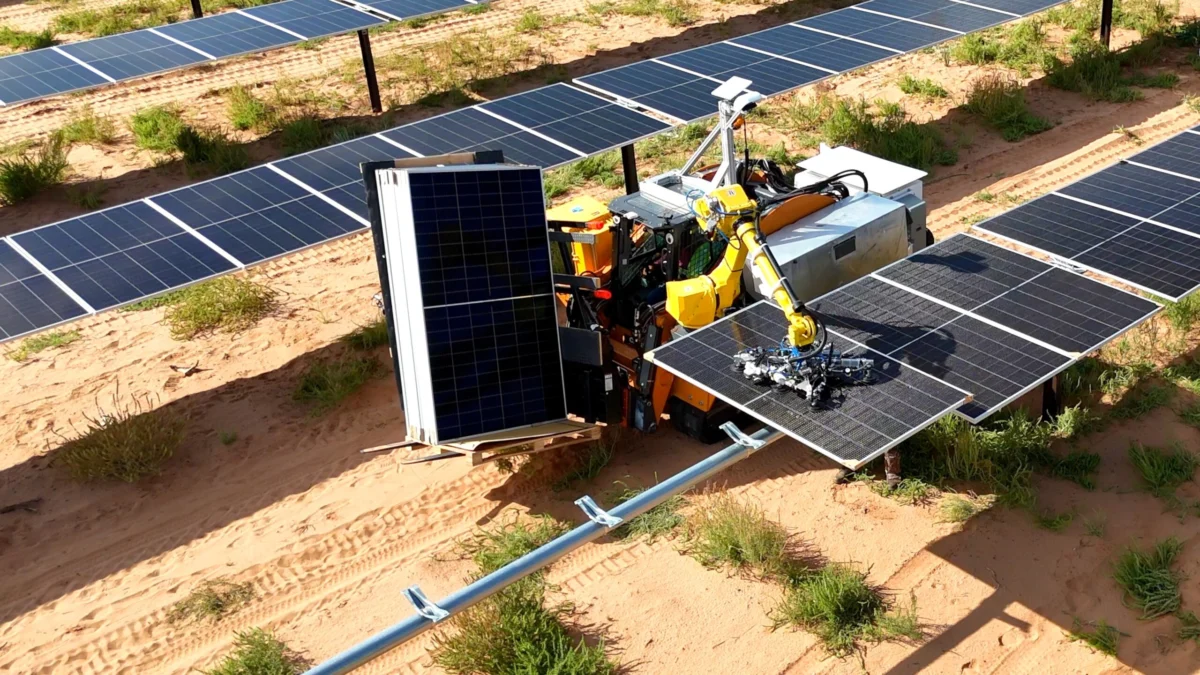
Gritt’s strategic approach diverges from many competitors in the robotics space. Rather than undertaking the costly and time-consuming process of designing and manufacturing its own proprietary robots from the ground up, Gritt leverages readily available, off-the-shelf hardware. This includes rented heavy machinery like skidders and advanced robotic arms manufactured by established industrial robotics companies such as Kawasaki. Gritt’s innovation lies in building sophisticated software platforms that integrate and control these existing hardware components using its advanced AI models. This hardware-agnostic strategy allows Gritt to focus its resources on developing cutting-edge AI, potentially enabling faster deployment, greater flexibility, and a more capital-efficient growth model.
The initial application of Gritt’s intelligent systems is focused on a critical and labor-intensive aspect of solar farm construction: the handling and installation of large glass solar panels. Gritt’s robots are tasked with the demanding job of unloading these heavy, fragile panels, transporting them across often uneven terrain to the precise locations of their metal support frames, and then positioning them on these frames. A key feature of their system is its ability to achieve sub-millimeter accuracy during placement, ensuring the panels are perfectly aligned for human workers to then securely fasten them. This automation of a physically demanding and precise task significantly reduces manual labor, enhances safety, and accelerates the overall installation process.
Andrew Beebe, a partner at Obvious Ventures who spearheaded Gritt’s Series A round, praised the founders’ practical and results-oriented mindset. "There are people who used to build rockets that went into space and had infinite budget for the smallest little part, and then there are people who know what it means to get into dirty, dull, and dangerous jobs and scale them like mad," Beebe remarked. He added, "These guys are in the second camp, and that’s a special kind of entrepreneur that has the technical chops, the AI, and the machine vision skills to make it work." This statement underscores Gritt’s pragmatic approach to solving real-world construction challenges with sophisticated technology.
The efficacy of Gritt’s systems is already being demonstrated in the field. The company currently has two systems actively deployed, continuously collecting data that is fed back into their AI models to refine and improve their behavior. The operational impact has been remarkable. Puneet Puri reports that a typical eight-person crew, working without Gritt’s automation, can install approximately 800 solar panels per day. However, the same crew, when augmented by Gritt’s intelligent systems, can dramatically increase their productivity, installing between 3,000 to 4,000 panels daily. This represents a staggering 375% to 500% increase in efficiency, highlighting the transformative potential of Gritt’s technology in scaling solar energy deployment.
Gritt is rapidly gaining traction in the market. The company has already secured contracts to assist in the installation of a substantial 2.8 gigawatts (GW) of solar panels within the next 18 months. Its customer base includes three of the top ten power construction companies in the United States, indicating strong industry validation and confidence in its solutions. Looking ahead, Gritt aims to expand its operational footprint significantly, with plans to deploy 48 of its intelligent systems within the next six months. This aggressive expansion strategy reflects both the market demand and the company’s capacity to scale its technology.
A Gritt customer, who chose to remain anonymous for competitive reasons but expressed significant enthusiasm for the system, provided valuable qualitative feedback. This customer anticipates that Gritt’s technology will make it considerably easier to undertake projects at remote sites, where attracting and retaining a sufficient workforce is often a major hurdle. Furthermore, the customer expects a notable reduction in workplace injuries. Manually lifting and positioning 100-pound solar panels overhead is an arduous and hazardous task, prone to causing strains and other musculoskeletal injuries. By automating this "dirty, dull, and dangerous" work, Gritt’s systems promise to create safer working environments for human laborers.
Gritt operates within a competitive landscape, facing other companies that are also developing panel-installing robots. These rivals include Luminous Robotics, Cosmic, and China’s Trinabot. A key differentiator, as previously mentioned, lies in Gritt’s strategic decision to focus on AI software and off-the-shelf hardware, whereas these competitors are primarily engaged in building their own proprietary robotic hardware. This fundamental difference could significantly shape the trajectory of growth and cost structures for these companies as demand for solar installation automation continues to surge. Gritt’s asset-light approach, relying on readily available and potentially lower-cost rented or purchased hardware, may allow it to scale faster and with a leaner operational footprint compared to companies that bear the heavy R&D and manufacturing costs associated with bespoke robotic systems.
Looking beyond its initial application, Gritt harbors ambitious plans for expanding the capabilities of its intelligent systems. The company intends to add new manipulation tasks, enabling its robots to not only position but also fasten solar panels, drill posts for mounting structures, and even construct the racks upon which the panels sit. In the longer term, Gritt envisions moving into a broader array of common, labor-intensive construction tasks. A prime example is the intricate process of tying rebar—reinforcing steel bars—before concrete is poured over it, a task that currently relies heavily on manual labor and precise dexterity.
The foundational enabler for Gritt’s expansive vision, according to its founders, is the transformative rise of new AI models. Puneet Puri highlighted this shift, explaining, "Making a system for one solution was still possible to some extent five years ago, right?" He contrasted this with the current capabilities of AI, which are making such work increasingly "generalizable." This means that the same underlying AI pipeline, with its sophisticated perception, learning, and control algorithms, can be reused and continuously improved across a diverse range of tasks and environments. Puri provided a compelling example: training Gritt’s system to stack cinder blocks took several weeks, but leveraging the same underlying software, a similar demonstration involving the much more complex task of rebar tying was achieved in just a single day. This illustrates the exponential gains in efficiency and adaptability offered by modern, generalizable AI.
Beyond merely automating physical tasks, Gritt’s founders believe that the comprehensive suite of sensors and the integrated intelligence embedded within their systems can offer far more than just installation assistance. They envision these systems boosting overall site management and decision-making capabilities. For instance, an intelligent Gritt system could detect an open trench on a construction site as a storm approaches, automatically alerting workers to cover it before rain can cause damage to components or create safety hazards. Similarly, the system could flag missing inventory in real-time, preventing costly delays due to material shortages.
Puri encapsulated this broader vision, stating, "Gritt becomes now this layer of physical AI, which is doing this dextrous, labor-intensive task, plus it can help you take decisions on the site." This positions Gritt not merely as a provider of robotic tools but as an intelligent platform that brings unprecedented levels of awareness, efficiency, and proactive management to complex construction environments. By addressing critical labor shortages, accelerating project timelines, enhancing safety, and improving operational intelligence, Gritt is poised to play a pivotal role in the global transition to sustainable energy and the modernization of the construction industry.