 11
11
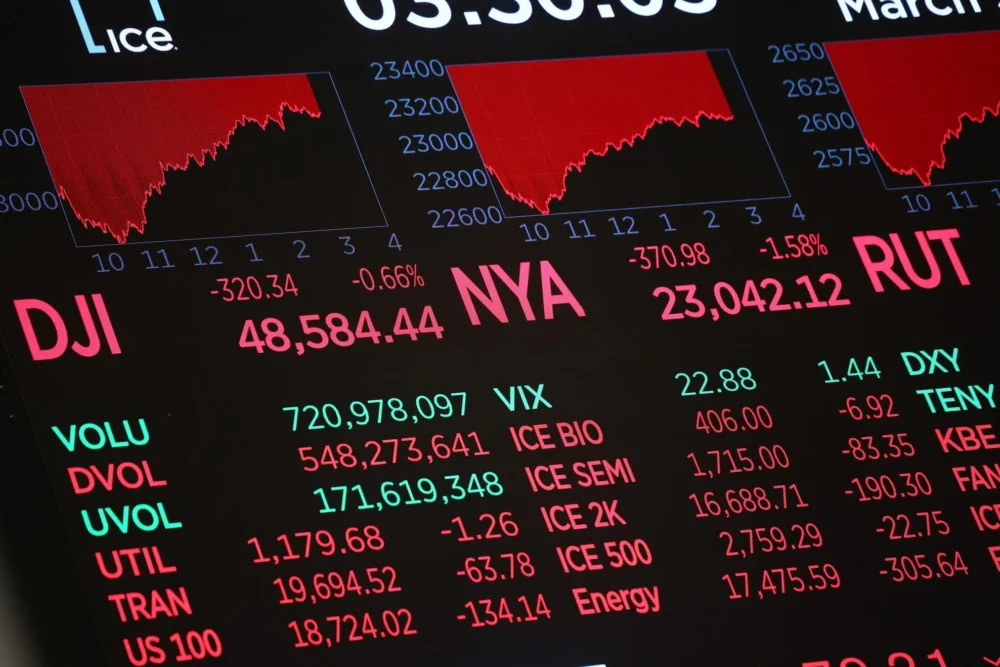
Global financial markets experienced significant turbulence on Thursday, with major U.S. stock indexes registering sharp declines, primarily driven by escalating geopolitical tensions in the Middle East. The ongoing conflict involving Iran has sent shockwaves through the energy sector, propelling oil prices to levels not seen in nearly two years. This surge in crude oil, a critical global commodity, has ignited widespread fears among investors and economists about a potential resurgence of inflation and its detrimental impact on the broader economy, casting a shadow over the trajectory of interest rates.
Market Meltdown on Thursday
The Dow Jones Industrial Average, a bellwether for the U.S. economy, bore the brunt of the market’s anxiety, plummeting by a staggering 1,089 points, equivalent to a 2.2% drop, by Thursday afternoon. This significant decline reflected a broad-based sell-off across various sectors. The S&P 500, a broader measure of large-cap U.S. equities, also experienced a substantial setback, falling by 1.3%. Meanwhile, the tech-heavy Nasdaq Composite, home to many of the nation’s most innovative companies, saw a 1.1% decrease, indicating that even growth-oriented stocks were not immune to the pervasive market unease. These movements underscored a collective investor flight from riskier assets amid heightened global uncertainty.
Oil Prices Soar to Near Two-Year Highs
The most immediate and dramatic consequence of the escalating Iran conflict was observed in the global oil markets. West Texas Intermediate (WTI), the key benchmark for U.S. crude oil, surged dramatically by 9%, pushing its price above the $81 per barrel mark. Concurrently, Brent Crude, the international benchmark, also experienced a significant uptick, rising by 5% to settle at approximately $85.45 per barrel. These price points represent the highest levels recorded for both indexes since July 2024, highlighting the profound impact of geopolitical instability on global energy supplies.
The impetus for this sharp rally in oil futures was a series of concerning reports from the Persian Gulf region. Iranian state media claimed that Iran had successfully struck an oil tanker with a missile. This assertion was further corroborated by reports from the British Navy, which independently confirmed an explosion on a tanker operating in Iraqi waters. While details surrounding these incidents remained fluid, the mere reports were sufficient to inject a substantial risk premium into oil prices. The Strait of Hormuz, a critical chokepoint for global oil shipments and a region of immense strategic importance, became a focal point of concern, with fears mounting over potential disruptions to the flow of crude oil from the Middle East to global markets. Any significant impediment to this vital shipping lane could have catastrophic implications for global energy security and prices.
Leading Losers Across Key Indexes
The market downturn was not uniform, but rather concentrated in specific sectors and companies that are particularly sensitive to economic fluctuations and geopolitical risks. Among the components of the Dow Jones Industrial Average, several industrial and financial giants led the losses. Caterpillar, a global manufacturer of heavy equipment often seen as a proxy for global economic activity, saw its shares fall by 4.6%. Walmart, the retail behemoth, dropped 4.3%, reflecting concerns about consumer spending in an inflationary environment. Investment banking giant Goldman Sachs slid by 3.9%, while aerospace giant Boeing, highly dependent on international trade and stability, recorded a 3.3% decline.
On the Nasdaq, a similar pattern emerged, with major technology players experiencing notable drops. Advanced Micro Devices (AMD) fell by 2.5%, followed by Apple (1.5%), Nvidia (1.5%), Alphabet (1.4%), and Tesla (0.9%). These declines in tech stocks, often perceived as growth engines, underscored a broader market sentiment of caution and risk aversion, even for companies with strong fundamentals.

Tangent: AI Chip Restrictions Add to Tech Woes
Adding another layer of complexity to the tech sector’s struggles, particularly for semiconductor companies, was a separate development reported by Bloomberg. This report indicated that the U.S. government was in the process of drafting stringent new regulations aimed at restricting the shipment of advanced artificial intelligence (AI) chips. These proposed rules would grant the U.S. sweeping power over the global sales of such critical technology, potentially requiring companies to seek explicit government permission for nearly all exports of AI-related hardware. This development contributed directly to the stock declines observed in companies like Nvidia and AMD, both of which are major players in the AI chip market and rely heavily on international sales. The White House, AMD, and Nvidia had not immediately responded to requests for comment regarding these potential regulations, leaving investors to grapple with the uncertainty surrounding future global market access for these crucial technologies.
A Look Back: Dow’s Volatility Earlier in the Week
The market’s fragility was not confined to Thursday alone. Earlier in the week, on Tuesday, the Dow Jones Industrial Average had already demonstrated significant intraday volatility. At its lowest point, the index had plunged by 1,278 points, marking what would have been its largest single-day percentage decline (2.6%) since April 2025. That previous substantial drop was attributed to then-President Donald Trump’s announcement of his "Liberation Day" tariffs, highlighting how trade and geopolitical policy decisions can trigger immediate and severe market reactions. While the Dow managed to recover some ground by Tuesday’s close, finishing down 0.8%, the episode served as a stark reminder of the underlying nervousness within the financial community and its susceptibility to sudden shifts in the global landscape.
Inflation Fears and the Federal Reserve’s Dilemma
The most significant long-term concern emanating from the rising oil and gas prices is the potential for a renewed surge in inflation. Energy costs are a fundamental component of the global economy, influencing everything from transportation and manufacturing expenses to the price of consumer goods. A sustained increase in oil prices could therefore ripple through the economy, pushing up overall inflation rates. This prospect has created a significant dilemma for the Federal Reserve, the U.S. central bank, which has been carefully navigating its monetary policy with the dual mandate of achieving maximum employment and maintaining price stability.
Higher inflation would likely complicate the Fed’s plans for potentially cutting interest rates, a move many investors had been eagerly anticipating. Lower interest rates typically stimulate economic growth but can also fuel inflationary pressures. Federal Reserve Bank of Minneapolis president Neel Kashkari addressed these concerns on Tuesday, stating that it was likely "too soon" to accurately estimate the full impact the Iran conflict could have on the U.S. economy. However, he explicitly acknowledged the heightened uncertainty surrounding future interest rate cuts, directly linking it to the surging energy prices. His comments underscored the cautious approach the Fed is likely to take, prioritizing inflation control even if it means delaying or foregoing rate reductions.
Diverging Analyst Perspectives on Impact
Financial analysts and economists have offered a range of perspectives on the potential economic fallout from the Iran conflict. Kristian Ker, an analyst at LPL Financial, articulated concerns that the war would inevitably disrupt the global energy market. He emphasized that any "substantial disruption" to the flow of oil and natural gas, particularly from a region as critical as the Middle East, could significantly "influence inflation expectations." This view suggests a more pessimistic outlook, where sustained energy price increases could embed higher inflation into the economic system, making it harder for central banks to manage.
Conversely, some economists have sought to temper these concerns, pointing to historical precedents. Tom Porcelli of Wells Fargo Economics and Daniel Skelly of Morgan Stanley both suggested on Thursday that the volatility surrounding geopolitical conflicts tends to be "relatively short-lived." This perspective implies that while initial market reactions and price spikes can be dramatic, the global economy often demonstrates resilience, and markets tend to stabilize and recover as the immediate shock subsides or new supply chains adapt. They likely draw on past conflicts where initial market fears eventually gave way to a more measured response, without necessarily triggering long-term economic downturns or sustained inflationary spirals. However, the unique complexities of the current geopolitical climate and the persistent inflation concerns prior to the conflict mean that even "short-lived" volatility can have significant, albeit temporary, consequences for markets and consumer sentiment.