 11
11
A recent analysis, leveraging data from Ahrefs, has illuminated the landscape of the most financially demanding keywords on Google Ads within the United States. This report meticulously details the top 100 keywords, alongside their estimated monthly search volume and the significant cost per click (CPC) advertisers are willing to invest. The data reveals that securing visibility for these highly contested terms can come with a substantial price tag, with some keywords commanding CPCs as high as $105.00.
The comprehensive list showcases a diverse range of industries and search intents. Leading the pack, "chordee repair" stands out with a $105.00 CPC and a search volume of 800 monthly searches. Close behind are terms related to legal services, particularly mesothelioma attorneys. Keywords such as "mesothelioma attorney chicago," "lawsuit mesothelioma," and "dallas mesothelioma lawyer" all carry a $100.00 CPC, indicating fierce competition among law firms vying for these high-value cases. Other legal terms like "los angeles slip and fall attorney" and "truck wreck lawyers" also feature prominently, with CPCs reaching $100.00.
The technology sector also shows a strong presence among the most expensive keywords. Terms like "apps live," "adtheorent," and "axon taser" each carry a $100.00 CPC. The mention of "aaxn" and "axon company" suggests interest in the Axon Enterprise, a company known for its electroshock weapons and body cameras. Furthermore, advertising-related terms like "interstitial ads cpm" and "advertise feedbuzzard" highlight the investment in digital advertising strategies, with CPCs at $100.00.
Beyond immediate service needs, certain consumer-related searches also command high CPCs. "How bad is monster zero sugar for you" with a $100.00 CPC and 1,000 monthly searches, suggests a strong consumer interest in health impacts of popular products, prompting advertisers to capture this audience. Similarly, travel-related terms like "disney cruise line incidents" and "carnival cruise death" also show a $100.00 CPC, reflecting the high stakes involved in addressing consumer concerns and potential legal issues within the cruise industry.
The underlying mechanism driving these exorbitant costs is Google’s auction-based advertising system. Companies must consistently outbid one another to secure prime positions in the search engine results pages (SERPs). When a keyword experiences high demand, it signifies that numerous businesses are vying for that specific search term, thereby escalating the cost per click. This competitive bidding process is particularly intense for keywords that are believed to generate a significant return on investment (ROI).
The profitability of these keywords is often tied to the high lifetime value of a customer or the potential for substantial revenue per transaction. Industries where a single client acquisition can lead to considerable financial gain are characterized by the most aggressive bidding. This is frequently observed in sectors such as legal services, where a successful case can result in large settlements or fees, and in high-value B2B services where client contracts are worth millions.
An analysis of the top 10,000 most expensive keywords reveals that certain industries consistently dominate the list. The legal sector, particularly personal injury, medical malpractice (like mesothelioma cases), and truck accidents, emerges as a primary driver of high CPCs. This is due to the potentially massive financial implications of these cases. Furthermore, the financial services industry, including terms related to insurance, loans, and investment, also shows a significant presence. Technology and software, especially those catering to businesses (B2B), also feature prominently, as the acquisition of a business client can yield substantial recurring revenue. Healthcare services, particularly specialized medical treatments and legal recourse for medical issues, also contribute to the list of expensive keywords.
In navigating the landscape of high-cost keywords, a key insight from marketing consultant Dan Kennedy is pertinent: "Whoever can spend the most money to acquire a customer wins." This underscores that the objective is not necessarily to avoid paying for expensive keywords, but rather to strategically bid on those that align with business goals and yield a positive ROI. If a keyword consistently generates profitable customer acquisitions, its "expense" becomes relative to the value it delivers.
Effective Google Ads management involves more than just avoiding high CPCs; it requires optimizing campaigns for efficiency and profitability. Strategies such as meticulous keyword research, targeted audience segmentation, compelling ad copy, and optimized landing pages are crucial. Focusing on long-tail keywords, which are more specific and often have lower competition and CPCs, can also be an effective approach. Additionally, leveraging negative keywords to prevent ads from appearing for irrelevant searches can help conserve budget and improve ad performance.
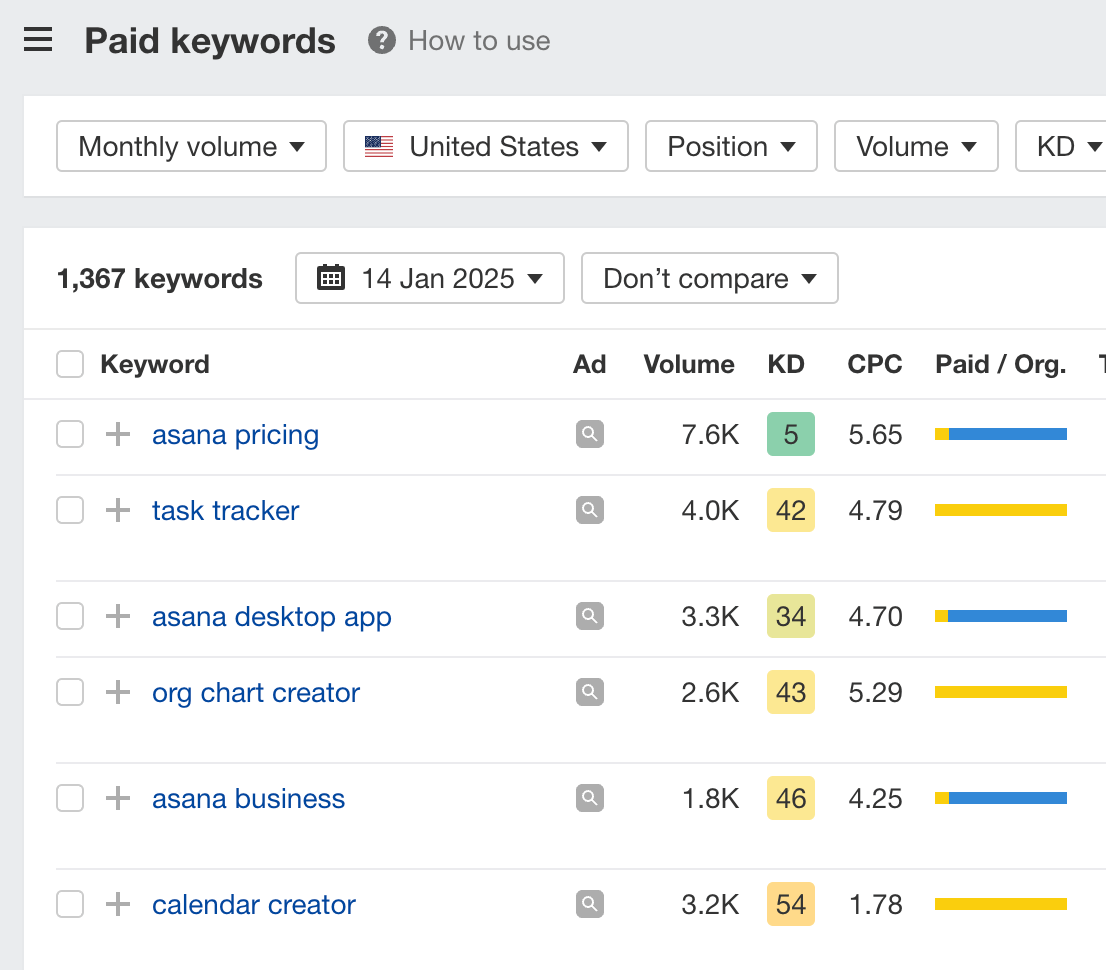
Understanding competitor strategies is also vital. By analyzing the paid keywords that competitors are bidding on, businesses can gain valuable insights into profitable market segments and potentially identify overlooked opportunities. Tools that allow for the examination of competitor ad campaigns can reveal the keywords they are targeting, the CPCs they are paying, and the landing pages they are directing traffic to. For instance, analyzing a competitor like Asana.com can reveal that they are bidding on a significant number of keywords in the U.S., providing data on their spending and the specific terms driving their paid traffic. This competitive intelligence can inform bidding strategies and help businesses allocate their advertising budget more effectively.
In conclusion, the data on the most expensive Google Ads keywords in the U.S. paints a picture of intense competition, particularly in sectors where customer acquisition carries high potential value. While these keywords demand significant investment, their cost is often justified by the substantial ROI they can deliver when managed strategically. The key for advertisers lies not in avoiding expense, but in intelligently investing in keywords that drive profitable growth, informed by market analysis and a deep understanding of their target audience and competitive landscape.