 11
11
Fusion startup Helion is reportedly in advanced discussions to supply significant amounts of electricity to OpenAI, a generative artificial intelligence company. This potential agreement highlights a growing trend of technology giants seeking vast, clean energy sources to power their increasingly demanding AI operations. Both Helion and OpenAI share a common prominent backer in Sam Altman, the CEO of OpenAI, who has been a vocal proponent and investor in both entities.
The proposed deal, first brought to light by Axios, is currently in its nascent stages but could see OpenAI securing a substantial 12.5% of Helion’s anticipated power generation. The targets outlined are ambitious: five gigawatts (GW) by 2030, escalating dramatically to 50 GW by 2035. This arrangement mirrors a similar agreement Helion inked with OpenAI’s strategic partner, Microsoft, in 2023, where Microsoft committed to purchasing fusion power from Helion starting in 2028. Such early commitments from major tech players underscore the urgent need for scalable, clean energy solutions as AI development accelerates.
The figures reported, if they materialize, paint a picture of extraordinary ambition and expected rapid scaling for Helion’s fusion power plant technology. Each of Helion’s commercial reactors is designed to produce 50 megawatts (MW) of electricity. To meet the 2030 target of five gigawatts, the company would need to construct and deploy 800 reactors within the next six years. Furthermore, to reach the 2035 target of 50 gigawatts, an additional 7,200 reactors would need to be built and installed, bringing the total to 8,000 reactors. This represents an unprecedented pace of development and deployment for any advanced energy technology, particularly one as complex as nuclear fusion.
The scale of this endeavor is immense. For context, 50 gigawatts is roughly equivalent to the entire installed power generation capacity of a medium-sized industrialized nation or powering tens of millions of homes. Achieving such a rapid build-out would require not only a technological breakthrough but also a monumental industrial effort encompassing manufacturing, supply chain logistics, site selection, and regulatory approvals at an unparalleled pace. Helion has not yet responded to inquiries regarding these specifics.
Helion is in a race against time and competition to bring its first commercial-scale reactor online. Should the startup succeed in meeting these aggressive timelines, particularly the 2028 target implied by the Microsoft deal, it would place Helion years ahead of most of its competitors in the fusion energy sector. Many other fusion startups and research initiatives are generally targeting the early 2030s for the commencement of commercial operations, highlighting the audacious nature of Helion’s roadmap.
The company has garnered significant financial backing to fuel its ambitious goals. Last year, Helion successfully raised $425 million from a diverse group of investors. Sam Altman was a key participant in this funding round, alongside prominent venture capital firms such as Mitril, Lightspeed, and Softbank. This substantial investment underscores the belief among high-profile investors in Helion’s technology and its potential to revolutionize the energy landscape.
Fusion power, often heralded as the "holy grail" of clean energy, seeks to replicate the process that powers the sun and stars. It involves fusing light atomic nuclei to release enormous amounts of energy, with the promise of virtually limitless, carbon-free electricity without the long-lived radioactive waste associated with conventional nuclear fission. However, achieving sustained, net energy-positive fusion has been one of the most formidable scientific and engineering challenges of the last century.
Most fusion startups and research programs are pursuing one of two primary approaches to harness this energy. The first involves magnetic confinement, where extremely hot plasma (a superheated, ionized gas) is contained by powerful magnetic fields, typically in donut-shaped devices called tokamaks or more complex stellarators. The second is inertial confinement, which uses high-powered lasers or particle beams to rapidly compress and heat a small fuel pellet, mimicking miniature explosions. In both these approaches, the primary method for generating electricity involves harvesting the heat produced by the fusion reactions to boil water, which then drives a steam turbine connected to a generator, similar to conventional power plants.
Helion, however, is taking a distinct and potentially revolutionary approach. The company is developing a unique reactor design that aims to convert fusion energy directly into electricity using magnets, bypassing the less efficient and complex steam cycle. This direct energy conversion method could offer significant advantages in terms of efficiency, cost, and overall plant simplicity.
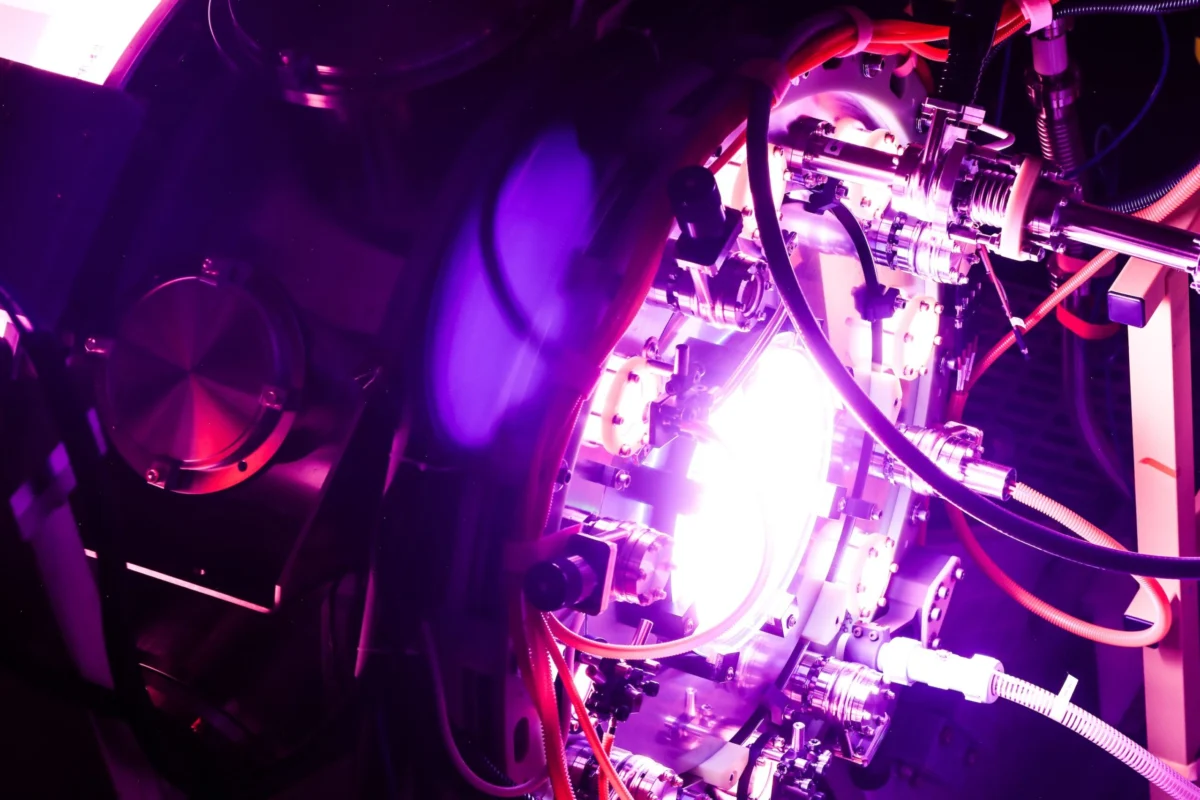
At the heart of Helion’s technology is an hourglass-shaped reactor. Within this vessel, fusion fuel – typically isotopes of hydrogen – is first heated to extreme temperatures, turning it into plasma at either end of the hourglass. Powerful magnetic fields then accelerate these plasma streams towards each other, causing them to collide in the center of the reactor. At the point of collision, another set of intense magnets compresses the merged plasma ball to an even higher density and temperature, triggering fusion reactions. Critically, as the fusion reaction occurs, the expanding plasma pushes back against these magnetic fields. This interaction directly converts the kinetic energy of the expanding plasma into electrical current through electromagnetic induction, eliminating the need for a thermal-to-mechanical-to-electrical conversion process.
Helion is currently operating its Polaris prototype, a crucial step in its developmental roadmap towards commercial power generation. The progress made with Polaris has been significant. In February, the company announced that it had successfully generated plasmas inside the reactor that reached a blistering 150 million degrees Celsius. While an extraordinary achievement, Helion projects that approximately 200 million degrees Celsius will be required for sustained commercial operations, indicating that the company is tantalizingly close to its technical milestones.
Sam Altman’s involvement in this potential deal, despite his official recusal, underscores his strategic vision for the future of artificial intelligence. Although he has reportedly stepped down from his position as chair of Helion’s board and has formally recused himself from discussions between Helion and OpenAI to mitigate potential conflicts of interest, his influence and "fingerprints" are widely acknowledged to be instrumental in fostering such high-level connections. Altman has consistently articulated a belief that the exponential growth of AI will necessitate equally exponential growth in clean, affordable energy. His investments across both the AI and advanced energy sectors reflect a deliberate strategy to ensure the foundational resources for a future dominated by powerful AI.
This is not the first instance of Altman strategically repositioning himself to enable synergistic partnerships between his various ventures. Last year, Altman also stepped down as board chair of Oklo, a startup focused on small modular nuclear reactors (SMRs). At the time, Caroline Cochran, Oklo’s co-founder and chief operating officer, stated that the move was specifically intended to "allow Oklo to explore strategic partnerships with leading AI companies, including potentially with OpenAI." This pattern suggests a deliberate and consistent approach by Altman to facilitate the energy supply required for the AI revolution he is spearheading. The convergence of AI and advanced energy technologies, with figures like Altman at the nexus, marks a pivotal moment in both sectors, shaping the future infrastructure of a technologically advanced world.