 11
11
Washington D.C. – A bipartisan legislative effort is underway in the U.S. Senate to curb the presence of sports betting and "casino-style" contracts on prediction markets overseen by the Commodity Futures Trading Commission (CFTC). Senators Adam Schiff (D-CA) and John Curtis (R-UT) are expected to introduce such a bill on Monday, according to a report by The Wall Street Journal.
Senator Curtis, a co-sponsor of the proposed legislation, expressed strong concerns regarding the accessibility of these betting and gaming contracts to young individuals. "Too many young people in Utah are getting exposed to addictive sports betting and casino-style gaming contracts that belong under state control, not under federal regulators," Curtis stated to The Wall Street Journal. This initiative reflects a growing sentiment in Washington to impose restrictions on certain types of prediction market contracts, a push that has intensified in recent weeks.
The impending bill comes at a time of heightened regulatory scrutiny over prediction markets, particularly in the wake of renewed concerns about insider trading. These concerns were notably sparked by events surrounding the U.S.-Israeli conflict with Iran, where unusual trading activity on prediction markets raised questions about potential illicit information use.
This proposed legislation builds upon previous efforts by Senator Schiff. On March 10, he introduced the DEATH BETS Act, a bill specifically aimed at prohibiting CFTC-regulated prediction markets from listing contracts related to sensitive topics such as war, terrorism, assassination, and individual death. The introduction of the DEATH BETS Act signaled a broader congressional interest in policing the boundaries of what can be traded on these platforms.
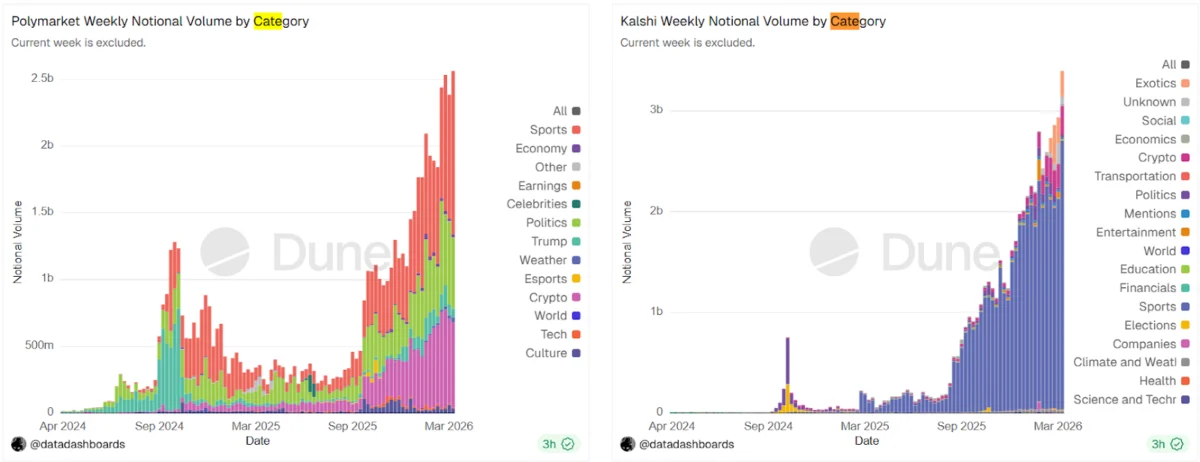
Sports betting has emerged as a significant driver of trading volume on prediction market platforms. Data from Dune Analytics reveals that sports-related contracts constituted a substantial portion of weekly trading activity on major platforms. Last week, sports contracts accounted for 47.7% of Polymarket’s weekly notional volume and a commanding 78.8% for Kalshi. In terms of sheer volume, sports betting generated an impressive $1.2 billion in weekly notional trading volume for Polymarket and $2.6 billion for Kalshi, highlighting its dominant role in the prediction market landscape.
The intensifying regulatory pressure is not confined to Capitol Hill. The CFTC itself has taken steps to clarify its stance on prediction markets. On March 12, the commission issued a staff advisory that formally classifies event contracts traded on prediction markets as a "financial asset class." This classification carries significant regulatory implications.

Furthermore, the CFTC has submitted an Advanced Notice of Proposed Rulemaking, initiating a public comment period to gather feedback on how the Commodity Exchange Act (CEA) should be applied to prediction markets. Both Polymarket and Kalshi currently operate as Designated Contract Markets (DCMs) under the CFTC’s regulatory framework.
However, the extent of the CFTC’s exclusive jurisdiction over these markets has recently been challenged in the courts. CFTC Chair Michael Selig has asserted the commission’s "exclusive jurisdiction" over prediction markets. Yet, a ruling by an Ohio judge on March 9 cast doubt on this assertion. The judge determined that Kalshi had not adequately demonstrated that the CEA would preempt Ohio’s sports gambling laws, nor that these specific sports betting contracts fell under the exclusive jurisdiction of the CFTC.
Adding to the legal challenges, a Nevada judge issued a temporary injunction on Friday, barring Kalshi from offering sports, election, and entertainment event contracts within the state for a period of 14 days. The judge found that regulators had a reasonable likelihood of success in arguing that these prediction markets violated Nevada’s gambling laws.
These legal decisions, alongside the proposed bipartisan legislation, indicate a growing trend towards tighter regulation and potential restrictions on prediction markets, particularly concerning activities that bear resemblance to traditional forms of gambling. The convergence of legislative action and judicial scrutiny suggests a critical juncture for the future of prediction markets in the United States, with a clear focus on delineating the boundaries between financial derivatives, state-controlled gambling, and federally regulated markets.
Cointelegraph reached out to the senators for comment and a copy of the draft bill.
Cointelegraph is committed to independent, transparent journalism. This news article is produced in accordance with Cointelegraph’s Editorial Policy and aims to provide accurate and timely information. Readers are encouraged to verify information independently.