11
11
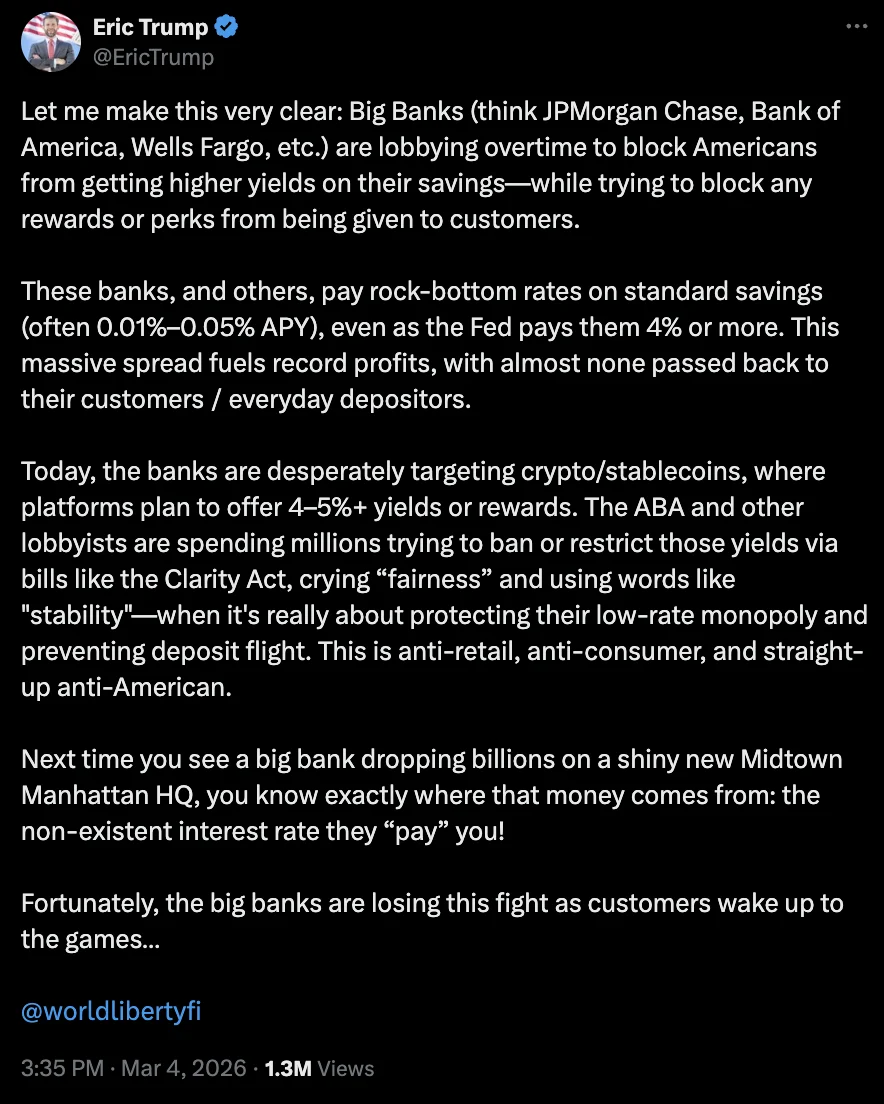
Eric Trump, son of former US President Donald Trump and a co-founder of the crypto venture World Liberty Financial, has publicly aligned himself with the growing anti-bank sentiment prevalent within the cryptocurrency industry. His recent X post, made hours after his father’s own critical remarks, highlighted a perceived opposition from financial institutions towards digital assets amidst ongoing legislative gridlock concerning a market structure bill.
The dispute, which has significantly stalled progress on the crucial legislation, centers on the contentious issue of stablecoin yields. Eric Trump, echoing sentiments often voiced by cryptocurrency proponents, claimed that banks are "desperately targeting" cryptocurrencies and stablecoins. This accusation comes as discussions surrounding the market structure bill in the US Senate remain protracted. The timing of his post underscores a coordinated messaging strategy, as it followed closely on the heels of President Trump’s own public statement, where he accused banks of holding the legislation "hostage."
World Liberty Financial, the crypto company co-founded by Eric Trump, has been tangentially linked to this discourse. When approached for comment regarding Eric Trump’s public stance, a representative for the company emphasized that World Liberty Financial is "not a political organization." The representative reiterated that Eric Trump "has been clear about why he helped create World Liberty Financial," suggesting his involvement in the crypto space is driven by specific motivations that may or may not be directly tied to political agendas.
The core of the legislative impasse lies in the differing perspectives on stablecoin yield, a feature that allows users to earn interest on their stablecoin holdings. This aspect of stablecoins has created a significant divide among US lawmakers, banking industry representatives, and cryptocurrency firms. Eric Trump and a considerable segment of the crypto industry advocate for the continuation of stablecoin yield, arguing that its prohibition would "block any rewards or perks from being given to customers." Conversely, certain banking organizations have expressed concerns that such yields could destabilize the credit system and create a risk of deposit flight. These organizations have argued that allowing stablecoin yields could undermine traditional banking functions and lead to an exodus of funds from conventional deposit accounts.
This public friction follows a series of high-level meetings involving White House officials, banking executives, and cryptocurrency industry representatives. These discussions were aimed at finding common ground on how to address stablecoin yield within the proposed market structure bill. The legislation, previously known as the CLARITY Act when it successfully passed the House of Representatives in July, has faced numerous delays. These setbacks are attributed to factors including a lengthy government shutdown and ongoing debates among legislators concerning ethics, the burgeoning field of tokenized equities, and the regulation of stablecoins.

The Senate Agriculture Committee did advance its version of the bill in January, marking a procedural step forward. However, the Senate Banking Committee subsequently postponed a scheduled markup session, and as of Thursday, a new date had yet to be announced. For the legislation to move towards a potential vote in the full Senate, both committee versions will likely require approval from their respective panels and subsequent consolidation into a unified bill.
The market structure bill is a complex piece of proposed legislation designed to provide a comprehensive regulatory framework for the evolving digital asset landscape. Its passage is seen by many in the crypto industry as essential for providing regulatory clarity and fostering innovation. However, disagreements over specific provisions, particularly those related to stablecoins, have proved to be significant hurdles. The debate over stablecoin yields is particularly acute, as it touches upon fundamental aspects of financial intermediation and the competitive landscape between traditional finance and the burgeoning digital asset sector.
Proponents of stablecoin yield argue that it is a crucial mechanism for attracting users to the stablecoin ecosystem and a vital component of the value proposition offered by many digital asset platforms. They contend that banning or severely restricting these yields would stifle competition and innovation in the digital asset space, potentially pushing users towards less regulated or offshore platforms. Furthermore, they argue that stablecoins, when properly regulated, can offer a more efficient and accessible way for individuals to manage their digital assets and earn returns.
On the other hand, banking industry representatives and some policymakers express concerns that stablecoin yields, particularly when offered at rates significantly higher than those available on traditional bank deposits, could incentivize a destabilizing flow of funds away from the banking system. They argue that this could weaken the stability of the financial system, particularly during times of economic stress. The potential for "deposit flight" is a significant concern, as a rapid withdrawal of funds from banks could have cascading negative effects on credit availability and overall economic stability. Additionally, there are concerns that unregulated or inadequately regulated stablecoin yields could expose consumers to undue risk.
The involvement of prominent political figures like Eric Trump and his father in this debate signals the increasing intersection of cryptocurrency regulation and mainstream politics. Their public criticism of banks, while aligning with the crypto industry’s narrative, also highlights the broader political dynamics at play. The Trump family’s engagement in the crypto space, through ventures like World Liberty Financial, adds another layer of complexity to their public statements and potential policy implications.
The delays in passing the market structure bill underscore the challenges of crafting effective and comprehensive regulations for a rapidly evolving industry. The ongoing disagreements over stablecoin yields are a prime example of the complex trade-offs that lawmakers must navigate. Finding a balance that fosters innovation, protects consumers, and ensures financial stability remains a critical objective for regulators and legislators. The continued public pronouncements from influential figures like Eric Trump suggest that the debate over the future of digital assets and their regulation will remain a prominent issue in the political and financial spheres. The eventual outcome of the market structure bill will have significant implications for the cryptocurrency industry and its relationship with the traditional financial system.